BJT Constant Current Bias Options

Thread Starter

SamR

Joined Mar 19, 2019
5,491
Note that the L version in a TO-92 package can dissipate very little heat.
Yup, definitely limited to less than 100mA and the TO-220 package requires substantial heatsinking. I played around using a plated copper crimp lug on a TO-92 package as a heatsink but had no real empirical data that it improved heat dissipation. May be time to revisit that with a thermocouple... Add another line to the already long To-Do list.
 

crutschow

Joined Mar 14, 2008
38,512
More complex current mirrors may or may not have a transistor in a direct diode connection. Even pretty simple enhancements to improve performance in some regard often insert other things in the way, such as a resistor in the base path of the diode-connected transistor to reduce sensitivity to transistor beta or a resistor in the collector path of that transistor to better match the nominal Vce of the output transistor.
They all have some form of connection between the collector and base of one of the transistors, even if there are some added resistors to improve its performance.
That's where the "mirror" comes from.
 

Thread Starter

SamR

Joined Mar 19, 2019
5,491
The LM317L constant-current circuit is a single device with one resistor.
I thought it used 2. One to set and regulate the voltage and the second to fix the current at the set voltage? I'll have to recreate the LM317 LTS circuit. My color blindness is real problem with small lines as I need a LOT of color saturation to decipher it. I have to do a lot of interpolation with resistor colors and usually resort to a meter reading to determine... I could never have passed the AT&T wire color test.
 
Last edited:

crutschow

Joined Mar 14, 2008
38,512
I thought it used 2. One to set the voltage and the second to fix the current at the set voltage?
Why do you want to "set the voltage"?
By definition, it's the voltage that varies to maintain a constant-current.

You perhaps are thinking of a voltage power supply with a constant-current limit.
 

WBahn

Joined Mar 31, 2012
32,848
They all have some form of connection between the collector and base of one of the transistors, even if there are some added resistors to improve its performance.
That's where the "mirror" comes from.
In some circuits, the connections are virtual and there are no direct connections at all -- the circuitry just makes everything behave as if it were.

The "mirror" concept is just that the current in one transistor is used to "program" a different transistor with a (possibly scaled) current.
 

WBahn

Joined Mar 31, 2012
32,848
"Virtual"?
Can you show an example of such a virtual connection in a current-mirror?
There was actually a thread a while back that had such a circuit -- don't know if I can find it again. You could analyze it either as a pretty standard current-mirror-based circuit or, more rigorously, as a log/anti-log circuit (which you can do for any current mirror circuit).
 

AnalogKid

Joined Aug 1, 2013
12,135
I thought it used 2. One to set and regulate the voltage and the second to fix the current at the set voltage?
Nope. Think it through. In a world with a variable load, the output of a power supply cannot be both constant-voltage and constant-current. The LM317 needs two resistors when operating as a traditional voltage regulator. The datasheet has the constant-current circuit and the resistor equation.

In a constant-voltage source, the output current varies when the load varies. In a constant-current source, the output voltage varies when the load varies.

ak
 
Last edited:

Thread Starter

SamR

Joined Mar 19, 2019
5,491
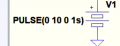
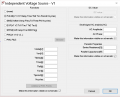
OK, I need a bit of LTS help here. Not exactly sure what pulse is and how you set it up? Seems to be a pulsed DC signal...
1696475455079.png
1696475954298.png

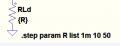
Then here you are stepping the resistance of RLd. Is that a special component name or the edited name? {R} calls the .step command with its parameters? Been a while since I used .step so I'm a bit fuzzy on it.
1696475634598.png

Or, is there a link to the LM317 CV and CC.asc file? Didn't find it on electro-tech-online...
 

ronsimpson

Joined Oct 7, 2019
4,694
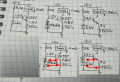
1. I don't use the first circuit because the B-E voltage changes with temperature. This causes the current to change.
2. Circuit two is also temperature unstable. I use a diode like the 1N4148 (or better yet another transistor) to compensate for the B-E voltage change. Then use a resistor to set the voltage across the 56 ohm resistor. (see bottom circuit)
3. Zeners in the 4 to 6V range are good with temperature. I added a diode to temperature compensate the transistor and then use a low voltage Zener to set the voltage across the 510 resistor.
1696476224790.png
 

WBahn

Joined Mar 31, 2012
32,848
Okay, but I've never hear of a virtual circuit connection before.:confused:
Sure you have. It's the same idea as there being a virtual short between the inputs of an opamp operating in the active region. The circuitry forces behavior that results in the same behavior, at least in some respect, as if the virtual connection actually existed.
 

crutschow

Joined Mar 14, 2008
38,512
OK, I need a bit of LTS help here. Not exactly sure what pulse is and how you set it up? Seems to be a pulsed DC signal...
The Spice pulse option is a sort of Swiss army knife of sources.
All those parameters determine the nature of the output which can be a pulse, triangle wave, sawtooth, etc. depending upon those parameter values.
For my simulation, I just set it to give a 1 second ramp from 0V to 10V, as show in the top plot.
Then here you are stepping the resistance of RLd. Is that a special component name or the edited name? {R} calls the .step command with its parameters? Been a while since I used .step so I'm a bit fuzzy on it.
Yes, if you put a name (here R) with curly brackets around it, then Spice views it as a parameter variable that must be elsewhere defined.
Here I then used the .step command to step the param R to the stated values.
In this case it was for the resistances, 1mΩ, 10Ω, and 50Ω as shown by the three different colored plot traces.
 

WBahn

Joined Mar 31, 2012
32,848
OK, I need a bit of LTS help here. Not exactly sure what pulse is and how you set it up? Seems to be a pulsed DC signal...
View attachment 304212
View attachment 304214

Then here you are stepping the resistance of RLd. Is that a special component name or the edited name? {R} calls the .step command with its parameters? Been a while since I used .step so I'm a bit fuzzy on it.
View attachment 304213

Or, is there a link to the LM317 CV and CC.asc file? Didn't find it on electro-tech-online...

For the various source options in LTSpice:

https://www.analog.com/en/technical-articles/ltspice-generating-triangular-sawtooth-waveforms.html

The "Pulse" source generates a sequence of pulses that go between two voltages (V1 and V2) with certain timing characteristics such as a delay before the first pulse happens (often used to let the circuit settle down before applying a signal to it), rise and fall times, and how long the voltage is "on" and what the overall period is. You can also tell it to only produce so many pulses before it turns off permanently.

Here the pulse starts at 0 V and goes to 10 V with no delay and a rise time of 1 s. Normally, you provide seven parameters. I don't know what the defaults are for missing parameters except the last one, which is that the pulses continue for the duration of the simulation. In this case, it really doesn't matter what the other parameters default to because the simulation ended before they became a factor.

The .step command simply says to run the simulation three times, once for every value in the list. For each simulation, the parameter R is set to the corresponding value in that list and that parameter is used to set the resistance of RLd (which is just a normal resistor whose value is set to {R}, which means to set it to the value obtained by evaluating the expression between the curly braces.
 

crutschow

Joined Mar 14, 2008
38,512
Sure you have. It's the same idea as there being a virtual short between the inputs of an opamp operating in the active region. The circuitry forces behavior that results in the same behavior, at least in some respect, as if the virtual connection actually existed.
I still don't understand how that can apply to a current-mirror circuit, since, to me, a current-mirror is a specific arrangement of two or more transistors, the mirrors the current in one transistor to the other.
 

WBahn

Joined Mar 31, 2012
32,848
I still don't understand how that can apply to a current-mirror circuit, since, to me, a current-mirror is a specific arrangement of two or more transistors, the mirrors the current in one transistor to the other.
Perhaps this will help.

Consider the basic current mirror. How it works is that the diode-connected transistor is forced to operate in such a way that the base-emitter voltage of that transistor corresponds to the collector current that is flowing through it, which the external circuit controls. So, for this transistor, the collector current establishes the Vbe.

Then, that base-emitter voltage is transferred to a different (nominally identical) transistor such that that Vbe establishes a collector current which, at least ideally, is equal to the collector current in the first transistor.

But now imagine that, for whatever reason, we couldn't directly connect the bases of the two transistors together. Perhaps they need to operate in two electrically-isolated circuits. So instead we measure the Vbe of the first transistor with an ADC, then transmitted that digital data through an opticoupler to the other part of the circuit, and then use a DAC to produce that same voltage and apply it to the other transistor.

We have achieved the same goal -- the Vbe of the input transistor is applied to the mirror transistor just as if they were traditionally connected instead of being virtually connected by way of how the circuit is designed.

We can do things like this to create mirrors in which the emitters of the two transistors aren't at the same reference or to introduce offsets in the voltage to scale the output current of the mirror transistor.
 

AnalogKid

Joined Aug 1, 2013
12,135
I played around using a plated copper crimp lug on a TO-92 package as a heatsink but had no real empirical data that it improved heat dissipation.
I still have some TO-5, TO-18, and TO-92 clip-on / slip-on heatsinks from back in the day.

ak
 

Thread Starter

SamR

Joined Mar 19, 2019
5,491
Yup, I remember those "Elizabethan Collar" heat sinks for the metal cans and the Aavids for the TO-92s but those are a mite pricey. I played around with a #10/Yellow ring crimp-on terminal that fit the TO-92 pretty well and you could solder or bolt a "fan" piece of copper or aluminum onto it to increase its surface area. Molded the crimp-on section to slip over the TO-92 with a dab of heat transfer paste to aid the surface contact heat transfer. Just never got around to actually testing its cooling effect.
 

Thread Starter

SamR

Joined Mar 19, 2019
5,491
OK, to sum it up if I got it all correctly...

Using the diodes/Zener solution gives some temperature compensation. Does it also stiffen the current vs. the load or was that for the LM317 approach?

As to cost and board space concerns... Diodes, to me since I'm not making 1000s, are ~the same price as resistors and Zeners are only a tad more.

Once again, I like the Zener solution of the 4 circuits I started with.

Lagniappe, I like the JFET and LM317 & LM317L circuits even better.

Dual transistor circuits also give some temp compensation. Are they stiffer?

Haven't started on Op Amp current drivers yet...
 

crutschow

Joined Mar 14, 2008
38,512
I like the Zener solution of the 4 circuits I started with.
Just so the higher voltage drop from the Zener is not a problem, since it requires a higher voltage and generates more dissipation in the transistor.

The simplest and best performance is the LM317 circuit, which is likely also cheaper, since the LM317 is rather a jelly-bean item, and it can be bought in a TO-220 case if power dissipation is a concern.
 
Last edited:
Top