Bipolar stepping motors?

philba

Joined Aug 17, 2017
959
Typically steppers are rated at something like 3V and some current, call it Is. Ohms laws tells us that at, for example, 6V, it will get 2*Is and potentially let the blue smoke out. On any CNC, 3D printer, laser printer, etc, the steppers are run at 12 to 24V.

I agree that low step rates mean a low(er) duty cycle and thus may not burn out. But why take the risk when current limiting is very cheap and easy with modern stepper chips?

On an unknown stepper, I would measure the resistance of the coils and use 3V to calculate a pseudo-spec current.
 
Last edited:

philba

Joined Aug 17, 2017
959
So, I've been noodling the lower duty cycle thing and something about it was bothering me. Then I remembered, holding current. A stepper motor that isn't stepping will still draw current - called holding current. Modern drivers typically will time-out after a few hundred mS of no steps and reduce the holding current so as to avoid heating up the motor when not stepping. Interestingly, the TB6600 based stepper drivers usually don't implement holding current reduction - a big source of complaints against it. The L298 based drivers typically don't. And most homemade H-bridge based circuits don't either.
 

MaxHeadRoom

Joined Jul 18, 2013
30,672
So, I've been noodling the lower duty cycle thing and something about it was bothering me. Then I remembered, holding current. A stepper motor that isn't stepping will still draw current - called holding current. Modern drivers typically will time-out after a few hundred mS of no steps and reduce the holding current so as to avoid heating up the motor when not stepping. Interestingly, the TB6600 based stepper drivers usually don't implement holding current reduction - a big source of complaints against it. The L298 based drivers typically don't. And most homemade H-bridge based circuits don't either.
The holding or stationary current of the stepper motor should be maintained throughout the RPM range as far as possible.
It all depend on the application as to whether you retain this current when stationary, in the case of CNC it is usually desirable in order to ensure position.
If it is required to lower it at zero RPM, many 'Homemade' design use a micro of some kind so it is easy to do.
Max.
 

Thread Starter

spinnaker

Joined Oct 29, 2009
7,830
The holding or stationary current of the stepper motor should be maintained throughout the RPM range as far as possible.
It all depend on the application as to whether you retain this current when stationary, in the case of CNC it is usually desirable in order to ensure position.
If it is required to lower it at zero RPM, many 'Homemade' design use a micro of some kind so it is easy to do.
Max.

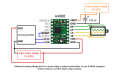
The A4988 has a sleep pin. From the sounds of it, on the datasheet this can be used to minimize current. But is looks like the chip drives the motor to home, so I am not sure of the purpose.

Sleep Mode

To minimize power consumption
when the motor is not in use, this input disables much of the
internal circuitry including the output FETs, current regulator,
and charge pump. A logic low on the S
pin puts the A4988
into Sleep mode. A logic high allows normal operation, as well as
start-up (at which time the A4988 drives the motor to the Home
microstep position). When emerging from Sleep mode, in order
to allow the charge pump to stabilize, provide a delay of 1 ms
before issuing a Step command.
 

MaxHeadRoom

Joined Jul 18, 2013
30,672
You could start low (5v?) and always increase if it shows signs of low torque and/or low operating temperature.
I don't think that Home position is the same thing as a Machine tool home definition.;)
It is rotor start position I would think.
Max.
 

philba

Joined Aug 17, 2017
959
Yeah, I think it goes to a full step position when coming out of sleep mode. Here's what the DS says:
A logic high allows normal operation, as well
as startup (at which time the A4988 drives the motor to the Home
microstep position).
The A4988 has a Vmot min of 8V so I'd start there. You can increase your safety level by turning the current to it's lowest point. Here's a video of it. Be aware that there is no consistent direction on the current adjustment trimmer from the various manufactures so you might have to experiment.
 

Thread Starter

spinnaker

Joined Oct 29, 2009
7,830
Yeah, I think it goes to a full step position when coming out of sleep mode. Here's what the DS says:


The A4988 has a Vmot min of 8V so I'd start there. You can increase your safety level by turning the current to it's lowest point. Here's a video of it. Be aware that there is no consistent direction on the current adjustment trimmer from the various manufactures so you might have to experiment.

Thanks. My bench PSU also has current limit. Any idea where I should start there?
 

philba

Joined Aug 17, 2017
959
measure the resistance of the coils. most steppers are spec'd at 3V so use ohms law to calculate the current. I'd set the limit at maybe 150% of that.

Note that the way a chopper like the A4988 works is it lets the current rise until it hits some preset value (controlled indirectly via the trimmer pot) and then shuts it off. It waits a period of time and start the process over again. Some what similar to the way a switch mode PS works. The instantaneous current will be above the "average" current you set via the trimmer.

So, I'm not sure what your bench PSU will do in that situation.
 
Last edited:

philba

Joined Aug 17, 2017
959
Yes, the DS says Abs Max current is 2A, pretty sure that is average current. The overcurrent limit shutdown point isn't stated but the DS implies it's like 5A (page 10,fig 4).

edit: ah, I was wrong, it does spec the overcurrent limit - 2.1A. page 4 towards the bottom. Though, they say it's "characterized" and not tested over the full temp range.
 
Last edited:

philba

Joined Aug 17, 2017
959
So just use 3V for the calculation, not the actual supply voltage correct?
Yes. that's how the CNC people do it - take the spec'd current and aim for that. We are basically guessing at the spec but it's probably not far off. Ultimately, you should pay attention to the motor. If it heats up dangerously high, you would want to reduce the current. I wish I could tell you what the max safe temp is but it depends on the motor. On my machines, I try to keep the current as low as possible and still have the machine work well. But that depends on how much work it's doing.
 
Top