Symetrical op-amp with bipolar bjt pair on input

Thread Starter

Michal Podmanický

Joined May 11, 2019
289
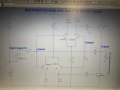
I tried to simulate such a op-amp, the result looks quite good. What do you think a problems can appear in real build? A matching the parameters of npn to pnp?
Do you have some ideas about improvement?

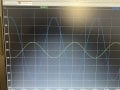
Note: A green is input signal, blue is output.
Note: The phase compensator is not designed properly but works somehow.
IMG_3352.jpegIMG_3353.jpegIMG_3355.jpeg
 

ronsimpson

Joined Oct 7, 2019
4,646
problems can appear in real build?
In SPICE all the transistors are matched exactly.
If all the transistors were on the same silicon (IC) The transistor pairs will be very close matched. We put the transistors as close to each other as possible to help keep them the same.
If you use discrete transistors, there is a chance the two parts came from the same silicon wafer and on the same side and they will match OK. In production there is a chance the two transistors were made a year apart and not from the same silicon. They probably will not match. There will be "input offset voltage problems". And different gain problems. etc.
 

crutschow

Joined Mar 14, 2008
38,316
You need internal compensation of the amp for it to be stable in closed-loop operation.
You can't compensate it properly on the output, because it will vary with the output load.

And -70dB of gain indicates its not working.
 

eetech00

Joined Jun 8, 2013
4,704
The current sources will have to be converted to current mirrors of appropriate current levels. On IC’s, the current levels are set by adjusting the size/ratio of the mirrored transistors.
 

Thread Starter

Michal Podmanický

Joined May 11, 2019
289
You need internal compensation of the amp for it to be stable in closed-loop operation.
You can't compensate it properly on the output, because it will vary with the output load.

And -70dB of gain indicates its not working.
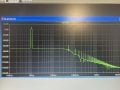
The last picture is FFT of output signal.


Should the phase compensator placed on output work if the quiescent current of output bjts will 20 times of load? Like 20mA quiescent and 1mA load+feedback resistors?

Where would you place the compensator?
 

WBahn

Joined Mar 31, 2012
32,702
I tried to simulate such a op-amp, the result looks quite good. What do you think a problems can appear in real build? A matching the parameters of npn to pnp?
A matching of everything. Your simulation assumes that the transistors are perfectly matched, as well as the resistors.

Also, where are you going to find ideal current sources with infinite output impedance to use in your real build?

Do you have some ideas about improvement?
Learn about how to run Monte Carlo simulations and set up tolerances on all of the parts that should be closely matched. That will give you an idea of whether they are matched closely enough.

If you are building this out of discrete components, the matching usually won't be very good.

Note: A green is input signal, blue is output.
Name the nodes you are going to display on a graph or reference in a discussion.

Note: The phase compensator is not designed properly but works somehow.
This is known as "design by happening", you throw something at it and hope that it just happens to work somehow. It makes for extremely fragile designs.
 

MisterBill2

Joined Jan 23, 2018
27,159
Several high-end equipment manufacturers have used external FET transistors ahead of op-amps with good results. BUT they are not likely to reveal trade secrets. Others use two very low noise transistors external to an op-amp to reduce noise. BUT just because it works for some does not mean it will work for everybody.
 

Ian0

Joined Aug 7, 2020
13,097
And -70dB of gain indicates its not working.
That's the FFT of the output signal, not the gain/frequency plot.


Try running it again with a longer sampling time, because any harmonic distortions are below the noise floor, and the real noise floor is a lot lower than -70dB. A decent op-amp will have 2nd and 3rd harmonics below -110dB.

The other problem you might have with it, as @Bordodynov says, is keeping the bias of the output transistors stable with temperature. As Vbe drops as temperature rises the bias will increase until they are both conducting.

Unfortunately they days when manufacturers published internal circuitry on analogue devices are now gone, and you can't quickly check a datasheet to see how the big manufacturer's achieved it!
 

Bordodynov

Joined May 20, 2015
3,429
In order to be able to work in the vicinity of the power buses, two pairs of transistors must also be added. Without this, the circuit will not be able to operate in repeater mode.
 
Top