Bipolar transistor in saturation

Thread Starter

Ian0

Joined Aug 7, 2020
13,097
Something that has been mentioned a lot on this forum is the general rule for base current in a bipolar transistor to switch it fully on, i.e. in saturation.
The rule of thumb is a tenth of the collector current.
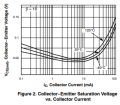
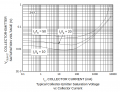
Now this is the first time I've actually seen that information presented as a graph:
Screenshot from 2025-12-31 14-21-54.png
The transistor in question is the DXTN3C60P from Diodes inc (whom I still think of as Zetex, and have only just stopped thinking of as Ferranti)
 

ronsimpson

Joined Oct 7, 2019
4,645
base current in a bipolar transistor to switch it fully on
It is not shown in this data sheet, but the Storage Delay, and switching speed is very dependent on Ic/Ib ratio. At 10 the delay is long and at 50 the delay is short. This is a low voltage part that switches fast. High voltage transistors are doped differently and thus are much slower. I have spent decades trying to get more speed out of 1000 and 1500V transistors.
 

Thread Starter

Ian0

Joined Aug 7, 2020
13,097
It is not shown in this data sheet, but the Storage Delay, and switching speed is very dependent on Ic/Ib ratio. At 10 the delay is long and at 50 the delay is short. This is a low voltage part that switches fast. High voltage transistors are doped differently and thus are much slower. I have spent decades trying to get more speed out of 1000 and 1500V transistors.
Very true. Getting a transistor into saturation is a lot easier than getting it OUT of saturation!
 

schmitt trigger

Joined Jul 12, 2010
2,027
Cruts;
Motorola Semiconductor (remember it?) on its three-tome transistor data books from the early 1980s did publish that information.
The books were heavy and voluminous, and I discarded them in a house move.
Which I now regret.
 

crutschow

Joined Mar 14, 2008
38,314
Motorola Semiconductor (remember it?)
I fondly do.
(Their 68000 series micros were very good at the time, probably better than Intel's. It was IBMs selection of Intel's 8088 for the PC that likely kept Intel alive while helping kill Motorola. AMD survived by coming out with a clone for the 8088.).

It is sad to me how many of the early pioneers in semiconductors, that were large companies at the time (Motorola, Fairchild, National, RCA, etc.) and the smaller companies (Burr Brown, Intersil, Precision Monolithics, Mostek, Signetics, Siliconix, MOS Technology, etc.) are now gone from that business (mostly absorbed by the biggies that are left).

RCA, the biggest US electronics company in the 50's and 60's for example, had the foresight to come out in 1968 with the first CMOS digital circuits (the slow, metal-gate CD4000 series) but then did not pursue their advancement, apparently not seeing a future for the process, such as the self-aligned silicon-gate, which was developed the same year (catastrophic miss), and thus faded from the scene as vacuum tubes became obsolete.
(Their last gasp was the miniature Nuvistor tube in 1959 which had better high-frequency performance than the available transistors for about 10 years).
 
Last edited:

WBahn

Joined Mar 31, 2012
32,702
Something that has been mentioned a lot on this forum is the general rule for base current in a bipolar transistor to switch it fully on, i.e. in saturation.
The rule of thumb is a tenth of the collector current.
Now this is the first time I've actually seen that information presented as a graph:
View attachment 361412
The transistor in question is the DXTN3C60P from Diodes inc (whom I still think of as Zetex, and have only just stopped thinking of as Ferranti)
Most data sheets show a few graphs at a forced beta of 10. The nice thing about this one is that it shows graphs for other values of the forced beta, underscoring that there is nothing magical about a value of 10.

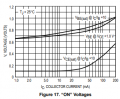
Here's the comparable graph for the 2N3904 from OnSemi:
1767203834697.png
The have similar graphs for Vbesat, Turn-on Time, Rise Time, Storage Time and Fall Time, all characterized at a forced beta of 10.

This is from the Motorola datasheet for the same transistor
1767204232306.png
It characterizes a few of the parameters at both a forced beta of 10 and at 20.

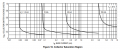
The graph that I wish more data sheets had was the following (also from the Motorola data sheet):

1767204304218.png

I would love to see it include curves at the temperature extremes. Being greedy, it would also be nice to see the bounding curves at room temperature (the same for hfe).
 

hrs

Joined Jun 13, 2014
520
For many 2Nxxxx transistors saturation is specified at 1/10th base current with Vce ~ 0.2V.
For many BCxxx transistors saturation is specified at 1/20th base current with Vce ~ 0.2V.
Presumably one can engineer the junction to do one or the other. What, if any, is the trade-off here?
 

WBahn

Joined Mar 31, 2012
32,702
For many 2Nxxxx transistors saturation is specified at 1/10th base current with Vce ~ 0.2V.
For many BCxxx transistors saturation is specified at 1/20th base current with Vce ~ 0.2V.
Presumably one can engineer the junction to do one or the other. What, if any, is the trade-off here?
You really can't specify saturation as being with both a beta and a Vce value, as that will only apply at one particular value of Ic (at a given junction temperature).

The old rule of thumb that Vcesat was 200 mV (or sometimes either 250 mV or even 300 mV) generally applies as the maximum Vcesat at currents approaching the limits. Normal Vcesat is usually well below this in the 50 mV to 100 mV range.

For instance, the 2N3904 is intended for operation with Ic in the 10 mA range and Vce sat there is typically in the 40 mV range. When you start pushing the 100 mA range it's getting up into the 130 mV range, but that this current, the beta in the active region has also collapsed to around 40.
 

MrAl

Joined Jun 17, 2014
13,667
It is not shown in this data sheet, but the Storage Delay, and switching speed is very dependent on Ic/Ib ratio. At 10 the delay is long and at 50 the delay is short. This is a low voltage part that switches fast. High voltage transistors are doped differently and thus are much slower. I have spent decades trying to get more speed out of 1000 and 1500V transistors.
Hi,

I read a lot about this in the 1980's from information from the Rutgers Library.
As you probably know, the key is the storage time which is dependent on the carriers in the base region.

What have you tried so far?
The usual solution is to prevent the device from going into saturation in the first place.
 

MrAl

Joined Jun 17, 2014
13,667
Most data sheets show a few graphs at a forced beta of 10. The nice thing about this one is that it shows graphs for other values of the forced beta, underscoring that there is nothing magical about a value of 10.

Here's the comparable graph for the 2N3904 from OnSemi:
View attachment 361422
The have similar graphs for Vbesat, Turn-on Time, Rise Time, Storage Time and Fall Time, all characterized at a forced beta of 10.

This is from the Motorola datasheet for the same transistor
View attachment 361423
It characterizes a few of the parameters at both a forced beta of 10 and at 20.

The graph that I wish more data sheets had was the following (also from the Motorola data sheet):

View attachment 361424

I would love to see it include curves at the temperature extremes. Being greedy, it would also be nice to see the bounding curves at room temperature (the same for hfe).
Hi,

What I see in Figure 16 is that there is something a little 'magical' about the base current being 1/10 times the collector current.
In each graph, with a base current of 0.1 times the collector current, we see the lowest Vsat voltage. Anything less than that the Vsat starts to rise, and anything more than that it probably stays flat.
At some point however it may rise with increased base current simply because the BE voltage will rise more and more.
 

MrAl

Joined Jun 17, 2014
13,667
Something that has been mentioned a lot on this forum is the general rule for base current in a bipolar transistor to switch it fully on, i.e. in saturation.
The rule of thumb is a tenth of the collector current.
Now this is the first time I've actually seen that information presented as a graph:
View attachment 361412
The transistor in question is the DXTN3C60P from Diodes inc (whom I still think of as Zetex, and have only just stopped thinking of as Ferranti)
Hi,

Zetex transistors are some of the best when it comes to Vsat characteristics.

We might be able to reproduce these graphs from the basic components that make up a transistor.
I have not tried with any Spice software yet though.
 

WBahn

Joined Mar 31, 2012
32,702
Hi,

What I see in Figure 16 is that there is something a little 'magical' about the base current being 1/10 times the collector current.
In each graph, with a base current of 0.1 times the collector current, we see the lowest Vsat voltage. Anything less than that the Vsat starts to rise, and anything more than that it probably stays flat.
At some point however it may rise with increased base current simply because the BE voltage will rise more and more.
What basis do you have for concluding that it probably stays flat after Ic/Ib = 10?

There is nothing magical about a forced beta of 10. Power transistors are typically speced in saturation at a value of 5 or even less.

It is a convention for spec comparison that dates back to the earliest days of commercially-available discrete small-signal transistors and is likely do to one manufacturer happening to choose it for their spec'ed behavior and other manufacturers following suit just so they could compare and contrast their transistors to the others.
 

ronsimpson

Joined Oct 7, 2019
4,645
What have you tried so far?
I could teach for days on this topic.
Ib1 is Base on current, say 5A. Then I have Ib2 Base turn off current = about Collector current -25A.

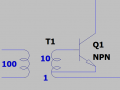
Here is a Base drive circuit that I have used many times. "Proportional base drive." When Q1 is on current flows C-E, around the transformer 1 turn. There are 10T E to B. The 0 to 25A in the C will force o to 2.5A in the Base. 10/1 (current transformer)
The turn off is done on the 100 turn winding. It takes 2.5A there to discharge the Base charge at 25A.
1767217370213.png
Note the high voltage transistors have a B-E voltage of about 1V not 0.65V like low voltage transistors.
 

WBahn

Joined Mar 31, 2012
32,702
What basis do you have for concluding that it probably stays flat after Ic/Ib = 10?

There is nothing magical about a forced beta of 10. Power transistors are typically speced in saturation at a value of 5 or even less.

It is a convention for spec comparison that dates back to the earliest days of commercially-available discrete small-signal transistors and is likely do to one manufacturer happening to choose it for their spec'ed behavior and other manufacturers following suit just so they could compare and contrast their transistors to the others.
I did some digging and, based on limited exploration, it appears that the 2N3904 may have been the first widely-used transistor to use characterize saturation behavior at a forced beta of ten when Motorola published their data sheet in the 1966 time frame. Prior to that, the emphasis was on behavior in the active region for amplification purposes and saturation characteristics were weakly covered and might be at various forced betas, which might not even be specified at all. But in the latter part of the 1960s the used of transistors in switching applications was becoming more common and manufacturers began including better characterizations and adopted the convention established by Motorola.

While the value of 10 is not magical or fundamental, it was nice-round value that represented a reasonable compromise between a value low enough to ensure that transistors were in solid saturation even if they were operating near the edges of their design envelope as well as pushing production tolerances, but not so low as to suffer from increased base current power dissipation, increased charge storage and slower turn-off times. There appears to have been a positive-feedback loop driving this adoptions. As switching applications became more common, design handbooks used the forced betas that could be found in data sheets of the day, which early on meant using a value of 10 because that was the single most-common parameter found in data sheets that were following Motorola's example (which it appears to have adopted in the early-1960s). But then more data sheets provided characterization at a forced-beta of 10 because that was what the design handbooks that were available were using in their examples. So data sheets for earlier transistors that didn't specify a forced-beta of ten were generally updated with that value when they were re-issued in the late-60s and early-70s. Thus, that became the defactor norm for transistor saturation characteristics unless there was a compelling reason to use some other value for a particular transistor or application.
 

xox

Joined Sep 8, 2017
936
Isn't a bipolar transistor considered to be fully saturated once the collector voltage falls basically one diode drop below the base voltage? If so, that seems like a much simpler metric to go by.
 
Top