Bi-directional current limiting circuit?

Thread Starter

LikeTheSandwich

Joined Feb 22, 2021
213
Edit: sorry I just realized I should have posted this in power electronics. Please feel free to move it, I don't see any way for me to move it or delete this and repost it.

Does anyone know of a bi-directional current limiting circuit? Basically a constant current circuit but it can go two ways? Basically I want to add a system backup battery to my car, one that I can use to run the radio and stuff for several hours without draining my main battery, and then have it recharge at a decent rate when the engine is running. My goal is to just attach the circuit to a 12 volt deep cycle battery that I could put in the back of the car and plug into the cigarette lighter socket I have at the back. With my somewhat limited knowledge on the topic the only way I could think of to do this would be to have a pair of constant current circuits and then switch between them with a relay based on whichever side had the higher voltage (or just set a trigger voltage at whatever the cigarette lighter standard voltage is or something like that).
 

Ian0

Joined Aug 7, 2020
13,276
How big is the deep-cycle battery compared to the car battery? The alternator will deliver the correct voltages to recharge a lead acid battery simply by connecting the two in parallel. Then there's only two things to deal with:
1) Making sure that when first connected to the alternator, the secondary battery doesn't take enough current to blow the fuse
2) Making sure that the secondary battery doesn't try to supply the load when starting the engine.

1) You might already have enough resistance in the circuit to a lighter plug to prevent this happening.
2) You need a split-charge relay, which operates from the ignition light terminal of the alternator.
 

MrChips

Joined Oct 2, 2009
35,171
You have to turn the ignition switch to ACC in order to use the radio and ACC jack. This draws power from the main battery.

I don’t see how you can do what you want using a relay.
 

Ian0

Joined Aug 7, 2020
13,276
You have to turn the ignition switch to ACC in order to use the radio and ACC jack. This draws power from the main battery.

I don’t see how you can do what you want using a relay.
Split charge relay is a common fitting for vehicles towing trailers, but you are correct that he couldn‘t use the accessory socket.
 

MrChips

Joined Oct 2, 2009
35,171
Also the car radio and ACC “stuff” are connected to the car battery.
You would have to rewire the car in order to connect them to the leisure battery.
 

MrChips

Joined Oct 2, 2009
35,171
But how will you stop the drain from the main battery when the secondary battery is connected?
The batteries will be in parallel and both will discharge from the load.
I am thinking that with the ignition switch off, the main battery is disconnected via the ACC relay.
The leisure battery still feeds ACC circuit.

How often do you need to use the ACC circuit?
It seems to me that the simple solution is to plug into the ACC socket only when you need it

What about two 10 A schottky diodes wired in anti-parallel mode in series with the leisure battery?
 

crutschow

Joined Mar 14, 2008
38,802
I'm thinking that the diode would drop about 0.3V which would increase to about 0.8V at higher currents, a mild current limiting circuit.
We still have to worry about the two situations mention in post #2;
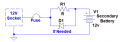
Edited charge limit resistor information:

A small-value, series power resistor could limit the charging current.
The resistance should limit the current to about 0.1 of the battery's Ah rating.
I would estimate no more than about a 2V drop across the resistor during charging (for a 14.6V charging voltage).

If necessary, a Schottky diode in parallel would minimize the voltage drop when the current is flowing in the opposite direction to power the accessory equipment.
(Concept below):
Note that the socket or plug may already have a fuse.

If the accessory power goes off when starting as typically done, then there's no problem with the secondary battery supplying current during start.

1790093245777.png
 
Last edited:

kiroma

Joined Apr 30, 2014
202
Just came here to tell about bi-directional current limiting...
One time? -Fuse.
More times? -PPTC fuse.
Undefined amount of times? Some circuit with power components, I'd go with a sense resistor and an amplifier to trigger a relay into disconnecting the circuit.
Low power? I think it's doable with Schottky diodes in series with BJTs, 2 rows in anti parallel, and some circuit to control them.
But others are offering a different approach on the problem. I just came here to say this, if someone is/will be interested.
 

kiroma

Joined Apr 30, 2014
202
Also the car radio and ACC “stuff” are connected to the car battery.
You would have to rewire the car in order to connect them to the leisure battery.
I was reading through the thread now...
Yeah, TS wants to have a separate battery for his separate use. That means you have to disconnect these things from the main battery, and then put a charging circuit (because just putting in parallel with the main battery isn't current-limited), and also an interrupting circuit when the battery is drained (whatever form of rudimentary babysitter/fuel gauge). This means you need a charger with "power path" technology.

Edit: Power path is important for when the car is on and you want to turn on the radio, for example. If the radio is consuming less than the charger, you don't really need a power path. But if your sound system is powerful enough, your charging circuit might not be able to charge the battery and the sound system. In this case having a beefier charger would destroy your separate battery when just charging. Thus power path is important. It would deviate/bypass power to the system and limited power to the battery to charge safely and healthy.
 
Last edited:

crutschow

Joined Mar 14, 2008
38,802
That means you have to disconnect these things from the main battery, and then put a charging circuit (because just putting in parallel with the main battery isn't current-limited),
I think all you need is the circuit in my post #13.

The secondary battery is charged through the current-limiting resistor when the alternator is on.

The secondary battery can then power the accessory equipment through the diode when the motor and accessory connection to the main battery is off.
 

kiroma

Joined Apr 30, 2014
202
I think all you need is the circuit in my post #13.

The secondary battery is charged through the current-limiting resistor when the alternator is on.

The secondary battery can then power the accessory equipment through the diode when the motor and accessory connection to the main battery is off.
What if he needs to power something more powerful than the power the resistor allows for charging?
It would discharge the second battery while trying to be charged. Then you put a smaller resistance, but that gives you a prohibitive high current when just charging.
All I can say is that it might work, depending on your load(s).
Also, I saw years ago that while cranking the engine, the battery drops a good amount of volts, so the diode can fry trying to deliver high current to the main battery. So you might want to put a beefy diode. The same with the resistor (but in power dissipation capability).
It's a simple circuit but it's not optimal. So it depends whether the TS wants to charge the battery as quick as possible without damaging it, of course.
Also, when you don't want to spend hours on maintenance in the subsequent years, it's a good idea to keep it simple, as @crutschow likes (ie. apply his circuit).
 
It depends on the voltage, maximum current, and how accurately the current needs to be limited in both directions. A simple resistor may work for basic protection, but an active circuit using MOSFETs and current sensing would give much better control.

It would help if you could share the supply voltage, required current limit, load type, and a circuit diagram.

I manage , and I find that exact electrical requirements make troubleshooting discussions much easier.
 
Last edited by a moderator:
Top