Best First Projects for Learning Basic Electronics?

MrChips

Joined Oct 2, 2009
34,981
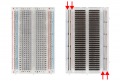
This is what a half-sized breadboard looks like from the top and from below.
1781125096143.png

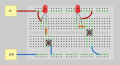
Here are two examples of connecting an LED, resistor, pushbutton on the breadboard.
Instead of a 5 V power supply, you can use a 9 V battery. You can also omit the pushbutton switch.
1781125172146.png

If you want to create your own graphics of breadboard layouts, download a free program called Fritzing.
 

robp1956

Joined Jun 12, 2026
118
Hi everyone
I’m new to electronics and currently trying to learn the basics step by step.


What are some of the best beginner projects you recommend for learning fundamental concepts like voltage, current, resistance, and basic components?


I’ve heard about using breadboards and simple circuits, but I’d really appreciate suggestions on where to start so I can learn properly through practice.


Thanks in advance
I can't add much to what the others have wisely advised. but I can reiterate some basics. Do experiment but start very small. But absolutely if you are not fairly competent in Mathematics to include algebra and the theory behind what you are trying to do. to build it and have it work is one thing but knowing and understanding why it works is invaluable and that is what the theory part will bring to you. No matter what Good luck in your journey in the world of electronics it's a very interesting and enjoyable hobby.
 

tsmspace

Joined Mar 16, 2026
133
Thanks for that, I’ll check out the 555 circuits seems like a good place to start.


I’ve been trying to get into breadboarding too, still getting used to how everything connects but it’s pretty fun so far.


I’m in Quebec by the way. How about you?
there's always the old way(s) and some new ways.

arduino is widespread marketed as a great starting point, but you need to program and the electronics part of it is minimal. It's easy to buy a bunch of arduino stuff that will just sit around.


I would still get one. just a beginner kit, and a genuine one if you are money-having because the support is helpful.
Amazon.com: Arduino Uno REV3 [A000066] - ATmega328P Microcontroller, 16MHz, 14 Digital I/O Pins, 6 Analog Inputs, 32KB Flash, USB Connectivity, Compatible with Arduino IDE for DIY Projects and Prototyping : Arduino®: Electronics
and this
Amazon.com: ELEGOO Electronic Fun Kit Bundle with Breadboard Cable Resistor, Capacitor, LED, Potentiometer total 235 Items for Arduino : Electronics


Then I would buy this and build it: Amazon.com: QSYZAIL LM317 Adjustable Voltage Regulator Set DIY Electronics Kit for Adults : Industrial & Scientific

You will use it a lot
and I would buy this: HUAGZIMO 9 Set Soldering Practice Kits with Universal Board: Amazon.com: Tools & Home Improvement

here's a really awesome collection of publications and all kinds of stuff. scroll down far enough to 'download ebooks' for some outdated but still relevant school books , but really just browse to find anything you can imagine. TE Index for website

and finally, having viewed your other posts, I think you want this: FNIRSI New DSO510 DSO152 DSO153 Mini Handheld Digital 2 IN 1 Oscilloscope Portable 48MS/s 10MHz Bandwidth Electronic Repair Tool - AliExpress 1420

and MAKE SURE you get the "dso153 with option"

hey wow! look! it's the single best learn electronics soldering kit ever produced (post oscilloscopes are cheap era) RLC oscillations integrate electronics with op amp application LC arithmetic | eBay
 
Last edited:

MisterBill2

Joined Jan 23, 2018
27,847
My first, completely scratch-built project was an audio amplifier: a 6SN7 DUAL TRIODE 2 stage voltage amplifier, followed by a 6V6 power amplifer stage, with a 5Y3 power rectifier tube. It worked adequately, must have delivered almost 3 watts to a speaker. Quite an accomplishment for a kid who had only built a couple Knight Kit projects. before that. All I started with was the schematic, and a whole bunch of quite used electronic stuff.
 

tonyStewart

Joined May 8, 2012
238
This simple web-simulator is unlimited for analog , only by your imagination of real RLC effects on high speed circuits of wire inductance, resistance and coupling capacitance. It has dozens of analog-digital circuits built in and you can plot V,I P for any part, node and resize, change, combine them . If you learn how to test it with plots and understand it, then you will learn faster. The time scale on plots can be zoomed with your mouse wheel, but the sampling rate {ps,ns,us, ms etc} has bounds unless the rate of change is too much between samples then "convergence error" occurs. It is usually chosen to be 1000x greater than the periodic frequency of interest displayed. Logic and Op Amps can be any voltage in properties and you can add LED's as indicators for any colour. You can learn all the properties of diodes and transistors by custom parameters or use the ideal quadratic behavior. All diodes have capacitance proportional to the current rating (Rs*C=T) except in Falstad's sim. so one adds pF or nF to simulate real parts or adds ESR to e-Caps for the same reason.

Start with a simple RLC response. Then change the generator to a triangle or square wave. See how many circuits you can learn.
 

MisterBill2

Joined Jan 23, 2018
27,847
I think that accurate simulators are a good idea. I tried a couple of logic simulators many years ago and while they may have been accurate they were far from easy to use. I assume that they are much better today. If a simulator produces "close enough" results, that is what they need to do.
A good ANALOG simulator would be very handy for experimenting with component tolerances doing a design evaluation..
 

WBahn

Joined Mar 31, 2012
33,016
A good ANALOG simulator would be very handy for experimenting with component tolerances doing a design evaluation..
A very good way to do this is to set up a Monte Carlo simulation to evaluate the performance of the tolerances of as many components as you want to consider.
 

MisterBill2

Joined Jan 23, 2018
27,847
Probably won't need to look too far for one of those
The last two posts is why I suggested an audio amplifier. Possibly very useful for a lot of things, AND fairly easy to analyse as to how it operates. And with a bit of added parts it becomes a handy signal tracer, useful for servicing a lot of types of circuits.
 

tsmspace

Joined Mar 16, 2026
133
The last two posts is why I suggested an audio amplifier. Possibly very useful for a lot of things, AND fairly easy to analyse as to how it operates. And with a bit of added parts it becomes a handy signal tracer, useful for servicing a lot of types of circuits.
It's hard to find them but on aliexpress, amazon, and some other places there are little kits that are a simple one-transistor amplifier, or a simple lc oscillator, things like that. I really like them because they are new, oscilloscopes were never part of the beginners repertoire in the past, but now that oscilloscopes that can see all the beginner signals are 30$, there are starting to be more kits available that only make sense if you have one, since without one they are like little bricks.
 

MisterBill2

Joined Jan 23, 2018
27,847
Thereason for suggesting an audio amplifier is that no test equipment is required to verify that it is functioning. Of course, that is, if it is built as a system that inludes a loudspeaker as part of the package. Certainly that is quite a bit different than a one transistor amplifier on a small board, and a bit more complex. I had not considered the situation of individuals with no resources available except by purchase from outside suppliers. I had a collection of assorted "stuff" before I had any inclination or ability to assemble things. Not at all a "sterile" environment.
 
Hi everyone
I’m new to electronics and currently trying to learn the basics step by step.


What are some of the best beginner projects you recommend for learning fundamental concepts like voltage, current, resistance, and basic components?


I’ve heard about using breadboards and simple circuits, but I’d really appreciate suggestions on where to start so I can learn properly through practice.


Thanks in advance
Play around with DC circuits using your breadboard and learn by doing by applying Ohm's law to calculate simple current, voltage and resistance.
 
Last edited by a moderator:
At this late point, there is indeed one more consideration: It is simpler to learn, and usually much more accurate, to learn by the means of reading, instead of building things, particularaly breadboard projects.
To even understand a project, either one that works, or one that does not work, a person needs to be able to understand the function of the individual elements. THAT knowledge is better gained thru reading about how circuits function.
How do you learn about how even a one transistor amplifier circuit works if you have not read and understood that changing the base current produces a larger change in the collector current, and that both the base and collector currents flow thru the EMITER connection?
Even more fundamentaly, consider how people learn in school! Quite a bit of education is by the means of reading, followed by teachers adding explanations and additional information. Certainly most of the education provided by instruction and instructors is not "learning by doing", but rather "learning by listening."
That is also related to "oral history", not even read, but heard directly.
 
At this late point, there is indeed one more consideration: It is simpler to learn, and usually much more accurate, to learn by the means of reading, instead of building things, particularaly breadboard projects.
To even understand a project, either one that works, or one that does not work, a person needs to be able to understand the function of the individual elements. THAT knowledge is better gained thru reading about how circuits function.
How do you learn about how even a one transistor amplifier circuit works if you have not read and understood that changing the base current produces a larger change in the collector current, and that both the base and collector currents flow thru the EMITER connection?
Reading should be done alongside practical hands on experiments if nothing else it keeps it interesting.
 
Top