Facebook
 Google
 GitHub
 Linkedin
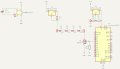
This is my first ever shematics and also first time "designin"(lol) a circuit this complicated.
The breadboard circuit also doesn't have any capacitors just like the schematics, I'll add them later, but that probably won't solve the problem.
The XL6009E1 module is an adjustable boost converter similar to this, capable of 4W output. It's set to 22v.
The battery is a 3.7v-4..2v 2200mAh lithium-ion, capable of 8W output(assuming the maximum output current is 1C). Its terminals are connected to the module's input termninals. All of the VCC and GND symbols in the schematics are directly connected to the module's output terminals.
The reasoning behind the LM317's is:
1. LEDs drop around 3v each, and so can't be driven directly by the battery, so I first boost the voltage and then build a constant current source which provides around 200mA, resulting about 2.5v measured for each LED.
2. I want to drive the Arduino with the same battery(will replace it with a bare microcontroller chip later on). Also this page says:
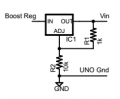
So I built a constant voltage source of around 12 volts and fed it to the Vin pin which is then regulated by the Arduino's on-board regulator.
My problem is that all of this work and LEDs turn on perfectly only as long as Arduino is not connected to the circuit but as soon as I add it, it loads down everything, although the measured current through the Vin pin is only 60mA. This promblem persists exactly the same way with either of these configurations:
1. MOSFET triggered manually
2. MOSFET is disconnected and LEDs are directly drawing from the LM317 current source.
3. LEDs are directly connected to the output of XL6009 module(I did it by mistake but very briefly)
I've also replaced Arduino with a 100 ohm resistor from the output of the LM317 voltage source to ground and it's still the same issue, but resistors higher than 200 ohm don't have any negative effect on LEDs remaining on with full brightness.
I'm wondering maybe I shouldn't connect a constant current soruce and a constant voltage source to the same power rail(XL6009) in parallel, and what is the proper way to do this.
Also I appreciate any other commentery on the circuit, schematics, etc.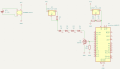
The breadboard circuit also doesn't have any capacitors just like the schematics, I'll add them later, but that probably won't solve the problem.
The XL6009E1 module is an adjustable boost converter similar to this, capable of 4W output. It's set to 22v.
The battery is a 3.7v-4..2v 2200mAh lithium-ion, capable of 8W output(assuming the maximum output current is 1C). Its terminals are connected to the module's input termninals. All of the VCC and GND symbols in the schematics are directly connected to the module's output terminals.
The reasoning behind the LM317's is:
1. LEDs drop around 3v each, and so can't be driven directly by the battery, so I first boost the voltage and then build a constant current source which provides around 200mA, resulting about 2.5v measured for each LED.
2. I want to drive the Arduino with the same battery(will replace it with a bare microcontroller chip later on). Also this page says:
.Although 3V3 and 5V pins can be used as power inputs, it is not recommended if no power supply is connected through the USB port, the barrel jack connector, or the VIN pin. 3V3 and 5V pins are connected directly to the onboard voltage regulator's output pin. Suppose the voltage in the voltage regulator output pin becomes higher than the input voltage of the voltage regulator. In that case, a large current may flow into the voltage regulator from its output pin to its input pin. That large current can permanently damage your board's voltage regulator.
So I built a constant voltage source of around 12 volts and fed it to the Vin pin which is then regulated by the Arduino's on-board regulator.
My problem is that all of this work and LEDs turn on perfectly only as long as Arduino is not connected to the circuit but as soon as I add it, it loads down everything, although the measured current through the Vin pin is only 60mA. This promblem persists exactly the same way with either of these configurations:
1. MOSFET triggered manually
2. MOSFET is disconnected and LEDs are directly drawing from the LM317 current source.
3. LEDs are directly connected to the output of XL6009 module(I did it by mistake but very briefly)
I've also replaced Arduino with a 100 ohm resistor from the output of the LM317 voltage source to ground and it's still the same issue, but resistors higher than 200 ohm don't have any negative effect on LEDs remaining on with full brightness.
I'm wondering maybe I shouldn't connect a constant current soruce and a constant voltage source to the same power rail(XL6009) in parallel, and what is the proper way to do this.
Also I appreciate any other commentery on the circuit, schematics, etc.