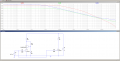
A simple bipolar transistor amplifier gives a gain of 30dB but with 1% distortion. A TL071 transimpedance amplifier gives 33dB gain but with no increase in distortion over that resulting from the JFET.View attachment 316642
A simple bipolar transistor amplifier gives a gain of 30dB but with 1% distortion. A TL071 transimpedance amplifier gives 33dB gain but with no increase in distortion over that resulting from the JFET.View attachment 316642
Ian0, you are very clever in your presentations. could you do another? I will post the two circuits below. Can you compare them and show freq resp, distortion and noise? Thanks
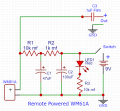
I'm not sure why I feel the need to defend this circuit after 9 years but it is what it is and some people never change.
1 and 0, I'm not sure that I agree with your simulation for the non-AMP output. When I do this in Falstad I see about a 30 X different in output between the Amp versus the non-Amp version after it settles (about 15 seconds).
Truth be known this circuit was derived from a coil antenna radio receiver for RFID reader I designed ... substitute the electret mic with a tuned LC and the front end circuit is the same.
I have used this circuit or variations of this circuit on countless projects and it has performed well in every case.
Sometimes the simulators produce an inaccurate result on the output based on simulating with "ideal" components and that can be unfortunate.
As you can see, the "amplifier" slightly reduces the signal (mainly due to the loading of R3), and I think my conclusion of "better off without" is valid.
The conclusion is not entirely correct. It is necessary to take into account the impedance of the signal source - resistance and capacitance. The cascode circuit has a smaller input capacitance. Use a better microphone subcircuit for a correct comparison.
The conclusion is not entirely correct. It is necessary to take into account the impedance of the signal source - resistance and capacitance. The cascode circuit has a smaller input capacitance. Use a better microphone subcircuit for a correct comparison.
Agreed, if the microphone (by which I mean the device complete with JFET) were driving a resistance, but it is driving a transimpedance amplifier, so the effective Miller capacitance of the JFET will be its Cgd.
The simulation doesn't include the element's source resistance, which would create a low-pass filter with Cgs of the JFET and its Miller capacitance, but I was just intending to compare the two circuits rather than to analyse the frequency response of each.
The bipolar circuit, with is lower open-loop gain will have more voltage at the transistor base, so more Miller capacitance on the JFET. I used to use that circuit with bass-beat detectors, where it was followed by a 200Hz low-pass filter. It's not hi-fi enough to use for anything else.
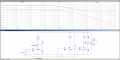
According to the datasheet the output extends to 20kHz with a 2kΩ load. A bit of experimentation gives the correct result with a 680k source impedance, and you can see that the cascode reduces the low frequency gain due to the extra 47k resistor (as previous) but extends the frequency response. The TL071 circuit has the same effect.
But here's something that takes some explaining.
Adding the third circuit to the SPICE simulation gives the second circuit a response that extends to 1GHz and beyond. A feature that disappears if the third circuit is deleted. (And no, I didn't make the mistake of assuming that the node numbers remained the same)
I'm not sure why I feel the need to defend this circuit after 9 years but it is what it is and some people never change.
1 and 0, I'm not sure that I agree with your simulation for the non-AMP output. When I do this in Falstad I see about a 30 X different in output between the Amp versus the non-Amp version after it settles (about 15 seconds).
Truth be known this circuit was derived from a coil antenna radio receiver for RFID reader I designed ... substitute the electret mic with a tuned LC and the front end circuit is the same.
I have used this circuit or variations of this circuit on countless projects and it has performed well in every case.
Sometimes the simulators produce an inaccurate result on the output based on simulating with "ideal" components and that can be unfortunate.
Hi Beau,
I am not one who has besmirched your design. I found it unusual and interesting and given the low parts count and ease of putting it on perf board, I thought it would be ideal for speaker building hobbyists feeding their line inputs.
To that end, please see my slight modifications of your circuit below and please answer my four questions.
The mod offers switched gain. What level of gain would you suggest? I was thinking a gain of 20 would start pushing the envelope on the transistor's gain. Thoughts?
The mod offers a 200-ohm resistor at the output to minimize problems with cheap interconnect cables. OK?
The mod offers no output cap because line inputs typically have a cap for protection any way. OK?
The mod offers a filter for the battery B+ supply. Suggestions?
- Unless your power supply (9V battery) is noisy, then the voltage stabilizer caps aren't really necessary.
- I would ditch the 200 Ohm and leave the Cap as it biases any DC offset the transistor induces.
Also provides a above and below zero drive to anything you connect to it.
- Gain switch? if that works for you. Essentially the circuit has automatic gain that "auto tunes" to find the sweet spot where the transistor just wants to turn on, but at the same time wants to turn off. How? The 50k charges the 10uF until the transistor starts to turn ON. As the transistor turns ON the collector in series with the Mic quenches the positive supply to the 50k preventing further charge to the 10uF. This forms a voltage reference at the transistor base that is resistant to change and slightly higher than the resting voltage across the positive supply to the mic (B-E junction voltage). At this point the circuit is in balance and any slight fluctuation from the MIC causes an imbalance that will be seen on the collector in phase with the emitter voltage from the mic.
Essentially the circuit has automatic gain that "auto tunes" to find the sweet spot where the transistor just wants to turn on, but at the same time wants to turn off.
No it doesn't. It's a simple common base amplifier. The voltage gain is controlled only by the collector resistor. (True, if you get the wrong voltage on the base, it won't work, but as the output of the microphone is a constant current source, there is huge latitude for setting the base voltage of what is in effect a cascode stage.)
The increase in voltage gain is at the expense of increased output impedance. The input resistance of the next stage is in parallel with the output impedance, so that might ultimately be what determines the gain.
And don't leave out the output coupling capacitor, there is no law that says that the input to any amplifier must be capacitively coupled. You might find one that is for some esoteric reason direct coupled throughout and blow up the speakers.
Ian0 ,
Your just wrong. It's not a Common Base Amplifier. If you would look at the resistor arrangement you would notice that.
It is however a Collector Feedback Amplifier that has advantages over a Common Base Amplifier. Mainly by keeping the “Quiescent Operating Point” between the two extremes of operation with respect to the transistor being either “fully-ON” or “fully-OFF”.
The only thing I have done that is unique was to swap the input (transistor Base) and the GND (Transistor Emitter).
This change simply makes the output in Phase with the input rather than 180 deg out of phase.
Ian0 ,
Your just wrong. It's not a Common Base Amplifier. If you would look at the resistor arrangement you would notice that.
It is however a Collector Feedback Amplifier that has advantages over a Common Base Amplifier. Mainly by keeping the “Quiescent Operating Point” between the two extremes of operation with respect to the transistor being either “fully-ON” or “fully-OFF”.
The only thing I have done that is unique was to swap the input (transistor Base) and the GND (Transistor Emitter).
This change simply makes the output in Phase with the input rather than 180 deg out of phase.
The base is connected to AC ground. The input connects to the emitter. The output connects to the collector. If that's not a common base amplifier, what is?
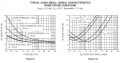
One comment is that the 2N3904 transistor is not rated as being a low noise device. And it seems that a microphone pre-amp should be picked to be a lower noise transistor.
One comment is that the 2N3904 transistor is not rated as being a low noise device. And it seems that a microphone pre-amp should be picked to be a lower noise transistor.
I think Motorola hoped it might have been, because they put the noise figure graphs in the datasheet. If they are not hoping to sell it as a low-noise device you don't get noise figure graphs. and you're right - they could be better! (And for 500uA collector current, it is best at a source resistance of 200Ω)
Having said that, 3dB above the Johnson noise of a 1k resistor is a three orders of magnitude better than a telephone handset microphone inset.
OK, then it seems that there has been a change since I saw the concern about transistor noise. That was a while back, and evidently things have changed a bit. OR, could it be that only MOTOROLA 2N3904 transistors are a bit different as far as noise goes. I am very much aware that is the case with some integrated circuits , which had a serious effect on a product I designed quite a few years back.
OK, then it seems that there has been a change since I saw the concern about transistor noise. That was a while back, and evidently things have changed a bit. OR, could it be that only MOTOROLA 2N3904 transistors are a bit different as far as noise goes. I am very much aware that is the case with some integrated circuits , which had a serious effect on a product I designed quite a few years back.
It might be like the 2N4403, which was invented as a medium power switching transistor, until someone discovered that its noise figure was seriously good for low source impedances (<0.5dB). But we digress. . . .

 Facebook
 Google
 GitHub
 Linkedin