Facebook
 Google
 GitHub
 Linkedin

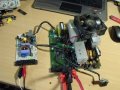
I am building a desktop power supply using free parts from an IBM netfinity server from the late 90's. The power supply is built by Magnetek and has a case # of 3722-40-1 and a IBM part number 01K9880 made week 16 of 1999 and rated for 400 watts by Magnetek.
I did my due diligence in regards to searching for information and documentation without any luck. All I managed to find was refurbished and used units for sale. I am assuming this is because IBM is notorious about not sharing information.
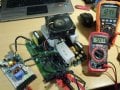
Without any schematic available, I decided to try and reverse engineer the power supply. This is where I will tell you, I am no engineer. Most of my experience is that of an electrician and avid do it yourself type. While tracing parts of the board I decided to apply power to the board and take some measurements with my Rigol 1054Z. In the process of doing this I managed to turn the damn thing on!
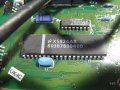
I was probing the main processor on the power supply a 40 pin XS912AB (no info available) (bottom line number) 80387800400. The second number listed on the bottom of the chip is the same on multiple smps from the same server, the top number is different on the second unit I have and is XS824AB.
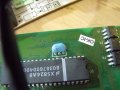
When the supply turned on I was probing a ceramic resonator labeled 8.00T next to the processor. As it turns out I probed the output pin of this 3 pin resonator. I was surprised that it turned on. I measured voltage on all of the rails and had 3.3, 5.47 and 12.44 volts and the 12 volt rail dropped to 12.11 volts under a load. I even attached 3 different motors to the outputs to test under a load. Needless to say, they all worked under a load. I also went on to try and figure out what the oscilloscope did to turn the supply on and cannot understand how or why it did. I did further testing and could not get it to start by using a DMM and check the voltages of the resonator. BTW the voltage was something like 2.6 volts on pins 1 and 3 of the ceramic resonator. With the DMM not turning it on, i thought about paralleling a capacitor to pin 3. this works kind of. I attached the positive pin of a small electrolytic cap rated at 16 volts and attached the negative pin to ground on the output of the supply (which is what I used for all voltage measurements against a ground), and nothing happened. Puzzled I tried to attach just the positive pin of the paralleled cap to the pin 3 and then placed myself in the circuit attached to the ground pin (the ground pin was only touched by myself and not the supply ground). By placing myself in the circuit, it turned the power supply on. Once the supply starts, I remove the capacitor from parallel and it seems to run perfectly fine until I remove the AC power from the rectifying board of the supply.
Curious about the results I took it one more step. I used a piece of 16 awg insulated wire and touched it to the pin 3 and nothing happened. I tried it this way because I dont know if the extra inductance in this ceramic resistor is what is causing this to happen or not. So i then stripped the unattached end of the wire and touched it while it was in circuit with pin 3. It works. Now sometimes it starts immediately or "kind of burps to life" if I remove the wire too soon and then goes back to standby mode until I touch it again. But it always starts without fail. There are no changes or modifications done to the power supply other than they are not in the metal case, but instead on my workbench side by side and even have the fan plugged in and laying on top of the heat sinks. There are no variables involved that I can think of other than the supply is on my workbench.
I mention these came from a server. I have already taken two apart just for something to do because I didnt think I would be able to get them to work. I cannot remember I I have any other complete ones laying around I have not taken apart yet. I will look and if I do, will repeat this on it and see what happens. I will also add the server was removed completely working and intact minus the hard drive.
Can anyone explain to me in a somewhat simple way how or why this is working like this? And what I should be concerned with in regards of putting this back in its case with a wire soldered to pin 3 and ran to the outside of the case for me to activate it with?
Moderators note : removed double images
I did my due diligence in regards to searching for information and documentation without any luck. All I managed to find was refurbished and used units for sale. I am assuming this is because IBM is notorious about not sharing information.
Without any schematic available, I decided to try and reverse engineer the power supply. This is where I will tell you, I am no engineer. Most of my experience is that of an electrician and avid do it yourself type. While tracing parts of the board I decided to apply power to the board and take some measurements with my Rigol 1054Z. In the process of doing this I managed to turn the damn thing on!
I was probing the main processor on the power supply a 40 pin XS912AB (no info available) (bottom line number) 80387800400. The second number listed on the bottom of the chip is the same on multiple smps from the same server, the top number is different on the second unit I have and is XS824AB.
When the supply turned on I was probing a ceramic resonator labeled 8.00T next to the processor. As it turns out I probed the output pin of this 3 pin resonator. I was surprised that it turned on. I measured voltage on all of the rails and had 3.3, 5.47 and 12.44 volts and the 12 volt rail dropped to 12.11 volts under a load. I even attached 3 different motors to the outputs to test under a load. Needless to say, they all worked under a load. I also went on to try and figure out what the oscilloscope did to turn the supply on and cannot understand how or why it did. I did further testing and could not get it to start by using a DMM and check the voltages of the resonator. BTW the voltage was something like 2.6 volts on pins 1 and 3 of the ceramic resonator. With the DMM not turning it on, i thought about paralleling a capacitor to pin 3. this works kind of. I attached the positive pin of a small electrolytic cap rated at 16 volts and attached the negative pin to ground on the output of the supply (which is what I used for all voltage measurements against a ground), and nothing happened. Puzzled I tried to attach just the positive pin of the paralleled cap to the pin 3 and then placed myself in the circuit attached to the ground pin (the ground pin was only touched by myself and not the supply ground). By placing myself in the circuit, it turned the power supply on. Once the supply starts, I remove the capacitor from parallel and it seems to run perfectly fine until I remove the AC power from the rectifying board of the supply.
Curious about the results I took it one more step. I used a piece of 16 awg insulated wire and touched it to the pin 3 and nothing happened. I tried it this way because I dont know if the extra inductance in this ceramic resistor is what is causing this to happen or not. So i then stripped the unattached end of the wire and touched it while it was in circuit with pin 3. It works. Now sometimes it starts immediately or "kind of burps to life" if I remove the wire too soon and then goes back to standby mode until I touch it again. But it always starts without fail. There are no changes or modifications done to the power supply other than they are not in the metal case, but instead on my workbench side by side and even have the fan plugged in and laying on top of the heat sinks. There are no variables involved that I can think of other than the supply is on my workbench.
I mention these came from a server. I have already taken two apart just for something to do because I didnt think I would be able to get them to work. I cannot remember I I have any other complete ones laying around I have not taken apart yet. I will look and if I do, will repeat this on it and see what happens. I will also add the server was removed completely working and intact minus the hard drive.
Can anyone explain to me in a somewhat simple way how or why this is working like this? And what I should be concerned with in regards of putting this back in its case with a wire soldered to pin 3 and ran to the outside of the case for me to activate it with?
Moderators note : removed double images
Last edited by a moderator: