BC212 Transistor Question (Marshall amplifier repair)

ian field

Joined Oct 27, 2012
6,536
To refresh: Check the other diodes and transistors for shorts first. And seriously, use a series lamp in the mains supply. (75 to 100 watts at 120 volts). If the amp is OK, the lamp will momentarily flash, and then quickly dim to a dull glow. If it remains bright, then trouble still exists.
Lamp filaments are PTC - by the time they heat up and limit the current, the damage is already done.
 

Thread Starter

sweatyk

Joined Aug 13, 2013
55
It is very unusual to have only one fuse on a power amp, normally there are two separate fuses, one for the +ve power rail and one for the -ve power rail.

I normally put a 10 ohm resistor instead of each of those 2 fuses, for initial testing.

The schematics you provided don't show the PSU? The first one you posted was the preamp, and the second one was the power amp.

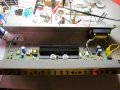
RB Everything is on one pcb with the exception of the power transformer. In the picture where you see the yellow jumper is the only fuse on this pcb. There is not a separate one for -ve and +ve.
 

Attachments

Thread Starter

sweatyk

Joined Aug 13, 2013
55
Lamp filaments are PTC - by the time they heat up and limit the current, the damage is already done.


Ian I don't have access to a variac so you are saying that the light bulb rig would not be the best way for running this for testing? Would placing the 10 ohm resistors in the +ve and -ve circuit buy me time and be the way to go as RB suggested?
 

ian field

Joined Oct 27, 2012
6,536
Ian I don't have access to a variac so you are saying that the light bulb rig would not be the best way for running this for testing? Would placing the 10 ohm resistors in the +ve and -ve circuit buy me time and be the way to go as RB suggested?
If you've ever noticed - most bulbs blow at the instant of switch on, when the filament is cold it has a low resistance, so there's an inrush current.

Just measure one at room temperature with a DMM, then compare the measured resistance with what calculates from rated volts & watts. You can calculate the instantaneous inrush from the measured cold resistance & rated voltage.

Before CFLs became a practical proposition, I used to salvage any NTC inrush thermistors from any scrap electronics, I'd wire one behind the switch plate for the room lighting - I was already getting filament bulbs lasting the claimed life for CFLs.
 

tubeguy

Joined Nov 3, 2012
1,157
Yes, lamps are PTC. The 100 watt lamps' cold resistance is about 10 ohms. On power-up, if a short exists in the equipment, allowing even more current to flow, the lamps resistance quickly increases. This increased resistance further limits the current.

Calculate the on-resistance of a 100 watt, 120 volt lamp.

If you don't have a variac, a lamp is very usable.
 
Last edited:

THE_RB

Joined Feb 11, 2008
5,438
RB Everything is on one pcb with the exception of the power transformer. In the picture where you see the yellow jumper is the only fuse on this pcb. There is not a separate one for -ve and +ve.
OK, thanks for that. It looks like they only fused the AC going into the transformer primary, then have no fuses on the two +ve and -ve rails. A bit cheap and nasty.

We still need to know what the amp is actually doing!

Assuming it is NOT blowing that one fuse, you don't have a big overcurrent situation. So if that is OK, you can power up the amp and measure some voltages as discussed before, the most important voltage is the amp output which tells us if the amp is pulling hard to -ve rail, or hard to +ve rail, or if the biasing is ok(ish) and the voltage is close to zero.
 

ian field

Joined Oct 27, 2012
6,536
Yes, lamps are PTC. The 100 watt lamps' cold resistance is about 10 ohms. On power-up, if a short exists in the equipment, allowing even more current to flow, the lamps resistance quickly increases. This increased resistance further limits the current.

Calculate the on-resistance of a 100 watt, 120 volt lamp.

If you don't have a variac, a lamp is very usable.
My experience is mostly with SMPSUs in TVs & monitors - you can get away with lamp limiting on the final rail to the horizontal output stage, but on the mains side of the SMPSU, its no less likely to go pop if there's a fault when you put a lamp in series.

Since audio amps usually have a whacking great mains transformer, you're probably OK with lamp limiting.
 

Thread Starter

sweatyk

Joined Aug 13, 2013
55
I have good news and bad news. The good news is that this amp is now functioning. The bad news is the method in which it was repaired. Due to overwhelming circumstances I was forced to carpet bomb that area and quickly replaced several parts in the circuit. The reason to me that it’s bad news is I learned nothing in the process by doing that. However throughout this thread I did actually pick up some helpful tips that will aid my troubleshooting skills in the future. I would like to thank all whom chimed in to help guide me in the right direction including The RB, Studiot, Ian Field, Tubeguy, and anyone else I may have missed.
 

studiot

Joined Nov 9, 2007
4,998
Glad it's fixed.

;)

You can still learn stuff by playing with the parts you took out. You can build simple circuits with them and see which are still functioning.

go well
 

THE_RB

Joined Feb 11, 2008
5,438
Congrats on getting a fix!

And don't feel bad about replacing a heap of parts to get it working, with many amps the recommended "proper" repair procedure is to replace all the semis in the output stage. :)
 
Top