Basic Variable Power Load w IRFZ44N

Ian0

Joined Aug 7, 2020
13,132
The limit is usually determined by the number of address lines and the number of states for each address line. The number of states is usually two (though there are some devices which can detect "floating" as a third state), and the number of address lines is rarely more than three, so 8 is the usual limitation of the number of devices of the same type on I2C.

There are digital potentiometers with up/down pushbutton inputs, which would could be used instead of an encoder, and there are some devices with "clock" and "direction" inputs. If you call one encoder output "clock" then the logic level on the other, at the time of the clock edge is determined by the direction of rotation, so it should be possible to interface directly with an encoder.
 

Thread Starter

q12x

Joined Sep 25, 2015
2,227
And... Im back with the latest updates !!! Ta taaa ta taaa ...
I re-read 3pages ago, all the comments, especially from @Irving, 2-3 times even, to remember and re-understand details about this complex discussion.
I finally receive both DACs, MCP4725 and DAC0808, but I will concentrate on working with MCP4725for the moment.
Complain: (this forum textbox is changing the space character when I type, linking words toghether. If this website textbox didnt change at all, then is definitely my Firefox browser buggy - its not my keyboard, since everywhere else, except this forum textbox, is working perfectly).
I also received my IRLZ48N (Logic mosfets) as well, but I did not test them yet. I'm not completely sure how, I have an idea but im not sure if is a good one.
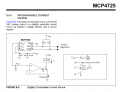
I looked into @Irving circuit with6 mosfets and refresh my memory. Here is a default circuit, very good tostart my first test with this DAC. I also have the other test version I though about myself, using a LM3914.
1754710448061.png
 

MrAl

Joined Jun 17, 2014
13,707
And... Im back with the latest updates !!! Ta taaa ta taaa ...
I re-read 3pages ago, all the comments, especially from @Irving, 2-3 times even, to remember and re-understand details about this complex discussion.
I finally receive both DACs, MCP4725 and DAC0808, but I will concentrate on working with MCP4725for the moment.
Complain: (this forum textbox is changing the space character when I type, linking words toghether. If this website textbox didnt change at all, then is definitely my Firefox browser buggy - its not my keyboard, since everywhere else, except this forum textbox, is working perfectly).
I also received my IRLZ48N (Logic mosfets) as well, but I did not test them yet. I'm not completely sure how, I have an idea but im not sure if is a good one.
I looked into @Irving circuit with6 mosfets and refresh my memory. Here is a default circuit, very good tostart my first test with this DAC. I also have the other test version I though about myself, using a LM3914.
View attachment 353918
Hi,

You may have to add some compensation and possibly a resistor from the output of the op amp to the base of the transistor.
If you only need it for resistive load it comes out simpler though.
 

Thread Starter

q12x

Joined Sep 25, 2015
2,227
Scale 1:1 components layout preparation. The 6pin IC is MCP4725. The 8pin IC is LM358.
I used the same cct as in the MCP4725 datasheet that I posted in my previeous post, but I changed the "Load" side with my IRFZ44N mosfet and 1R5W.
Because this mosfet remained as the target test, from my last (unfinished) experiments. Talking about patience - haha.
20250810_134819.jpg
 

Irving

Joined Jan 30, 2016
5,131
Never use the TO220 case mounting hole as a connection, its sole purpose is to bolt the case to a suitable heatsink at the right torque to get a good thermal contact. Fixing a rig terminal there will badly compromise that. I don't see any heatsink... that should be a #1 priority for the mechanical layout.
 

Thread Starter

q12x

Joined Sep 25, 2015
2,227
Never use the TO220 case mounting hole as a connection
yes, I made some alternatives for Drain connection, see the tr pin large pad connection OR soldered to the TO220 ear near the hole OR directly use a washer like connection that I can insert a screw through it and through the hole of TO220 ear. Nothing is wrong with all these 3 options. All are practical.
I don't see any heatsink...
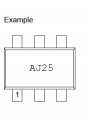
True... at this stage I was thinking to actually test this new chip, see how is doing, and get comfortable with it. By the way, the bastards did not marked the MCP4725 chip with a line or a point where #1 pin is. I kind of guess from a plastic crack when they are all assembled and snapped ...that might be the notch in top of the IC but it is so BAD, not being marked like that. And this is the second chip type I find with this problem.
By the way this is myvery first DAC circuit, in my life.
- The transistor I can screw on a heatsink after my 1st test - if everything is wired and mounted correctly.
That entire paper size, with the tr and the 5W resistor can be a single AL block !!! - now that I think about it.
Thanks for the observations so far !
 
Last edited:

Irving

Joined Jan 30, 2016
5,131
OR soldered to the TO220 ear near the hole OR directly use a washer like connection that I can insert a screw through it and through the hole of TO220 ear. Nothing is wrong with all these 3 options. All are practical.
Everything is wrong with those suggestions... You can't solder to the tab, its steel - you'd overheat the device long before you got a decent joint., And did you not understand my post #105 despite liking it! The only right way to connect to a TO220 device is the drain pin. While the tab is electrically connected to the drain the bonding isn't intended to carry any significant current..

marked the MCP4725 chip with a line or a point where #1 pin is
They don't need to - if you read the datasheet, when the markings are the right way up, pin 1 is bottom left.

1754837694604.png

The transistor I can screw on a heatsink after my 1st test - if everything is wired and mounted correctly.
And how are you going to ensure it doesn't fry immediately? Without a heatsink the junction temp will exceed spec at under 2W - can you be sure you can keep well inside that limit? What is your '1st test' scenario?

That entire paper size, with the tr and the 5W resistor can be a single AL block !!! - now that I think about it.
An AL block would be a very poor heatsink - what heatsink do you have?. And that type of ceramic power resistor should be mounted vertically in free air and away from other components.
 

Thread Starter

q12x

Joined Sep 25, 2015
2,227
And how are you going to ensure it doesn't fry immediately? Without a heatsink the junction temp will exceed spec at under 2W - can you be sure you can keep well inside that limit? What is your '1st test' scenario?
good point. I wasn't actually rushing linking everything to the mosfet. My plan is to put the voltmeter after the opamp - no links to the mosfet gate. And check if that is changing correctly and as low V as I send the code from my pc.
I can make a function to stay in a couple of volts, way less of the full open 10V of the gate.
I was also planning to test (initially) with a LM3914, but .... I think a voltmeter is the quickest way.
 

Irving

Joined Jan 30, 2016
5,131
good point. I wasn't actually rushing linking everything to the mosfet. My plan is to put the voltmeter after the opamp - no links to the mosfet gate. And check if that is changing correctly and as low V as I send the code from my pc.
I can make a function to stay in a couple of volts, way less of the full open 10V of the gate.
I was also planning to test (initially) with a LM3914, but .... I think a voltmeter is the quickest way.
That won't work. Without the complete feedback loop the output of the opamp will be either 0 or +12v and the gate should never be left unconnected; put a 10k to ground. With the loop in place the output of the opamp should be just enough to open the MOSFET channel to pass enough current through the 1 ohm resistor to match the output of the DAC. But any more than about 150mV from the DAC and the MOSFET will fry.
 

MrAl

Joined Jun 17, 2014
13,707
Everything is wrong with those suggestions... You can't solder to the tab, its steel - you'd overheat the device long before you got a decent joint., And did you not understand my post #105 despite liking it! The only right way to connect to a TO220 device is the drain pin. While the tab is electrically connected to the drain the bonding isn't intended to carry any significant current..


They don't need to - if you read the datasheet, when the markings are the right way up, pin 1 is bottom left.

View attachment 354001


And how are you going to ensure it doesn't fry immediately? Without a heatsink the junction temp will exceed spec at under 2W - can you be sure you can keep well inside that limit? What is your '1st test' scenario?


An AL block would be a very poor heatsink - what heatsink do you have?. And that type of ceramic power resistor should be mounted vertically in free air and away from other components.
I used to mark some of my chips with a white paint marker where the #1 pin is. That way I can quickly see what way it had to be plugged into the socket.
 

Thread Starter

q12x

Joined Sep 25, 2015
2,227
And success, at least partially. I managed to read the DAC Vout with a DVM. I had problems running the program too fast and my DVM was not catching the voltage correctly, it was averaging and showing me some erroneous voltages. But after I figure out the cause, I slowed down the program to 1s step and my DVM could catch up and display correctly all the voltage stepping I was expecting to see.
And of course the first thing I did, I mounted the DAC inverse, because no pin1 marking. And it was getting hot. I inverse it, hoping it will be the right position this time, and a leg broke off - what a nightmare is to work with these tiny components !!! I put another chip, but this time in the right position, and then re-run the code and all the tests. And it worked the second time. I also marked all the rest of the chips with a square file and some white paint into the new hole. Theoretically, you should read the text from top to bottom, inclining your chip towards left side. Thats thecorrect top side of the chip.At least for my chips. But the textpositioncanbe very random on chips. I dont think they are following a precise rule for marking them in a specific order. Anyway, I solved these problems so far.
Next, I will have to link the mosfet and like you suggested, directly on a heatsink to avoid burning it out.
Im expecting a voltage change from the output of the opamp, proportional with the voltage change from my DAC.
Thats why I originally suggestedthe reading with DVM on its output. If it is behaving as a comparator, switching from 0 to VCC then....probablywhen is not linked to the sense resistor.... I think this might be the cause you mentioned earlier.
Heatsink then.
 

dl324

Joined Mar 30, 2015
18,333
I mounted the DAC inverse, because no pin1 marking. And it was getting hot. I inverse it, hoping it will be the right position this time, and a leg broke off
That was probably a blessing in disguise. Devices tend to die rapidly when power connections are reversed. The ones that don't die outright are ticking time bombs.
 

panic mode

Joined Oct 10, 2011
4,995
.. I changed the "Load" side with my IRFZ44N mosfet and 1R5W.
so, what are the targeted design specs of your circuit?

i see 12VDC supply is fixed and shared with OpAmp. why is that? i would think that separating them would make design more versatile. i would have used small DC/DC converter like CRE1S0515SC to power OpAmp and allow MOSFET to connect to circuits that work with different voltages.

also resistor is 1R 5W. P=I^2*R so I=SQRT(P/R) meaning that it can handle at most 2.236A. similarly the max voltage is 2.236V. but DAC can output up to 5V.

so in order to not destroy your 1 Ohm resistor, DAC must limit its working range to less than 50%. that works out to max value of 1830 counts instead of supported 4095 counts. in other words you are losing resolution. if you do not limit this, wrong value will set the resistor ablaze. perhaps consider using voltage divider between DAC and OpAmp. this way you can use full resolution of DAC even though the current range is limited.
 

Thread Starter

q12x

Joined Sep 25, 2015
2,227
so in order to not destroy your 1R5W resistor, DAC must limit its working range to less than 50%
I have1R of 10W and 100W now ! I can change it very quickly if the resistor gets too hot.
This 1R5W is kind of the 'standard' Im using in these types of experiments.
Ideally I will start low, and gradually and slowly rise up the power and measure everything: temperature,I and V. I will make a graph.
Realistically, it can happen anything, anytime.
Im more concerned about the mosfet blowing up than the resistor, although the resistor is playing an important role too.
 

Thread Starter

q12x

Joined Sep 25, 2015
2,227
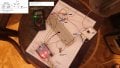
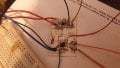
Read the notes in this image !!! Notice I did not powered with 12V. Im only showing that the cct is complete and ready.
I made an arduino program that is increasing the MCP4725 Vout up to max 2.2V because my voltmeter is averaging and not catching quite precise what the real voltage is. Note, if I increase+100mv after this value, it will jump to 0.09V and not to 2.18V as you might expect. Anyway, I had to deal with this error tolerance and understand it.
I added quite a thick and big in height as well, is like a cube the entire heatsink, not showing very well in the picture.
How all this works: -I'm increasing/incrementing +100mV per button press. When is reaching 2.2V (should have been 2V) is resetting to 0V. Im measuring the voltage over Vout and gnd of the MCP4725with that small DT-182 voltmeter.
I common all the grounds, from the arduino GND pin, MCP4725, LM358, IRFZ44N+1R5W.
20250812_122641_edited.jpg20250812_122701.jpg
Im a bit nervous about the next step. i dont know what to expect.
I think if I am linking 12V and 0V to the mosfet, it should ... I dont know...conduct something?I think I should add my digital thermometer over the mosfet. Right? What you will do from this stage forward? Im afraid of some unforeseen spikes ! Im paranoic about spikes on mosfets now! haha.
Again, this is my first DAC circuit ever ! Very cool so far, Im glad is working until here and nothing is burned. look at that rats nest of wiring...
 

panic mode

Joined Oct 10, 2011
4,995
so what are expected design parameters?
variable load/constant current source adjustable to 0-5A at 12V?

what are you using as 12VDC supply? does it have current limiting?
 

Thread Starter

q12x

Joined Sep 25, 2015
2,227
what are you using as 12VDC supply? does it have current limiting?
Good point. I was thinking on my ATX PSU, but now that you are mentioning, I should use my secondary var PSU.
so what are expected design parameters?
To get as much W on the Load resistor as I can, without burning my mosfet. I think.... my original intention was to test the mosfet how high it can go, at least to a max of 50*C.
This setup with the DAC was suggested awhile ago, and since I never used/experienced a DAC before, I said this is the right time for it. But to be sincere... I have no clue what to expect from it,other than better rezolution and more precision that using a POT, like I was using before it. It's all I can think about.If there are other things I canexpect to see/observe from using this DAC....do tell me. Other than what I enumerated.
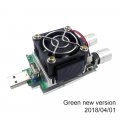
The full design scope is to make a close enough "Comercial Electronic Load Tester 35w" like this one in the picture:
Comercial Electronic Load Tester 35w usb_A.jpg
 

Thread Starter

q12x

Joined Sep 25, 2015
2,227
This is my secondary variable PSU.
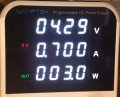
I set it to 12V and 100mA initially.When I connect it to the cct, on the 12V rail, it dropped to 4.29V, and switched to CC !
I think I should use a3rd psu with a constant 12V, not variable, only for the opamp. As it is now, the power resistor is unbalancing the voltage on the gate.
The second I increase the voltage on the DAC from 0.0 to 0.1 (100mV)thePSU switched to CC, exactly to this value you see in the picture. Itdid not changed, I dial up to 4.6V on DAC and nothinghere, thesamedisplaynumbers. Hmm. The higher the Amp limit I raised, the 1R5W resistor got warmer. So I leave it in the middle, not too hot, not too cold at thisautomatically calculated 3W.
20250812_175359.jpg
 

panic mode

Joined Oct 10, 2011
4,995
i cannot deduce specs of that product from the picture. link to it would be nice.

btw. mosfets are cheap. for example compared to IRFZ44, IRFB7545 is 30% of the price and 150% of the power (Pdmax=125W). also, if needed, one can put more than one. if the supply voltage does not exceed 12V, single IRFB7545 can do up to 10A.

if you sec your load to 100mA, your PSU should see 100mA as well. 700mA is way too high. what else have you connected to that PSU?
 

Thread Starter

q12x

Joined Sep 25, 2015
2,227
if you sec your load to 100mA, your PSU should see 100mA as well. 700mA is way too high. what else have you connected to that PSU?
originally I set it to 100mA, but then I raise it up to 700mA because nothing was happening.
NOW, I raise it to 1.2A limit andagain, nothing is happening, nothing different than before. The same thing. From 0.0 to 0.1V on my DAC, and the PSU is jumping to the maximum A Ilimit , and the voltage decreases on the display, sighthat it entered into CC mode.
This time I hooked up a 3rd PSU, my old one, and I setit to 12V andpower only the opamp rail, as shown in skematic. The mosfet power rail I put my secondary PSU and raiseits limit to 1.2A as mentioned. Still, nothing is different.
I was expecting to see a slow ramp up in temperature over the mosfet, as I was increasing the DAC Vout +100mV step, but nothing. Only the resistor is getting very hot to around 2W, so Im reseting to 0 for it to cool down.
In a way, I thinkall this might work correctly,only I can not read it right ! Is my thought.
 
Last edited:
Top