Facebook
 Google
 GitHub
 Linkedin

Hello everybody !
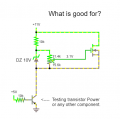
I have this Basic Variable Power Load w IRFZ44N cct. This is not my cct, I find it online and I am uncertain of its functionality.
I know there are these 2 types of driving a mosfet: linear mode and switching mode.
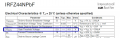
The usual way I know how to use my IRFZ44N is in full switching mode, with minimal RDSon as possible, from 10VGS up to maximum 20VGS as in its datasheet.
Here is what I understand from this cct:
This cct is made, by the look of it, in linear mode. Especially when the VDD is less than 10V.
That DZ10V and its 10k current protection, are there to limit higher voltages to a maximum of 10V on the transistor Gate. To protect it from over voltage and not burn its gate. The POT47k can be any value, I used 47k because is a rare value and I have a bunch left. Its role is to linearly change the voltage on the Gate, playing the role of a voltage divider. The current is very low, thanks to the 10k in front of the POT.
So,from my understanding, when the Gate receives less than <10V, RdsON will increase, lowering the performance of the transistor, increasing the power dissipated as heat over the transistor in the same time, and conducting way less current compared when is fully open with >=10V.
So, it is better to drive any mosfet as fully open as possible, with a minimal RdsOn as possible, to allow as much current to pass through it.
So this is the theory and practice I know so far. I kept away from driving mosfets in their linear region <10VGS.
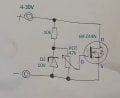
Now... to correct this cct, Im thinking on a boost DC converter. I already have a cct for it, that I can build. Its a bit complicated, including a 555 oscilator module, that drives a small mosfet included in a current pump with a 500uH coil module and in the end, a current rectification module, to liniarize the oscilations, making it as DC and smooth as possible pretty much. But is a big-ish cct to implement. What it does, it is taking a 5V input, and outputs 60V or so. I already made the circuit for another application, but Im thinking to make it again, this time to specifically drive my mosfet in this Power Load cct presented in the picture. But 60V or so is way over nominal VGS. That DZ10V is there to limit and assure a clean 10VGS. So Im safe at this point. Why to use this DC converter? For the simple reason, of driving everything from 5V ! My mosfet will be driven in switching mode, with a precise 10V on its gate, and everything else in the cct will run at 5V.
The problem is that POT, that is transforming everything I said until here into crap. Because whatever Im doing until the POT, doesnt matter. As long that POT is there, it will add a less than 10V on Gate and make it run more hot than I want it.
Whats the solution here? Where Im doing wrong? Is my logic so far ok? Do I miss anything? Any comment is welcomed.
One approach I believe you will come up with is to use PWM on this mosfet to pass less or more current through it, all in the switching mode, no linear mode. I thought of it as a possile solution, but I want to see what you say too.
Thank you.
I have this Basic Variable Power Load w IRFZ44N cct. This is not my cct, I find it online and I am uncertain of its functionality.
I know there are these 2 types of driving a mosfet: linear mode and switching mode.
The usual way I know how to use my IRFZ44N is in full switching mode, with minimal RDSon as possible, from 10VGS up to maximum 20VGS as in its datasheet.
Here is what I understand from this cct:
This cct is made, by the look of it, in linear mode. Especially when the VDD is less than 10V.
That DZ10V and its 10k current protection, are there to limit higher voltages to a maximum of 10V on the transistor Gate. To protect it from over voltage and not burn its gate. The POT47k can be any value, I used 47k because is a rare value and I have a bunch left. Its role is to linearly change the voltage on the Gate, playing the role of a voltage divider. The current is very low, thanks to the 10k in front of the POT.
So,from my understanding, when the Gate receives less than <10V, RdsON will increase, lowering the performance of the transistor, increasing the power dissipated as heat over the transistor in the same time, and conducting way less current compared when is fully open with >=10V.
So, it is better to drive any mosfet as fully open as possible, with a minimal RdsOn as possible, to allow as much current to pass through it.
So this is the theory and practice I know so far. I kept away from driving mosfets in their linear region <10VGS.
Now... to correct this cct, Im thinking on a boost DC converter. I already have a cct for it, that I can build. Its a bit complicated, including a 555 oscilator module, that drives a small mosfet included in a current pump with a 500uH coil module and in the end, a current rectification module, to liniarize the oscilations, making it as DC and smooth as possible pretty much. But is a big-ish cct to implement. What it does, it is taking a 5V input, and outputs 60V or so. I already made the circuit for another application, but Im thinking to make it again, this time to specifically drive my mosfet in this Power Load cct presented in the picture. But 60V or so is way over nominal VGS. That DZ10V is there to limit and assure a clean 10VGS. So Im safe at this point. Why to use this DC converter? For the simple reason, of driving everything from 5V ! My mosfet will be driven in switching mode, with a precise 10V on its gate, and everything else in the cct will run at 5V.
The problem is that POT, that is transforming everything I said until here into crap. Because whatever Im doing until the POT, doesnt matter. As long that POT is there, it will add a less than 10V on Gate and make it run more hot than I want it.
Whats the solution here? Where Im doing wrong? Is my logic so far ok? Do I miss anything? Any comment is welcomed.
One approach I believe you will come up with is to use PWM on this mosfet to pass less or more current through it, all in the switching mode, no linear mode. I thought of it as a possile solution, but I want to see what you say too.
Thank you.
Attachments
-
6.7 KB Views: 22
Last edited: