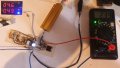
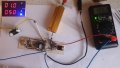
I have a lot of scrapped components. Also a couple of MCUs for Arduino.
I do not want to totally replicate that thing. Only the core functionality, the power part. For the moment.
Later, if Im pleased with the power, I will consider adding extra functionality like the rotary encoders, an arduino MCU, maybe even a color LCD that I have and never used yet, working on I2C communication.
At this point I want only the power part of the circuit nailed down.
Ok then, I will make another cct with opamp, and drive a mosfet instead of my usual NPN.
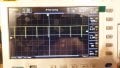
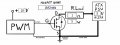
I also have this old experiment, where I used this square wave device. Here I was testing it and it worked fine.
I can use this cct again too, with a IRFZ44Z for the power test. It's an idea.
Or, I can make a variable 555 PWM cct to drive Gate directly, instead of this device.
What do you think? What to make first? the opamp or the 555 cct ?
Or, I can make a variable 555 PWM cct to drive Gate directly, instead of this device.
What do you think? What to make first? the opamp or the 555 cct ?
Op-amp, because it's meant to be a variable load, not a fixed load that is switched on and off.
Obviously, with a big inductor to filter the PWM back to linear, you could do it with PWM, but you will need a sizable inductor, and the heat dissipation will remain unchanged, just moved from MOSFET to resistor.
For a linear load I would recommend putting a resistor in the source so that the resistor and MOSFET dissipate equal amounts of power at full load. That also tend to make the op-amp circuit easier to stabilise.
If you are using it for testing, you need to know how the device under test reacts to different loads.
Depending on the application, you might also need to know how it reacts when the load switches on and off.
That is a very smart idea. I was having it in the back of my mind, but I never push it in front as a "do it" idea.
For the moment, I will concentrate only on getting done correctly and powerful enough of a resistive load.
That's my target.
Yes, I actually had this problem with my varPSU, killing a bunch of mosfets and probably some BJT's too. From switching spikes. I didnt solved that issue ... completely, only partially, through experimentation.
Now, I have a second varPSU that is more digitalized than my previous one. With very fixed increments in V and A. So it is not spiking at all on switching like the old one. Im still using my old one, but I have my eye on it.
But this is a separate problem I can not concentrate right now. I wish there was an easy fix.
Obviously, with a big inductor to filter the PWM back to linear, you could do it with PWM, but you will need a sizable inductor, and the heat dissipation will remain unchanged, just moved from MOSFET to resistor.
I think I understand your point here. So basically to rectify VDS from pulsing to continuous, is what you're saying, right? I can use a diode bridge rectifier for this part, and a smoothing capacitor, exactly as is done for the 50Hz from a coil transformer. Why the inductor? I also have a ton of scrapped inductors of a lot of sizes and shapes. And I never used 1. They keep piling up.
But I get your idea, I think, using an opamp to keep all the power heat dissipated only on the mosfet body and not on the resistor load as you mentioned. Interesting difference !
- Ok then, the opamp cct it is. Thanks ! I will start making it and update you soon.
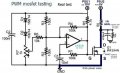
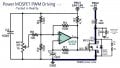
I think... this was the last cct test I did last time. But I don't remember exactly what I did. I made some mistakes back then and I also got the spiking problem killing my mosfets. One big mistake was using LM393 comparator instead of LM358 opamp. I had to correct my drawing here with this specific detail. I was experimenting and much-much later I realized that comparator was not linked correctly because it has a special way of wiring, compared with an opamp. And on top of that, damaging spikes from my PSU on/off switching. But this time I will use my #2 fanciest varPSU.
I think, that 4700uF and 10k in the mosfet D, helped with the on/off spikes.Yeah, probably that is what was doing there.
Anyway... this cct is what I will build :
(any corrections on it, now is the time to mention them)
also...this image title is 'PWM'... is it? I think I should change it into 'linear'. No?
Have you noticed that the "secondary breakdown" slope on a MOSFET SOA graph only appeared in the last decade? Before then, there were plenty of MOSFETs with the Zero tempco point at a very high current, but with the same SOA graph as the 2SK134!
Then suddenly, honesty took over!
For an active load, Rds(on) has no relevence, so the Exicon Lateral MOSFETs would give a stable solution, and they are hard to break.
I picked those as the first two IRFZ44N with different construction by way of illustration, but the IRFZ44N is obsolete now, and you wouldn't use one for this application anyway.
The Exicon devices are interesting but still quote their SOA at a 25C case temperature and even then are limited to <125W realistically.
My go-to device is the IXYS IXTX200N10L2 which even de-rated will do >250W (heatsink permitting). They are, AFAIK, the only manufacturer to quote their SOA at a real case temperature of 75C as well as the standard JEDEC 25C.
At it's naked basic circuit diagram, I believe those comercial power load are the same as my circuit here.
The only diference is they have some MCU both for handling the actual power on the mosfet, rotating the knobs, incrementally, and then displaying it.
No, they all use the opamp model in post #8 - anything open-ended with no controlling feedback IS an exercise in futility and not worth pursuing. The bad ones use a single MOSFET, the better ones use a pair of MOSFETs.
No, they all use the opamp model in post #8 - anything open-ended with no controlling feedback IS an exercise in futility and not worth pursuing. The bad ones use a single MOSFET, the better ones use a pair of MOSFETs
I picked those as the first two IRFZ44N with different construction by way of illustration, but the IRFZ44N is obsolete now, and you wouldn't use one for this application anyway.
The Exicon devices are interesting but still quote their SOA at a 25C case temperature and even then are limited to <125W realistically.
My go-to device is the IXYS IXTX200N10L2 which even de-rated will do >250W (heatsink permitting). They are, AFAIK, the only manufacturer to quote their SOA at a real case temperature of 75C as well as the standard JEDEC 25C.
The early IRF devices (IRF5x0 and IRF6x0) are far better for linear applications, because the zero temperature coefficient point of Vgs vs. Id is lower than the operating current, everything shares current because the cooler ones not the hotter ones take more than their fair share.
Even the IXYS device you mention is running below its zero tempco point. Bring back the 2SK405!
Hello @Irving
Updated cct:
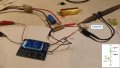
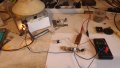
In this cct, I didnt include that first antispike module (cap+res). Im relying only on the diode to do it's job. So far so good, but I didnt switch my varPSU that often either. Also I should probably change with my new varPSU !!! I forgot about it. I am very used to my old varPSU -here in pictures.
Im powering with 12Vdc from my ATX PSU, the opamp Gate PWM switching side of the cct.
From my varPSU, I power with 5V and it will switch to A (lowering the voltage) when the Power increases on DS.
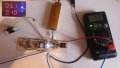
when the yellow POT is at min travel, the PWM~5%, the voltage on GS is 1.17V and the white LED stays Full ON. My varPSU =5.1V@0.10A
As I increase the PWM, (you can see the yellow POT rotated a bit) the LED turns off and is at exactly 4V on GS.
So the LED is invers proportional with the Gate opening.
At VGS=2.39V, my varPSU switches from V to A !!! (The voltage starting to decrease towards 1V)
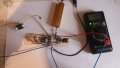
And here, the pot is at its maximum travel, 100% PWM, and the VGS=10.62V while my varPSU=1V@0.5A
- I limited my PSU to 0.5A to stay on the safe side while Im testing the functionality of the cct.
Later I will increase a bit the A limitation, for the real Power testing.
How can I get that 35W like in the commercial model ?! --I want that.--
I suggest to use multiple mosfets in // (parallel) ! Because I have 50 of them and they are all I have. The most powerful I have.
- Your IXTX200N10L2 powerful mosfet example, is way too expensive to be complete realists, but it is an interesting component that attracted my attention and I will keep it in mind. Is a new component for me. I can not afford such extravagant expense, but if this test here will be a success, I will consider buy 1 ... I think 1=20$ !!!!!!!!!!!!!!!!!!!!!!!!! ohohoa... hmm. We will see, hahaha, but way in the future. Is good that you show me what's out there !!!! I definitely didn't thought to search for it. So that's my point about it.
I wait for your next step !
Yes, PWM works to control average power. It does not serve the same purpose as a variable load.
For example, consider a battery capacity tester. You could test with a constant load of 100mA but testing with a PWM of 1A and 10% duty cycle would give very different results, because battery capacity deceases significantly with higher current.
Its not generic, its the basis of several perfectly functional solutions, including my 2400W active load. You have to adapt it to your specific requirement; no one can give you a "fully functional solution" for your requirement because you've never stated what you actually need.
Yours is not "fully functional and tested"; it may function for a while & you may be happy with playing with it, but fully functional and tested? - have you run it for several days continuously under various conditions and ambient temperatures? Is it stable to any reasonable degree; if you set it to a specific current or power load does it stay there within a given tolerance for hours or days at a time? Can you even set a specific load repeatably and accurately? And, as pointed out above, is it really testing what you think it's testing?
If I get a chance later I'll post a snippet of one of the 400W modules that make up my 2400W active load. Running multiple MOSFETs in parallel isn't as easy as you might think.
not to that extent because it was never finalized. I only test it for 30min a couple of times with different settings/tweaks and I hold my electronic thermometer on the mosfet and the components around it, and monitor everything to stay less than 50*C. Thats my personal threshold that Im sticking with. It is in plan to test it fully, like you say, a couple of days. But not at this point when I have room for expansion.
I bet you used 1 single very powerful mosfet like the IXTX200N10L2 example. ... for 1x400W module you say. Hmmm, very interesting.
What are you using this 2400W active load? To test diesel/gas/fuel output power generators?
like this one? for example:
Isn't that my single comparator PWM circuit with the comparator replaced with an opamp? With an opamp, the pull-up resistor (R5) isn't necessary. But I might put it between the output of the opamp and the gate to avoid potential oscillation.
yes, indeed, actually I find that the most use of a power load is to test power supplies of diverse fabrications.
My idea of using it is to test components, specifically the ones I have. I want to know exactly what I have and how far I can push them, to truly know their limits. Again, my stuff, what I have. I have brand new and also scrapped stuff. Thats my reason and my idea Im pointing. And now, I want to get close to that commercial 35W, and I think is possible, with what I have.
Im also learning about mosfets, how to drive them hard, and some characteristics I never thought for myself, thanks to these open discussions here.So Im shooting many rabits with 1 bullet, this project as weird as it sounds. But it is very fascinating subject and I like it.

 Facebook
 Google
 GitHub
 Linkedin