Basic SCR circuit

Thread Starter

mghg13

Joined Jul 17, 2013
62
Hello,

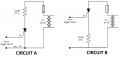
I've got a simple rectifier circuit connected as shown in CIRCUIT A. The load is connected in the upper part and the SCR in the lower part. It works fine.

I would like to know, what would happen if the positions of the load and the SCR were interchanged, i.e. they are connected as in CIRCUIT B.

Thanks

SCR Circuit.png
 
Last edited:

Thread Starter

mghg13

Joined Jul 17, 2013
62
According to me, if the SCR and load positions were interchanged, the trigger current would encounter some resistance since it would have to pass through the load.
Thus, it may be possible that the current is then too low for triggerring the SCR.

What do you think about my observation Alec_t?
 

crutschow

Joined Mar 14, 2008
38,512
Remember that it's the gate to cathode voltage that's important for triggering the SCR (both the forward and reverse voltage). How will those change between the two circuits?
 

Thread Starter

mghg13

Joined Jul 17, 2013
62
In Circuit B, the trigger voltage being applied will be divided between the SCR (gate to cathode terminal) and the load.
 

Alec_t

Joined Sep 17, 2013
15,119
As you've already observed, "Thus, it may be possible that the current is then too low for triggerring the SCR."
 

Thread Starter

mghg13

Joined Jul 17, 2013
62
As you've already observed, "Thus, it may be possible that the current is then too low for triggerring the SCR."
But then what would cause the current to be too low? Because, as you mentioned previously, practical loads are LOW in resistance?
 

Alec_t

Joined Sep 17, 2013
15,119
Because, as you mentioned previously, practical loads are LOW in resistance?
I said "many practical loads", not "all practical loads". Also, some SCRs require much more triggering current than others.
 

MrAl

Joined Jun 17, 2014
13,704
Hi,

First of all we have an unspecified 'block' in the schematic. To be sure of what is going to happen we would have to know what that block does functionally in the circuit. I'll assume at first that it is a short circuit.

I dont think the load will be a problem as the gate current is low compared to most loads, Yes, not every single load that could ever be conceived, but this load is 47 ohms and that's low enough.

The real problem is what happens once the SCR turns on.
If we say use a 3v trigger voltage through a current limiting resistor to power the gate (lowest node graphically in the schematic taken to be common) once the SCR turns on with a 1.4*6=8.4v at the cathode and that means the gate current goes very very low so the gate voltage goes to 3v and with 8.4v at the cathode that means we have 8.4-3=5.4v reverse bias on the gate to cathode. You'd have to check the data sheet to find out if it is OK to apply 5.4v (roughly) of reverse bias to the gate cathode junction.
For this circuit it looks like the AC rms voltage is only 6v so the peak is around 8.4v and with a little drop from the SCR it would be as high as exactly 8.4, but in real life the 6v winding might be a little higher too.

If the 'block' is not a short circuit but is actually a 4.7 ohm resistor (just for example) then the voltage at the cathode will only go up to about 7.6v peak so the reverse voltage across the gate cathode will only be about 7.6-3=4.6 volts now. So the block changes the analysis quite a bit unless it is a short circuit or a fuse.

Also, because of gate to cathode capacitance the reverse bias problem could be more severe for a short time as the cap charges up. With a typical gate voltage of 2v that means in the above we'd still have 7.6-2=5.6v of reverse bias.

The reverse bias problem could be worse if the supply voltage was higher of course. If it was 100v peak then we'd see a LOT of reverse bias, like 90v or more which cant be good.

If we use a gate pulse instead of constant drive, then we'd see the reverse bias for a shorter time but it would still be there.

The above discussion is true regardless what the load is except for the lowest voltage circuits, so i could not recommend doing it that way.
 
Last edited:
Top