Very Basic Electrical circuit

Thread Starter

Vihaan@123

Joined Oct 7, 2025
220
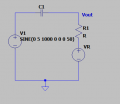
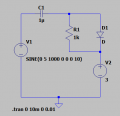
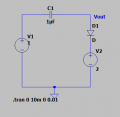
I am trying to solve a circuit with AC sources but to understand the problem i have drawn a circuit with DC
1761717705335.png

My major problem of understanding is since V1 is 1V and V2 is 2V, D1 is reverse biased or open circuit then if i measure voltage at Vout it will be V2 or 2V how? We are saying open circuit so V2 will not be connected to Vout. What i am missing here?
 

Ian0

Joined Aug 7, 2020
13,097
Are you measuring it in the real world? Or are you using perfect components and a perfect meter?
In the real world it will depend on the resistance of your meter and whether the diode has higher or lower leakage current than the capacitor.
When you get to the AC calculations the relative phases of V1 and V2 are very important.
 

Thread Starter

Vihaan@123

Joined Oct 7, 2025
220
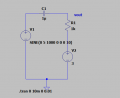
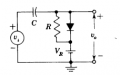
It is a textbook problem, will the output at Vout will be 0 or 2V if the initial voltage on the capacitor is 0? The actual problem is different 1761719882174.png
The circuit i modified to in post1 is not correct?
 

Thread Starter

Vihaan@123

Joined Oct 7, 2025
220
It is certainly not the same as the circuit in #4.
Ok if i analyze the actual circuit
when vi < VR the diode is reverse biased, and the circuit becomes as below
1761720605624.png
after that i am unable to proceed further i am not able to understand. What will be Vout in this condition when vi < VR?
 

WBahn

Joined Mar 31, 2012
32,702
I am trying to solve a circuit with AC sources but to understand the problem i have drawn a circuit with DC
View attachment 357840

My major problem of understanding is since V1 is 1V and V2 is 2V, D1 is reverse biased or open circuit then if i measure voltage at Vout it will be V2 or 2V how? We are saying open circuit so V2 will not be connected to Vout. What i am missing here?
Why are you saying it will be V2?

Are you assuming an ideal diode (i.e., zero reverse leakage current)? What forward diode drop are you assuming?

What about the capacitor? Is it ideal (no leakage)? Is it initially uncharged?

If so, the once you have established that D2 is not conducting, remove it from the circuit and determine Vout. As long as that value is no more than one diode drop above V2, your conclusion about the diode not conducting is correct.
 

WBahn

Joined Mar 31, 2012
32,702
Ok if i analyze the actual circuit
when vi < VR the diode is reverse biased, and the circuit becomes as below
View attachment 357843
after that i am unable to proceed further i am not able to understand. What will be Vout in this condition when vi < VR?
You need to be careful about using modified versions of the circuit since it is nonlinear and superposition doesn't hold. Doesn't mean you can't use that approach, you just have to be very careful.

Having said that, let's focus on your modified circuit. Show your best attempt to analyze what Vout will be for it. There are several ways to go about it and we have no idea which methods you know and don't know, so show us your best attempt. That will at least give us idea of what is in your toolbox. It will also help us spot what, exactly, is the source of your confusion.
 

WBahn

Joined Mar 31, 2012
32,702
A couple of things from the very start. The diode isn't in cutoff when Vi < Vr. It is in cutoff if the voltage across it is less than it's forward voltage drop (if we are using an ON-OFF diode model). Let's call that voltage Vd (you haven't said how ideal your diode is, so Vd might be zero if it's truly ideal, or it might be something like 0.7 V if it is trying to be more faithful to real diodes).

Second, you are mixing time-domain and frequency domain concepts in the same equation. Math doesn't work that way.

In your attempt to work the problem with the diode is forward biased (which implies you are using the truly-ideal model with Vd = 0 V), if your output is directly across Vr, an idead voltage source, what does Vo have to be?
 

Thread Starter

Vihaan@123

Joined Oct 7, 2025
220
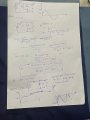
Thank you very much for the support, after your review some improvements done, i have not assumed ideal diode and considered 0.7V drop, may be i have complicated with equation 1, done some improvements but still feel some gaps in arriving the final result.
 

Attachments

Thread Starter

Vihaan@123

Joined Oct 7, 2025
220
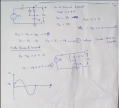
Ok now i think i understood after lot of effort when the diode is reverse biased the input voltage vi comes across the output or vout, this will be same as the charging and discharging of the capacitor using the R and C time constant. The vout will be same as vi, but my doubt is it true even if the diode is non ideal. When i simulated the waveform the bottom does not reach level of -5V.
1761795224488.png
i am worried there is diode voltage drop which should not happen and above the VR which is 3V it will be clamped to 3V + diode drop.
1761795291268.png
 

Thread Starter

Vihaan@123

Joined Oct 7, 2025
220
Why should the bottom reach -5 V?
1761880056707.png
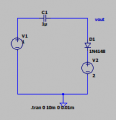
The input voltage v1(t) is directly applied across vout with capacitor C1 in between, and i assumed that capacitor will get fully charged with the max of negative of sine wave which is -5V. Why does it not reach -5V, please help.
 

MrAl

Joined Jun 17, 2014
13,667
I am trying to solve a circuit with AC sources but to understand the problem i have drawn a circuit with DC
View attachment 357840

My major problem of understanding is since V1 is 1V and V2 is 2V, D1 is reverse biased or open circuit then if i measure voltage at Vout it will be V2 or 2V how? We are saying open circuit so V2 will not be connected to Vout. What i am missing here?
For this circuit it looks like D1 never conducts. So what do you get if you call V1 a DC source of 1v, or if you call V1 an AC source with peak 1v, or V1 and AC source with peak of 5 volts? Three different answers.
 

MrAl

Joined Jun 17, 2014
13,667
It is a textbook problem, will the output at Vout will be 0 or 2V if the initial voltage on the capacitor is 0? The actual problem is different View attachment 357842
The circuit i modified to in post1 is not correct?
This circuit is different. The resistor and Vr are always in the circuit regardless of the diode conduction mode. If the output Vo gets higher than Vr then the diode conducts unless you consider it to have a drop of 0.7v and then it conducts at Vo+0.7v.
See if that helps you get some results.
 

MrAl

Joined Jun 17, 2014
13,667
View attachment 357972
The input voltage v1(t) is directly applied across vout with capacitor C1 in between, and i assumed that capacitor will get fully charged with the max of negative of sine wave which is -5V. Why does it not reach -5V, please help.
This circuit is even different than the previous two.
The value of Vout will depend on all of the components now. V2 provides a DC offset to Vout, and V1 provides an AC signal that rides on that DC offset. Vout will be AC with a DC offset.

See if you can come up with the transfer function now.
 

WBahn

Joined Mar 31, 2012
32,702
View attachment 357972
The input voltage v1(t) is directly applied across vout with capacitor C1 in between, and i assumed that capacitor will get fully charged with the max of negative of sine wave which is -5V. Why does it not reach -5V, please help.
How can a voltage be applied directly to something if there is something else in between?

The sinusoidal voltage (V1) only establishes the voltage on the left side of C1. The voltage on the right side of C1 differs by the amount of voltage across C1.

Going the other way, Vout is also determined by V2 and the current in R1.
 

Thread Starter

Vihaan@123

Joined Oct 7, 2025
220
For this circuit it looks like D1 never conducts. So what do you get if you call V1 a DC source of 1v, or if you call V1 an AC source with peak 1v, or V1 and AC source with peak of 5 volts? Three different answers.
Thank you very much for helping, the confusion with this schematic still remains
a. DC Voltage - 1V
1761974626266.png
1761974644588.png
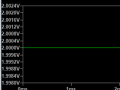
The simulation result shows 2V, that is real confusion, the diode D1 is open and the V2 - 2V power source is not connected to Vout.
In case if capacitor C1 initially uncharged at 0V and it can't raise immediately so it will remain at 0V. So expecting the Vout to be 0V.

b. Sinewave of 1V peak
In this case as well the diode is off during the entire positive and negative cycle, i expect a voltage of 0V but the output shows sinewave, not sure why. What i am missing?
 

MrAl

Joined Jun 17, 2014
13,667
Thank you very much for helping, the confusion with this schematic still remains
a. DC Voltage - 1V
View attachment 358053
View attachment 358054
The simulation result shows 2V, that is real confusion, the diode D1 is open and the V2 - 2V power source is not connected to Vout.
In case if capacitor C1 initially uncharged at 0V and it can't raise immediately so it will remain at 0V. So expecting the Vout to be 0V.

b. Sinewave of 1V peak
In this case as well the diode is off during the entire positive and negative cycle, i expect a voltage of 0V but the output shows sinewave, not sure why. What i am missing?
Keep in mind that a simulation is not as theoretical as the pure math is. In the case of a diode, here is some leakage. You can roughly model that as a somewhat high value resistor just to get a feel for what might be happening. If we had a 1MegOhm resistor in parallel to the diode, then what would we see?
With DC voltages the 2v source would dominate Vout because the cap would look like an open circuit after all exponentials died down.
With an AC voltage for V1, Vout will be constantly changing and that 1Megohm resistor across the diode will not load the output too much.
For your diode choice though that parallel resistance could be as high as 500Megohms.

Think about these ideas.
 
Top