Very basic Surge Protection TVS Circuit

Thread Starter

Tp86

Joined Sep 13, 2023
210
Hi all.

Im analysing the TSV surge protection circuit explained on this youtube video. I have 1 question about the circuit. I believe I am neglecting something simple but I cannot see what it is.

Lets make the following assumptions on the circuit:
- normal voltage of AC supply is 12V
- the zener diodes are 12V reverse drop, 0.6V forward drop
- and device (labeled D) will get damaged if it experiences more than 12.6V (or more than 13V or whatever)

I do understand that the 20V spike will go through the path highlighted in purple,
but what is stopping the same spike voltage (20V) from going through the cyan path through the device (labeled D) and thus damaging D?
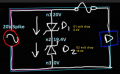
1734391228855.png

According to the video the voltage at D will be clipped at 12.6V, but I don't see how it is getting clipped as the full potential from power source seems to be connected to the load. Could someone please fill me in?
 

MisterBill2

Joined Jan 23, 2018
27,182
What is missing from that circuit is the fuse in series with the voltage source. When the TVS conducts, it does short circuit the supply and it does pop the fuse. The yootoob video "just forgot" to tell the rest of the story.
 

Thread Starter

Tp86

Joined Sep 13, 2023
210
What is missing from that circuit is the fuse in series with the voltage source. When the TVS conducts, it does short circuit the supply and it does pop the fuse. The yootoob video "just forgot" to tell the rest of the story.
MrAI gave me a good explaination this morning of why the device doesn't experience this high voltage (in most circumstances). Simply the fact that the zener diode path is very low impedance where as the load is likely to be at least a few hundred ohms. So the current through the diode path will be the vast majority. This allows for the the spike part to get clipped off and obsorbed by the diodes and the wires.

I can see what your saying about the fuse placement in series with the power supply and that is what i also thought would make sense. MrAI also made a good point though that fuses are not all that reliable, especially with high voltage as the arc created when blown allows a conductive path. If for any reason the diodes failed or where already failed the voltage spike will still go through the load

It brings to me to the question of weather or not I can test my surge protectors at home by feeding it a large voltage spike. Would the best way to do it by charging an inductor and then releasing it on on the surge protector male pins? And then using scope to probe a turned on outlet? Anyone have a better way that would not cost me an arm and a leg?
 

Thread Starter

Tp86

Joined Sep 13, 2023
210
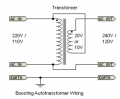
I found an answer for producing the high voltage. Simple use an AC transformer such as a 24V AC transformer and wire it in a boost configuration. Essentially wiring the conductors in series.
1734416540247.png

But now I wonder what a safe way to apply this voltage to the surge protector would be. How many milliseconds or less before I cause damage damage to diodes or wires (or is 264V too little to cause any damage for most surge protectors?) If it is fused i understand the fuse will blow from the short on the diode path. But I can buy a new one assuming its easily assessable
 

BobTPH

Joined Jun 5, 2013
11,463
That will provide a continuous high voltage, not a surge. TVS diodes do not protect against continuous high voltage.

On you original question, you have part of the answer but not all of it. Why does the low impedance help to reduce the voltage?

There is resistance in the wiring. Imagine a small resistor in series with the AC input. Now, the low impedance of the conducting TVS diode and the series resistance of your AC feed form a voltage divider, thus reducing the voltage. Inductance in the wiring also comes into play, limiting how fast current can change and dropping the voltage.

If it were not for these parasitics, it would behave much as you originally imagined, the high current would flow through both the TVS and the load.
 

MisterBill2

Joined Jan 23, 2018
27,182
There is a fundamental fallacy present in the application of the "whole house" surge protection devices that I have seen. That fallacy is that the impedance presented by the suppressor will somehow shunt the voltage spike so that it will not affect the load voltage. To achieve that effect there must be some means of limiting the mains current at the instant of the spike. None of the protection devices I have seen installed included any means to limit that current, except for the one that was connected to it's own circuit breaker, with nothing else connected to that circuit.
So the question to answer is how can a sole shunt device clamp a voltage spike from a very low resistance voltage source?? Stop and think about what the effective source resistance must be from your mains power connection. When you connect a ten amp load, how much does your mains voltage drop??? Probably not even one volt.
 

MrAl

Joined Jun 17, 2014
13,667
Hi all.

Im analysing the TSV surge protection circuit explained on this youtube video. I have 1 question about the circuit. I believe I am neglecting something simple but I cannot see what it is.

Lets make the following assumptions on the circuit:
- normal voltage of AC supply is 12V
- the zener diodes are 12V reverse drop, 0.6V forward drop
- and device (labeled D) will get damaged if it experiences more than 12.6V (or more than 13V or whatever)

I do understand that the 20V spike will go through the path highlighted in purple,
but what is stopping the same spike voltage (20V) from going through the cyan path through the device (labeled D) and thus damaging D?

View attachment 338145

According to the video the voltage at D will be clipped at 12.6V, but I don't see how it is getting clipped as the full potential from power source seems to be connected to the load. Could someone please fill me in?
Hello again,

As you can see now from the other replies, these circuit are a lot more complicated than they look because we have to take into account a lot of things that are not listed on the schematic diagram. Some of the other members here have mentioned some of these other items.

A short list here...
1. Power rating of the zener diodes.
2. Voltage and current rating of the fuse, and where it is placed in the circuit, and fusing time.
3. Impedance of the line coming in.
4. The tolerance of the load to take an overvoltage on its own.
5. The impedance of the lines connecting the load.
6. Any voltage clamping device such as surge protectors.

The power rating of the zener diodes tells us a little about how long they will last before blowing out when a surge voltage event occurs.
The impedance of the line coming in helps to reduce the maximum current that the diodes will ever see. That is often unknown. Inserting a small resistance might help, or a PTC surge rated thermistor is the usual way to go with these kinds of problems. They help to protect the diodes so the circuit remains operative throughout the event(s).

It might also be interesting to note that the transient surge protector devices found in power strips with surge protectors have a limited lifetime measured partly in the number of surge events. It is possible that they become completely ineffective after a few high surge events have taken place. It should also be mentioned that they are usually not used alone, but with an associated thermal fuse that is mounted in close proximity to the surge device so that if the device becomes too hot, the circuit opens up completely. I suppose you could do that with the diodes too.

For circuits like this that are important, meaning they have to protect expensive circuits, an actual clamp circuit is usually used. This would be a much more complicated circuit that is intended make sure the load will be protected from any overvoltage that may occur.
One that comes to mind right off is called a "crowbar circuit" which often incorporates an SCR that turns on and shorts out the load so that the load cannot get any voltage at all. The SCR has to be fast, but because there will always be some delay there would be other parts added to swamp out that surge before the SCR gets time to react. Those other parts could be those transient surge devices or zeners or something else.

If a fuse is used for high voltage, the fuse usually has to have a rating that is above the voltage rating. That's because when the fuse blows open there is a gap inside that may not be wide enough to prevent an arc from forming. The arc may have higher impedance than the fuse, but it could still allow a higher than usual voltage to get to the load.
There has also been some talk about connecting multiple fuses in series to get a higher voltage rating overall. That would mean placing say ten 1000v fuses in series to protect a 10kv circuit. Unfortunately, that does not work very well for a number of reasons so it's not a recommended practice.
 

MisterBill2

Joined Jan 23, 2018
27,182
The resistance of an arc between copper conductors is very low indeed. It seems that copper vapor is an excellent conductor.
Read the warnings about "arc flash protection" to understand the scary details. Not only is copper vapor HOT, and a good conductor of electricity, it also has a quite high specific heat capacity.
 

Thread Starter

Tp86

Joined Sep 13, 2023
210
That will provide a continuous high voltage, not a surge. TVS diodes do not protect against continuous high voltage.

On you original question, you have part of the answer but not all of it. Why does the low impedance help to reduce the voltage?

There is resistance in the wiring. Imagine a small resistor in series with the AC input. Now, the low impedance of the conducting TVS diode and the series resistance of your AC feed form a voltage divider, thus reducing the voltage. Inductance in the wiring also comes into play, limiting how fast current can change and dropping the voltage.

If it were not for these parasitics, it would behave much as you originally imagined, the high current would flow through both the TVS and the load.
Thank you for pointing this out. I neglected the voltage divider part of my analysis. It makes perfect sense now

There is a fundamental fallacy present in the application of the "whole house" surge protection devices that I have seen. That fallacy is that the impedance presented by the suppressor will somehow shunt the voltage spike so that it will not affect the load voltage. To achieve that effect there must be some means of limiting the mains current at the instant of the spike. None of the protection devices I have seen installed included any means to limit that current, except for the one that was connected to it's own circuit breaker, with nothing else connected to that circuit.
So the question to answer is how can a sole shunt device clamp a voltage spike from a very low resistance voltage source?? Stop and think about what the effective source resistance must be from your mains power connection. When you connect a ten amp load, how much does your mains voltage drop??? Probably not even one volt.
I think I see your point. In a whole house surge protector there will be a much less impedance on the load path than you would find on a GPO outlet with an ordinary appliance.

So if i understand correctly you are saying the impedance through the surge arrester path would be not many times lower than the impedance of the normal load path in a whole house surge protector condition?
 

Thread Starter

Tp86

Joined Sep 13, 2023
210
Hello again,

As you can see now from the other replies, these circuit are a lot more complicated than they look because we have to take into account a lot of things that are not listed on the schematic diagram. Some of the other members here have mentioned some of these other items.

A short list here...
1. Power rating of the zener diodes.
2. Voltage and current rating of the fuse, and where it is placed in the circuit, and fusing time.
3. Impedance of the line coming in.
4. The tolerance of the load to take an overvoltage on its own.
5. The impedance of the lines connecting the load.
6. Any voltage clamping device such as surge protectors.

The power rating of the zener diodes tells us a little about how long they will last before blowing out when a surge voltage event occurs.
The impedance of the line coming in helps to reduce the maximum current that the diodes will ever see. That is often unknown. Inserting a small resistance might help, or a PTC surge rated thermistor is the usual way to go with these kinds of problems. They help to protect the diodes so the circuit remains operative throughout the event(s).

It might also be interesting to note that the transient surge protector devices found in power strips with surge protectors have a limited lifetime measured partly in the number of surge events. It is possible that they become completely ineffective after a few high surge events have taken place. It should also be mentioned that they are usually not used alone, but with an associated thermal fuse that is mounted in close proximity to the surge device so that if the device becomes too hot, the circuit opens up completely. I suppose you could do that with the diodes too.

For circuits like this that are important, meaning they have to protect expensive circuits, an actual clamp circuit is usually used. This would be a much more complicated circuit that is intended make sure the load will be protected from any overvoltage that may occur.
One that comes to mind right off is called a "crowbar circuit" which often incorporates an SCR that turns on and shorts out the load so that the load cannot get any voltage at all. The SCR has to be fast, but because there will always be some delay there would be other parts added to swamp out that surge before the SCR gets time to react. Those other parts could be those transient surge devices or zeners or something else.

If a fuse is used for high voltage, the fuse usually has to have a rating that is above the voltage rating. That's because when the fuse blows open there is a gap inside that may not be wide enough to prevent an arc from forming. The arc may have higher impedance than the fuse, but it could still allow a higher than usual voltage to get to the load.
There has also been some talk about connecting multiple fuses in series to get a higher voltage rating overall. That would mean placing say ten 1000v fuses in series to protect a 10kv circuit. Unfortunately, that does not work very well for a number of reasons so it's not a recommended practice.
Thanks for for that. That was very interesting to read. I want to spend some time opening up some surge protectors at home so I can see what they look like on the inside
 

MrAl

Joined Jun 17, 2014
13,667
Thanks for for that. That was very interesting to read. I want to spend some time opening up some surge protectors at home so I can see what they look like on the inside
Oh that should be interesting. If you see a little cylinder with one slightly pointed end that's the thermal fuse. It has to be in close proximity to the transient surge protector. It may be connected with thermal epoxy so you don't want to break them apart if you even want to use that protector again. There could also be several transient surge protectors all wired in parallel to help shunt higher surge voltages as best as they can. They would have a higher "joule" rating.
 

MisterBill2

Joined Jan 23, 2018
27,182
Thank you for pointing this out. I neglected the voltage divider part of my analysis. It makes perfect sense now


I think I see your point. In a whole house surge protector there will be a much less impedance on the load path than you would find on a GPO outlet with an ordinary appliance.

So if i understand correctly you are saying the impedance through the surge arrester path would be not many times lower than the impedance of the normal load path in a whole house surge protector condition?
That is the way it looks. So the best choice to assure that a surge protector is able to shunt a spike is to also have an in line filter that will present a higher impedance to the effectively higher frequency of the spike. The combination of the lower impedance of the shunt with the higher series impedance of the series filter should reduce the spike quite a bit.
 

Thread Starter

Tp86

Joined Sep 13, 2023
210
There is a fundamental fallacy present in the application of the "whole house" surge protection devices that I have seen. That fallacy is that the impedance presented by the suppressor will somehow shunt the voltage spike so that it will not affect the load voltage. To achieve that effect there must be some means of limiting the mains current at the instant of the spike. None of the protection devices I have seen installed included any means to limit that current, except for the one that was connected to it's own circuit breaker, with nothing else connected to that circuit.
So the question to answer is how can a sole shunt device clamp a voltage spike from a very low resistance voltage source?? Stop and think about what the effective source resistance must be from your mains power connection. When you connect a ten amp load, how much does your mains voltage drop??? Probably not even one volt.
Thinking about this some more, I was about to say "wouldnt the severity of the risk at the load depend on which devices at the individual general power outlets have a large or small impedance. So small impedance devices may be subject to more voltage" But I am wrong, because if it there is a low impedance device connected to any power outlet, it will bring through the high potential through the load path where it branches with the arrester path so all devices will experience this potential.

That is the way it looks. So the best choice to assure that a surge protector is able to shunt a spike is to also have an in line filter that will present a higher impedance to the effectively higher frequency of the spike. The combination of the lower impedance of the shunt with the higher series impedance of the series filter should reduce the spike quite a bit.
So we would be talking about a filter with a cap (and inductor) configuration designed to filter out high frequency signals (the spike)?

I have some surge protectors at home and really want to open them but they have security screws (2 and 3 prong) so I cant open them. I'll have to order and wait to I get them before I can study :(
 

Bordodynov

Joined May 20, 2015
3,430
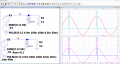
Often, illiterate people crawl into the Internet. Real voltage sources have an impedance. This impedance limits the current and this makes it possible to limit the voltage. I took a two-anode suppressor specifically designed to limit emissions as zener diodes. I have shown what happens without impedance (there is no limit) and what happens if there is an impedance (there is a limitation). Sometimes, in addition to the internal impedance, a choke or ferrite bead is added. They are effective for short spikes (emissions).ограничитель.png
 

Thread Starter

Tp86

Joined Sep 13, 2023
210
Often, illiterate people crawl into the Internet. Real voltage sources have an impedance. This impedance limits the current and this makes it possible to limit the voltage. I took a two-anode suppressor specifically designed to limit emissions as zener diodes. I have shown what happens without impedance (there is no limit) and what happens if there is an impedance (there is a limitation). Sometimes, in addition to the internal impedance, a choke or ferrite bead is added. They are effective for short spikes (emissions)
Thanks for simulation. I can clearly see the series resistance of the power supply makes a huge difference to current and voltage at the load. It is still delivering 16.5V at 70A for 4.9ms though which to me sounds quite worrying. It is 16.5*70*(4.9/1000) = 5.67J of energy I see. But opposed to 375*24*(4.9/1000) = 44.1J its not much. So 8 or so times more energy

Out of curiosity I did some research online and found the following estimates from power station to my wall outlet to determine the average resistance I should expect (here in Australia, Victoria)
  • Transmission: 0.5 ohms
  • Substation: 0.1 ohms
  • Distribution: 0.2 ohms
  • Home wiring: 0.1 to 0.5 ohms
Total resistance: 1.0 to 1.3 ohms


Oh that should be interesting. If you see a little cylinder with one slightly pointed end that's the thermal fuse. It has to be in close proximity to the transient surge protector. It may be connected with thermal epoxy so you don't want to break them apart if you even want to use that protector again. There could also be several transient surge protectors all wired in parallel to help shunt higher surge voltages as best as they can. They would have a higher "joule" rating.
Sounds fun to analyze. I am in the process of ordering the screwdrivers as I cannot open any of my surge protectors (Without brute force)
 

Thread Starter

Tp86

Joined Sep 13, 2023
210
Which, I expect, is significantly higher than the dynamic resistance of TVS diodes in breakdown.
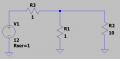
Yep I think so but I do not really not know for sure. One thing I thought of, there is no reason why a surge protector couldnt add an extra resister (R3) to add resistance before the divide occurs to further increase the ratio. So total series resistance would be 2ohm and zener path (sorry I cant draw them yet in LTSpice) would be 1ohm. So 2:1
1734519758811.png
 
Top