Basic distance emitor and receiver circuits

Thread Starter

q12x

Joined Sep 25, 2015
2,227
I should had mention from the start that i am an artist with some knowledge and experience in electronics, but I am not a real electronist.
I discover there are short wave emitor and receiver. They appear more promising, using a crystal instead of a coil. What are your thoughts about it?
Thank you.
 

DickCappels

Joined Aug 21, 2008
10,660
(Some text removed for clarity) They appear more promising, using a crystal instead of a coil. What are your thoughts about it?
Thank you.
For determining the transmit and/or receive frequency?

Crystal controlled transmitter and receivers tend to be much more stable and some services require the accuracy that can be achieved with crystal control for communications and control applications. There are still places for LC resonators but they are relatively scarce.
 

Thread Starter

q12x

Joined Sep 25, 2015
2,227
For determining the transmit and/or receive frequency?
Crystal controlled transmitter and receivers tend to be much more stable and some services require the accuracy that can be achieved with crystal control for communications and control applications. There are still places for LC resonators but they are relatively scarce.
I'm not that advanced to be too picky. I only want to be able to make them(receiver and transmitter) with gathered components and not rely on kits or special components (which are awesome but they cost money and also time until arrive, in order of months). So I want it build relatively short time- maxim in one month and be easy to make it and obtain positive results, and not experiment until my hair get white. This is my target with these circuits. And I just find out there are these short range with crystals, that may seem from the first look, a bit more to the point and not to chance as the coil ones. I am not that good at this chapter so you are free and I encourage you to baby step me into it if you want/can. I understand is a dificult subject but, all I am is oportunistic, in the sense, I find the circuit that works, I use it, and thats it. Not too much philosophy. If its more complicated than I want it to be, do explain and I will understand.
All I want is a short distance command through air. I dont really care how is done or how precise. All i care is to be fast to use (not having to pinpoint anything with precision (like a laser)) and not be triggered by ambient elements like sounds, lights, vibrations, etc.
I also had an idea about a "filter" that will permit/open only on red led color (for example). If Im making a led transmitter, I can put a red led to light. And the receiver to "filter" somehow all the ambient colors and if red is too much, then it will click. I just had the idea as an alternative to simple LED-LDR way. Im not sure how complicated is to make it.I never google it. If you have more ideas please tell me, even if i am a bit picky.
All I need are circuits that i can make, using LC or crystals or the red light way; or any other way is fine as long as its easy to build and to use.
Thank you for your reading.
 

BobTPH

Joined Jun 5, 2013
11,555
The laser diode is by far your best bet. What do you have for a sensor? The sensor can be placed at the end of a narrow tube painted black to eliminate ambient light.

Bob
 

DickCappels

Joined Aug 21, 2008
10,660
Can you program a microcontroller? That would help the receiver reject environmental noise regardless of whether you are going optical or RF.

You are probably best off using an optical link to start with -using visible LEDs or lasers. I once worked on a machine that used IR to synchronize a rotating polygon. After a few hours of trying to alight it I went out and bought some visible red LEDs (very bright LEDs were just becoming available at that time.) Alignment was a breeze when able to see where the light was going (using a white card) instead of guessing and feeling around in the virtual darkness.

You can pick up red laser pointers pretty cheaply and the same for phototransistors. Photo resistors are too slow for most data link applications. See what you can find and we can help you make something want out of it.
 

Thread Starter

q12x

Joined Sep 25, 2015
2,227
The laser diode is by far your best bet. What do you have for a sensor? The sensor can be placed at the end of a narrow tube painted black to eliminate ambient light.
Yes, I very much agree that is a BEST solution but it has a major downside: being so precise that I must carefully pinpoint it to the receiver. I want to point and click without looking, or at least with a very minimal looking, fugitive looking, absolutly no atention whatsoever. Like that, click and puf, the relay or transistor gets switched on the other side. That is my intention with this "wireless" command.
The best ideas I had so far, for the laser solution :
- to use a dark/colored filter glass, like the ones used in welding masks. But they can be made from colored plastics stack on each other,to give a reasonable shielding from ambient light. That can be easily penetrated by a laser... i imagine but i never made the test.
- as a receiver, a bunch of LDR's, like 25, put 5 on a line, and 5 on a row, forming a square of a sensor, big enough to NOT have to pin point to anything as small as 5mm as 1 ldr is having. They can be made from normal pnp transistors as well (I dont know from mosfets), if you expose the silicon inside to the light.
- on the same idea, 1 or more mini solar panel that are already big enough to not have to pinpoint too precise on them. I do not have solar panel, but I have an order on the way from ebay already for them, that is stagnating for 3 months I think. Thats why I include them as a possibility as well.
- any surface that react to the laser. I am not sure and this is more experimental or research to be done from my part. I am also asking around, like here on this forum, to you guys, maybe you know something out of the ordinary that will react in some interesting form to a laser pointer. A piece of large metal, or some strange materials that will give any form of output. Like a disturbance in the field of the metal, when the laser is pointing it, or something. I did not do my homework on this subject at all so I imagine and come with the best ideas I can think of.
 

Thread Starter

q12x

Joined Sep 25, 2015
2,227
Can you program a microcontroller? That would help the receiver reject environmental noise regardless of whether you are going optical or RF.
Yes !!! I did successfully program a PIC16F84 some 22 years ago. But nothing from that time, after. I did a couple of programs, from tutorials and myself afterward. And I still have the pickit2 programmer and also its software. I will have to remember a bunch of it but it will go faster than from the scratch. The only microcontroler I have is that PIC16f84. I do not have any other ones. I will have to buy more of them since it will come the time to use them more often than I thought I will, and I do trust them very much. On this page, what PIC do you recommend? I mean, which do you use most or figure out in time and from tests is good enough and have a balance of options on it for its size,pins and price?

You are probably best off using an optical link to start with -using visible LEDs or lasers. I once worked on a machine that used IR to synchronize a rotating polygon. After a few hours of trying to alight it I went out and bought some visible red LEDs (very bright LEDs were just becoming available at that time.) Alignment was a breeze when able to see where the light was going (using a white card) instead of guessing and feeling around in the virtual darkness.
You can pick up red laser pointers pretty cheaply and the same for phototransistors. Photo resistors are too slow for most data link applications. See what you can find and we can help you make something want out of it.
(i copy the previous comment and paste it to you here)
Laser is the BEST solution but it has a major downside: being so precise that I must carefully pinpoint it to the receiver. I want to point and click without looking, or at least with a very minimal looking, fugitive looking, absolutly no atention whatsoever. Like that, click and puf, the relay or transistor gets switched on the other side. That is my intention with this "wireless" command.
The best ideas I had so far, for the laser solution :
- to use a dark/colored filter glass, like the ones used in welding masks. But they can be made from colored plastics stack on each other,to give a reasonable shielding from ambient light. That can be easily penetrated by a laser... i imagine but i never made the test.
- as a receiver, a bunch of LDR's, like 25, put 5 on a line, and 5 on a row, forming a square of a sensor, big enough to NOT have to pin point to anything as small as 5mm as 1 ldr is having. They can be made from normal pnp transistors as well (I dont know from mosfets), if you expose the silicon inside to the light.
- on the same idea, 1 or more mini solar panel that are already big enough to not have to pinpoint too precise on them. I do not have solar panel, but I have an order on the way from ebay already for them, that is stagnating for 3 months I think. Thats why I include them as a possibility as well.
- any surface that react to the laser. I am not sure and this is more experimental or research to be done from my part. I am also asking around, like here on this forum, to you guys, maybe you know something out of the ordinary that will react in some interesting form to a laser pointer. A piece of large metal, or some strange materials that will give any form of output. Like a disturbance in the field of the metal, when the laser is pointing it, or something. I did not do my homework on this subject at all so I imagine and come with the best ideas I can think of.
(Here is the end of the pasted previous reply)

Now... the good part: is that I already have 10 laser diode pointers (from ebay) and they work normal. I also have bright leds, on various colors in SMD form and 3&5mm. I already have a couple of models of LDR's&photodiodes&phototransistors and I will have to make picture of them since I have some very strange ones I need explanation. But that is another subject.
The bad part: pulses of light, can only be counted with a PIC MCU ?
Or color of light (red for example) can only be read with a PIC MCU ?
I never worked with IR. I know there are IR LED's. But a simple LDR will detect its light? Or it needs a special LDR as well?
I should look to buy some very soon as well, and some pic's probably, depends how cheap they are. I also have to look into RF 433Mhz kit and DTMF kit from ebay as well. The price it will steep up very quickly. But they are very slow to arrive so my intention is to find and build one long before they arrive.
 

DickCappels

Joined Aug 21, 2008
10,660
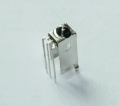
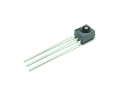
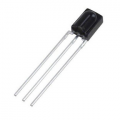
Thinking over what you are trying to do and some of the limitations you may encounter it occurred to me that a good solution might be to use an television remote control receiver such as one of these below.
1609220111812.png1609220124919.png1609220209020.png
They are great values for the money. The first (upper-left) one costs only US $0.07 high-end receivers (not shown here) can cost US$1.00.

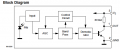
What's in a typical IR receiver:
1609220574339.png

The first thing, and it is not shown, is an IR filter. The wavelengths we see are greatly attenuated with this filter. After the IR filter there is a PIN diode to convert the light to current followed by a preamp with AGC.

The AGC circuit controls the sensitivity so that the receiver can operate over a wide range of signal strengths. The bandpass filter only passes signals from light being pulses at a specific frequency (usually 30 kHz to 38 kHz, square waves) and the output goes high when pulses of light of the correct wavelength optical window on the module. It automatically decodes on/off signals once it gets through the filtering.

Important note: All this filtering is intended to help the receiver ignore interfering signals.

The optical input angle is usually pretty large, I see 45° often because they are intended to be used for optical remote control of household appliances.

All you need to make it work is an IR LED and something to make pulses in the 30 kHz range. This transmitter can be as simple as an NE555 or even better, a microcontroller

Datasheet for a receiver: http://www.es.co.th/Schemetic/PDF/TSOP48.PDF
Microchip application note regarding IR remote contro: https://www.microchip.com/wwwAppNotes/AppNotes.aspx?appnote=en520424

As far as particular microcontrollers are concerned, with any luck one of our members with extensive PIC knowledge will comment. I can tell you that you don't need much in the way of memory or speed. The ability to clock the CPU with a crystal should make life simpler and maybe a UART would be helpful, though not necessary.
 

Thread Starter

q12x

Joined Sep 25, 2015
2,227
@djsfantasi I buy that DTMF today and I think is really intriguing component ! Is worth to play and experiment with it. I watched several youtube videos to familiarize with it and what it does, and that module by its own, is not receiving sound. It has a plug/jack on board and you must connect the sound/device to it. It will have to be a simple microphone? or an amplifier + mic board or a cellular with a tone application on it. Or a dual tone generator IC/board? I have no idea how that will have to be built...with or without an MCU. That is intriguing! The output is interesting, being binary. I think I might have to put a binary decoder or counter? if I want something more complex out of it. Or probably an MCU, like the ones I just buy. So thank you for telling me about it. It is a very interesting alternative!
- It seems there are special LDR's for the IR leds !!!!! mister @DickCappels, and the common ones are not good. I did not know that. It should be nice to work with the common ones. Eh well, im learning it now.
- I took 10 PIC for a really low price, I know they have very low capacity but... the big boss 16f84 is still a lot of money. Its good to have a good reserve of MCU in stock even if they have such high limitation in memory size. Talking with all of you here, finally made my mind and draw the line and took them. I should have done it long ago. I will even use one with the DTMF. Who knows. Im curious if I can program it with my pickit2. Hmmm. Ill have to research that as well.
- In the end I think I will use 433Mhz RF boards. I wished I could make it by hand and not having to spent such big money on them. Life.... if you want fancy stuff, you must pay, the capitalistic way.
- Though I am complaining about not having money, I did take all of these, and they seem a lot of money all summed up, but I dont have them when I need them, so its a very good acquisition to have in stock. That was the driving idea in the end.
Here is a screenshot:
 

Attachments

Last edited:

DickCappels

Joined Aug 21, 2008
10,660
The PIC 10f controllers are a good choice for something like this. There is no provision for a crystal clock unless you use a crystal with an oscillator external to the chip. I noticed that with PIC10LF322 the on-chip oscillator can be calibrated and comes factory calibrated to within 1% and that's probably good enough for simple control signalling. That may apply to other 10f controllers as well.

I bought some 432 MHz transmitters and regenerative receivers like the assemblies in the photo you posted via eBay and they were less than U.S. $1 each set (which is less than L4), delivered to me.

That band is for brief transmissions with a long interval between them. About a year ago somebody in the United States use a 432 MHz transmitter in a burglar alarm and people all around could not lock or unlock their cars. Such transmitters are regulated in most countries including the EU, so it is a good idea to learn about the laws relating to your location.
 

Thread Starter

q12x

Joined Sep 25, 2015
2,227
Here's an off the wall idea. Use DTMF but transmit the tones by modulating an LED (visible or IR). Could that be a thing?
We should look at the frequency that the dual tone is made of, and then find if a led will actually visible flicker at that frequency. If it will, then the problem is solved, since the receiver, the DTMF, will get it's signal from an ordinary LDR. It is my best guess and my plan how to proceed with it. But is a good idea !
I just look over it and the frequency is waaaaaaaaay too high for a led to flicker visible and then there are 2 frequncies superimposed (one on top of the other) and the led will just be eroneous at best. So it is not an option unfortunatly.
But it was a good question because it put me to research it. Now I know. And you too.
Screenshot_4.jpg
... and further investigation lead me to question the led frequency and google-ing a bit i find the answer into a forum, a complex and full answer that I like... so... definetly I have to test it when all will arrive...in 2(at best) to 6 months(if im lucky) - its because my country mail, the international mail is fine, but my country mail... just sucks, for the free mail postage, but is very good if you pay...so... they do it intentionally and we cant do anything about it. Eh well...
Here is that answer: https://electronics.stackexchange.c...ency-blinking-leds-and-sensor-for-that/118149
 
Last edited:

AlbertHall

Joined Jun 4, 2014
12,629
We should look at the frequency that the dual tone is made of, and then find if a led will actually visible flicker at that frequency. If it will, then the problem is solved, since the receiver, the DTMF, will get it's signal from an ordinary LDR. It is my best guess and my plan how to proceed with it. But is a good idea !
I am sure that the LED will be fast enough but an LDR probably won't be. It would need a photo-transistor.
 

Thread Starter

q12x

Joined Sep 25, 2015
2,227
I am sure that the LED will be fast enough but an LDR probably won't be. It would need a photo-transistor.
I definitely have to test it when all will arrive. I will make a picture of all the LDRs I have (I call them generically LDR but i have photothansitors and photodiodes between them as well.)
 

Thread Starter

q12x

Joined Sep 25, 2015
2,227
Im curious what these are:
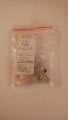
I buy them a while ago, with the thought they will be sensitive enough. But they are extremely sensitive. I am not sure they are even light sensors. I think they are IR sensors. I also open their datasheet but I couldnt figure out what they are.
PD638C https://pdf1.alldatasheet.com/datasheet-pdf/view/229850/EVERLIGHT/PD638C.html
IMG_20201230_125120.jpg
and I have some more:
these are clasic LDR GL5516, with excelent sensitivity :
IMG_20201230_125159.jpg
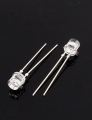
these are photo diodes. They are a bit less sensitive than the LDR.
IMG_20201230_125145.jpgthis is an img from internet of them. I dont have their series name. 1609330393941.png
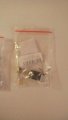
I sort them in bags by sensitivity so these are super low sensitivity- probably burned that they are almost work. But good enough if i have strong light on them. You can see a round metal transistor that I cut its head and use it succesfully as a light sensor.
IMG_20201230_125155.jpgIMG_20201230_125135.jpg
and some random ones that I could not clasify them and they just sitting there. Probably 1 or 2 are light sensors.
IMG_20201230_125310.jpg
 
Last edited:

BobTPH

Joined Jun 5, 2013
11,555
We should look at the frequency that the dual tone is made of, and then find if a led will actually visible flicker at that frequency. If it will, then the problem is solved, since the receiver, the DTMF, will get it's signal from an ordinary LDR. It is my best guess and my plan how to proceed with it. But is a good idea !
I just look over it and the frequency is waaaaaaaaay too high for a led to flicker visible and then there are 2 frequncies superimposed (one on top of the other) and the led will just be eroneous at best. So it is not an option unfortunatly.
But it was a good question because it put me to research it. Now I know. And you too.
View attachment 226251
... and further investigation lead me to question the led frequency and google-ing a bit i find the answer into a forum, a complex and full answer that I like... so... definetly I have to test it when all will arrive...in 2(at best) to 6 months(if im lucky) - its because my country mail, the international mail is fine, but my country mail... just sucks, for the free mail postage, but is very good if you pay...so... they do it intentionally and we cant do anything about it. Eh well...
Here is that answer: https://electronics.stackexchange.c...ency-blinking-leds-and-sensor-for-that/118149
To make this work, the receiver would need automatic gain control and serious filtering to avoid interference from ambient light. All of this, and more are built n to the TSOP IR detectors used on every consumer product remote.
 

bassbindevil

Joined Jan 23, 2014
922
I dont have that kind of stock or resources. I wish. I never worked with IR, or un-memorable few times.
Tell me, do I need a special receiver for an IR led, or is working fine with a LDR as well?
Really? I've rescued dead electronics from trails in the wood, vacant lots, curb sides, recycling yards, dumpsters. TVs and VCRs, CD and DVD players, satellite and cable TV boxes will have IR receiver modules; in older stuff, that'll be a small tin box with holes for the IR to get in; newer things may have a dark reddish translucent plastic component with or without metal shielding. Some laptops and computers had IrDA transmitter/receiver combos, and there were USB IR receivers bundled with Windows XP Media Center Edition computers. Remotes are cheap at thrift stores, if you don't have any old ones lying around. To test if an LED is working, look through a digital camera; human eyes can't see infrared very well, but camera sensors can (so much so that they're equipped with filters to reduce sensitivity to infrared).
An LDR might work if you add an IR filter (to reduce sensitivity to normal light), but the IR modules include an infrared filter, and (I'm pretty sure) an amplifier tuned for about 38 kHz. Your LED transmitter should be pulsed at 38 kHz as well; that could be done with a 555 timer, microcontroller, or a transistor multivibrator (among many possibilities).

[edit] I remembered another potential source of IR LEDs and receivers: mice. I'm looking inside a dead Logitech wireless mouse: the "movement" LED is infrared (it still lights, and my camera sees it), and there's an LED/sensor pair (both through-hole) for the scroll wheel. There are optical sensors in other e-waste, from floppy drives to optical disc players to VCRs. Some will be all one piece, with a slot for something to interrupt the path between LED and sensor; I don't know if you can just saw them in two, or maybe two similar sensors can be cut down so one is just a transmitter, the other a receiver. Those aren't likely to be as sensitive or work over long distances like a remote control sensor does, but if you have a fixed path, maybe lenses could improve the range.
 
Last edited:

Thread Starter

q12x

Joined Sep 25, 2015
2,227
- Really ! :]
Thank you for your answer. I already find an offer of 100 (50IR leds and 50IR sensors) from ebay. In the past I never thought to play with this types of components. I think they were pretty expensive in the electronic shop, so i said pass to them. Now is making me look too rookie, but that is the reality. Maybe i am too rookie, haha. Yes... I like how you described that the sensor have a IR filter on it. What I can manually use to transform an ordinary light sensor into an IR light sensor (foto - diode or transistor in this case, as the people here already mentioned I should use). I imagine a piece of colored glass will do the trick, right? or even dense colored but transparent plastic. Of course I will have to wait until the IR package arrives, in 2 to 6 months. Ugh. I will try to find, as you suggest here, through my "collection of forgotten stuff", if i can find a simple IR led. But my collection is very scarce.
If you look up a bit in this page, you will find i posted some photos with all my foto sensors i have. Some are dubious.
 
Top