Audio at racetrack help

Thread Starter

robismod

Joined Sep 22, 2015
378
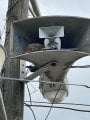
RE: Outdoor dirt go kart track. Audio has been 6 siren-type horn speakers with what looks like a Navy ship-type on one end. All are wired together to ONE 1/4” male cable that was inserted into an old Peavey powered mixing board. (Last weekend water got into the board and shut it down but a couple hours later another board was brought in and finished the night of racing.)
I’m assisting the gentleman who has been donating his time and the mixer to make the P.A. happen…
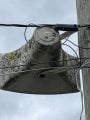
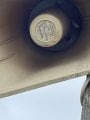
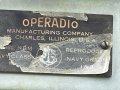
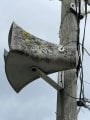
I’ve not been able to see these horn speakers up close and only found one tag on one unit that showed it as a Radio Shack unit. These 6 horns are not all matched so we’re not sure of anything other than they have “worked” in this configuration for several years. (Scary)
I can see the wire connecting them all but any connections are hidden behind a rear cap I believe.
Today, I think we’re gonna try to split them up—one line on three to left of race director box, and one line of three to right. (We can get to the line easily in the Box to split it up.)
We have several pieces of equipment we’ve used in years past in bands, so we’ll try to see how that works.
Not knowing how they’re wired I know could be an impedance nightmare, but…they have been working…somehow…lol
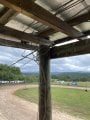
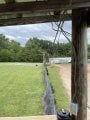
I know of the 70v systems but very little and will study it more. I’ll add a few pics…
 

Thread Starter

robismod

Joined Sep 22, 2015
378
Tell us about this equipment with photos of the front and rear.
We have a couple or three powered mixers but really too “big” for what they need. (too many channels and knobs and you know it doesn’t take much for someone to start turning knobs and get all out of whack) I’m leaning on using a cheap 3 or 4 channel passive mixer, and then run that into a power amp. Currently I have a Peavey CS1000 and a smaller Peavey 2.6 with 2 channels at 130 watts each. The other fellow was using his larger Peavey desk that had I think 600 watts per side and it was working fine—no heat issues or anything else. He did note that his SM58 XLR mic he’d have to run “wide open” to get good level at the track, but music played from an iPad came out good and loud. So, that was working but that board is too big and heavy to move and too easy for rain to get in it…(the little passive mixer can be tucked under an arm and stowed away) The power amps though, that’ll be a bigger issue to protect. Currently there is no protection from weather in the flag stand, but the other fellow is going to try and get them to put some Plexiglas panels on three sides which would help a ton…we’re going to head over again this evening and start trying some things and I’ll report back later.
 

MisterBill2

Joined Jan 23, 2018
27,809
The "70 volt" connection scheme provides two benefits, the most obvious being a lot less line resistance loss than an 8 ohm connection. The other benefit is being able toset the amount of power to each speaker independently. The down-side is the cost of the transformers, and having to know how much power should go to each speaker.
 

Thread Starter

robismod

Joined Sep 22, 2015
378
i think the 70V systems are for more distributed setup so the speakers there use transformer.
Yes I believe from what I read that would be the best method, especially with the fairly long wire runs. But for now, we’re hoping to just get it running again without any major hiccups until a better system we can put in. Positive thing is my other fellow will be there every race date so he will be keeping an eye on the system and maintaining as he has been.
 
Protecting electronic equipment from the weather, especially from rain getting inside, is indeed important. Both mixer panels and power amplifiers can suffer damage from water entrance, both from electrical voltage and current leakage and from corrosive damage.
 
Protecting electronic equipment from the weather, especially from rain getting inside, is indeed important. Both mixer panels and power amplifiers can suffer damage from water entrance, both from electrical voltage and current leakage and from corrosive damage.
Yes, protecting electronic equipment from rain and moisture is very important. Water ingress can cause electrical faults, leakage currents, and long-term corrosion, which may damage mixer panels, power amplifiers, and other electronic devices. Proper weather protection helps ensure safe and reliable operation.
 

Thread Starter

robismod

Joined Sep 22, 2015
378
Latest: we went over a couple days ago and tried to assess what we had to work with. Other fella wanted to try hooking back up to the one cable (running to all 6 horn speakers) with his board that had gotten wet. It seemed to work fine for a little while and after about 10 min. started to make some “static” or some distortion. We then decided to cut the speaker string in half and make two cables to plug in board outputs. So three on left and three on right. We then tried a couple more boards with power amps, and eventually settled on using an old Carvin powered mixer. It worked well with good volume levels but we still heard some distortion underneath. Found the first horn to the left bank wasn’t working. Disconnected it from the line and the sound cleared up. Ran it through the paces for an hour or so and no problems. The owner came by and said he would take care of the mixer himself and tote it back and forth to a little storage building nearby. And he’s going to look into some protection during events to keep moisture from blowing in on the equipment should a shower pop up.
So for now, we’re back up and running, but I’d like to soon look at replacing these old horns and wiring. I found the wire linking them to be a pair of about maybe 18-20 gauge solid core, and would break easily.
But again, for now, back up and running audio for the racing. Thanks again yall.
 
Top