I did the prototype in July 2018 on a hand wired LED matrix. I'll send you a schematic in PM. Probably won't be up-to-date because I made some changes along the way and never updated the schematic.When did you make it?
-Hello again. I just looked through all the IC's list and these are all the FF (Flip-Flop) I have:...I dont have your 74LS74...
If you have any Positive Edge Triggered 74LS series flipflop IC's in your list, try one of those instead of the 74LS74. Should work!
And by the look of it, I only have a "Negative-Edge-Triggered J-K FF" and not a Positive one.CDB472E Romania 1990 IPRS Baneasa equivalent to SN7472 Single AND Gated JK Master/Slave FF Flip-Flop with Preset and Clear
CDB476E Romania 1977 IPRS Baneasa equivalent to SN7476A Dual J-K FF Flip-Flop Asynchronous with Preset and Clear
74HCT73 High Speed CMOS Logic Dual Negative-Edge-Triggered J-K FF flip-flops with Reset 2 Gates (found as '74HC73' or 7473)
CD4013 x2 dual D FF flip-flop
CD4027 x6 Dual J-K FF Flip Flop
Unless you're really enthralled with TTL, I'd switch to CMOS. For low speed circuits, CD4xxx offers a wide supply range and lower cost. If you want speed, you can go with 74HC which will give speeds similar to 74xx and 74LSxx. If you want to mix CMOS and TTL, you can use 74HCT. TTL compatibility makes 74HCT have a narrower supply range than 74HC.I buy already this 74LS76


Im not 'enthralled ' with anything. Im simply looking for the cheapest of them all ! Its my #1 priority when I am searching to buy a component (or 10pcs). Im not biased towards anything really. I have no preference since I dont know them that well and good like you do. Im also not that good or advanced as you are into choosing and diferentiate between the technologies used. For me is fine since I am learning them. Is very good that you are telling me all of this, (actually repeating) my friend @dl324. I will try to keep in mind but sincerely when I am after the cheapest, I forget everything else; haha, you know how it is. Thank you for the correction, very cool table comparison. What is the usual name for CMOS that you are recommending? It is the 4000 series that I can see it mentioned in the table? or... something else?Unless you're really enthralled with TTL, I'd switch to CMOS.
I prefer CD4xxx and CD45xx because they have a wide operating voltage (3-15V). The main drawback, aside from static sensitivity, is their slow speed when compared to TTL.What is the usual name for CMOS that you are recommending? It is the 4000 series that I can see it mentioned in the table?
So I am I am totally screwed now that I have Negative Edge Triggered FF instead of Positive as I originally wanted.TTL did some screwy things. Like the clock inversion you observed and different pinouts.
The solution might be as simple as inverting the clock signal. It depends on the timing requirements.So I am I am totally screwed now that I have Negative Edge Triggered FF instead of Positive as I originally wanted.
How? (using a Not gate maybe?)The solution might be as simple as inverting the clock signal
That's the most obvious way. If the clock was coming from a flip flop with both polarity outputs, you could use the inverted output.How? (using a Not gate maybe?)
Thank you !That's the most obvious way. If the clock was coming from a flip flop with both polarity outputs, you could use the inverted output.
but still no effect. It might be switching still too fast ?!
No, you'll be fine with the 74LS76A, it'll just flip a few 10's of nsecs later, on the falling edge of the reset pulse instead of the earlier rising one!I believe I made a mistake.
I believe I also bought a Negative Edge Triggered IC. Aaaaah. And now I see it.
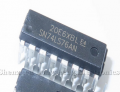
SN74LS76AN
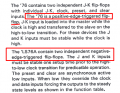
View attachment 277982View attachment 277983
When they say 'LS76A I believe they refer to this sector SN74LS76AN from the name. Correct? Im so screwed.
1- I am totally screwed now that I have Negative Edge Triggered IC instead of Positive as I originally wanted?
2- How can I slow down the original FF CD4027, not to switch this fast, to make it compatible for the diodes circuit?
Thank you.
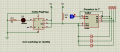
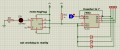
You mean like this:If you still have the NOT gate in the cct, move the 10K resistor so that it is connected to the INPUT of the gate, NOT its output, so that it pulls the diodes up to +5V.

Try the 74HCT73 instead, there may be something strange about the one you're using. Use a 74LS14 NOT gate for inverter if you have one.You mean like this:
View attachment 278024
I did it and still the LED is always on indifferent of my button press. (the led remained there from the last cct)
The 10k is directly on all those 3 diodes links now. But no difference.
Yes that was it !!! Thank you very much. Now is working.Edit: I've just noticed that you have the Reset and Clear pins tied Low: They must be tied High to work!
Im using this CDB476E which is an equivalent to SN7476. Indeed the romanian 7476 that im using right now is an equivalent to the original american 7476. Thats the difference. I bet it is a quality difference as well. I am expecting actually, the original (american) 74LS76's. But they will arrive in 1-2months from now. Which is still a Negative edge trigger; and I also ordered a couple of your 74LS74 that you first recommended which are the Positive edge trigger.Try the 74HCT73 instead, there may be something strange about the one you're using.
You are using your de-bounced switch circuit, yes? Try reducing the 10K pullup resistor to 2K2, or even 1K. This gives a much higher reset pulse, which will help with any randomness in the triggering of the flipflop as well! And do try the 74HCT73.Yes that was it !!! Thank you very much. Now is working.
BUT
it is randomly working. When I press the button
sometimes the led gets ON - sometimes stays OFF, and not switching as it should. And viceversa
sometimes the led gets OFF - sometimes says ON, and not switching as it should.
This tells me it is still some delay in play, not quite there yet but is there like more than 50%.
This is my interpretation: it is not fitting perfectly on the clock signal. Is a bit offset. How do I repair that now?
Im very happy we make it work !!! (you did it 100%) Thank you for that.
I also eliminated the NOT gate and still works exactly the same as with the NOT connected. Like someone here said, it is engaging on the negative clock edge or the positive clock edge, with the NOT or not NOT. Haha.
Im using this CDB476E which is an equivalent to SN7476. Indeed the romanian 7476 that im using right now is an equivalent to the original american 7476. Thats the difference. I bet it is a quality difference as well. I am expecting actually, the original (american) 74LS76's. But they will arrive in 1-2months from now. Which is still a Negative edge trigger; and I also ordered a couple of your 74LS74 that you first recommended which are the Positive edge trigger.
Yes, I always use it. I have the experience and I learned my lesson. For a clean impulse it is ideal. I love it and I am using it.You are using your de-bounced switch circuit, yes?
I just tried the 74HCT73. I noticed it is Not having a S (Set) pin. Only the R (Reset) that I put to +5V.And do try the 74HCT73.

I will do it now.Try reducing the 10K pullup resistor to 2K2, or even 1K.
Ok... I try it. I changed R4 from 10k to 1k resistor. It does indeed stabilizing the circuit ! I press that clock button like 50 times to catch a count to 1 as it was so obvious before. But it is always counting to 2 every time. Yah, it's an improvement !You are using your de-bounced switch circuit, yes? Try reducing the 10K pullup resistor to 2K2, or even 1K. This gives a much higher reset pulse, which will help with any randomness in the triggering of the flipflop as well! And do try the 74HCT73.