astable with single transistor?

Thread Starter

adav84

Joined Apr 28, 2012
17
I'm a hobbyist so this may sound silly or idle (not related to anything in practice), but I've been meditating on this a lot.
is %topic% possible in principle?
I know a simple astable is possible with a relay. The switch just pinches off the coil's current and there's a cap to slow the whole thing down and a resistor so that the cap doesn't discharge through the contacts' ~0R. But the relay, unlike the transistor, has hysteretic snap action. A transistor in a similar circuit will just settle at some intermediate voltage where it pinches, but not too hard. Any oscillation would be indistinguishable from the transistor's own noise. So it's just deep negative feedback but without the oscillation. Correct?
What about optocouplers?
 
Last edited:

AnalogKid

Joined Aug 1, 2013
12,127
"He is intelligent, but not experienced. His pattern suggest two-dimensional thinking."
Spock to Kirk, "Star Trek II: The Wrath Of Kahn"

Prejudices extend beyond persons. Of the three fundamental electronic components, none is less understood (by both professionals and amateurs) and therefore more reviled than the inductor.

1 - transistor
1 - resistor
1 - capacitor
1 - inductor
=
1 - blocking oscillator, patented in 1937

https://images.search.yahoo.com/sea...Gl2cw--?p=blocking+oscillator&fr=&fr2=piv-web

https://en.wikipedia.org/wiki/Blocking_oscillator

ak
 
Last edited:

AnalogKid

Joined Aug 1, 2013
12,127
Colpitts oscillator?
Hartley oscillator?
Clapp oscillator?
I like the way you think. Also - Wein, phase-shift ...

But if you parse the original question, an astable is fundamentally different from a sine oscillator, which is dynamically stable. The blocking oscillator is somewhere in the middle, in that it has some of the hysteretic circuit action of a traditional 2-transistor astable, but the output is not a saturated square wave. Still, to his general question, there are lots of 1-transistor oscillator circuits out there.

ak
 

Thread Starter

adav84

Joined Apr 28, 2012
17
Your description is not clear. Draw a circuit of what you are trying to do.
What is your definition of an "astable"?
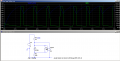
something like this, just with a transistor (or, better yet, an opto) in place of the relay

snapshot1.png

an astable, as I understand it, is an oscillator where the switching element pinches off its own control current (or the element is inverting and the output is fed back to the input) or two cross-coupled switching elements pinch off one another's control current in an alternating fashion.
 

RichardO

Joined May 4, 2013
2,270
The Schmitt trigger is somewhat different than a mutivibrator. The multivibrator gets feedback from the collectors to the bases. The Schmitt trigger gets part of the feedback from collector to base and the rest of the feedback through the emitters.

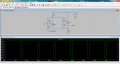
Yes, you can make an oscillator using a Schmitt trigger. By coincidance, I was very recently playing with high speed versions of this:
AAC_Schmitt_Oscillator.png
 

AnalogKid

Joined Aug 1, 2013
12,127
It just occurred to me the two-transistor Schmitt trigger and the multivibrator might be one and the same basic circuit (save for the caps and emitter resistors), just drawn differently, and BOTH are basically a differential amplifier (long tailed pair) with inputs and outputs cross-coupled. Are they?
No.

First, your astable circuit cannot help but oscillate, while your Schmitt circuit is perfectly stable and cannot ever oscillate without external feedback. That is the circuit feature that makes the Schmitt Trigger useful.

In your astable image, both emitters are hard connected to GND. In your Schmitt image, both emitters are connected together to a single emitter resistor. This is a very different form of feedback compared to the base-coupled feedback in the astable image.
(save for the caps and emitter resistors)
You are brushing aside the components that make the two circuits completely different.

ak
 

Thread Starter

adav84

Joined Apr 28, 2012
17
The Schmitt trigger is somewhat different than a mutivibrator. The multivibrator gets feedback from the collectors to the bases. The Schmitt trigger gets part of the feedback from collector to base and the rest of the feedback through the emitters.

Yes, you can make an oscillator using a Schmitt trigger. By coincidance, I was very recently playing with high speed versions of this:
View attachment 115087
You are brushing aside the components that make the two circuits completely different.
they all look vaguely like the long tailed pair, which is a differential amplifier, and all can be made _from_ an actual differential amplifier (opamp or comparator) using positive feedback (for snap action) and RC negative feedback (for oscillations)
I'm just trying to develop an intuitive mental model...
 

MrAl

Joined Jun 17, 2014
13,702
Hi,

Short story is the transistor can be used as a voltage amplifier with 180 degree phase shift so there would be various designs that should be able to oscillate. The simplest is probably the phase shift oscillator where the phase is shifted another 180 degrees from output back to input and that means it oscillates. One design uses three caps and three resistors for example possibly with some other bias resistors too. I would bet there is a circuit on the web. There is certainly one with an op amp of the same design.
You only have to have enough voltage gain to make up for the losses in the phase shift part of the circuit so that the total gain is 1 or greater. So this would work with frequencies that the transistor can handle and still provide enough gain to do that.
 

AnalogKid

Joined Aug 1, 2013
12,127
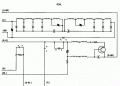
In other news - today (11/18/2016) is the 53rd anniversary of the introduction of Touch-Tone dialing in the Bell System. The original Touch-Tone pad produced two distinct sinewave tones for each button press using - - - only *one* transistor. In the realm of single-transistor oscillation, this is the still-reigning champ. OBTW, John Karlin is the guy who decided to flip a calculator keypad layout and put 123 across the top.

https://en.wikipedia.org/wiki/Dual-tone_multi-frequency_signaling

At a time when the vast majority of transistor circuit design was actually a transistorization of a classical vacuum tube circuit, Frank Boesch and Harry Heffes had a better idea. Their circuit produced two tones per button, each switchable over a one-octave range, using exactly *one* (*1*) transistor. Frank and Harry created a new oscillator circuit with an elegance that is unmatched to this day. Besides only one active device (that lone transistor buried in a group of protection devices), it had two precision-wound coils (something WE figured out last century) and no calibration or tuning adjustments - 8 frequencies, each within a 1% tolerance, that never drifted and never failed. Original keypads still work today.

ak

TouchTone-35_dial-h.gif
 

Attachments

Last edited:
Top