555 timer working in monostable mode followed by astable mode

Thread Starter

samsam0510

Joined Jan 16, 2025
9
Hi, I'm a newbie here, and this is my first post.

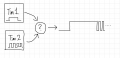
I am trying to create a signal that consists of a single pulse followed by a PWM.

I am currently attempting to implement this function using two 555 timers—one in monostable mode and the other in astable mode.

However, I can't figure out how to trigger the second timer immediately after the first timer ends.

ChatGPT suggested connecting the first timer's output to the second timer's reset, but this doesn't seem to solve the problem.

Are there any solutions or alternative approaches to achieve this?

I've attached a brief diagram of what I'm trying to do.
1737448602138.png

I would appreciate any help.
Thank you! :)

P.S.
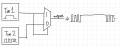
I've tried using an analog multiplexer(AMUX) like the following
1737448997686.png
however, during the LOW phase of the monstable output, the pwm signal was present which is undesirable in my situation.
 

AnalogKid

Joined Aug 1, 2013
12,081
If there is to be no PWM before the first 555 trigger, this probably will require a flipflop and gating. The ff is set by the first 555 output, allowing the PWM signal to pass when the first 555 goes low.

No schematic - traveling home with the NATIONAL CHAMPION BUCKEYES.

ak
 
Last edited:

sghioto

Joined Dec 31, 2017
8,634
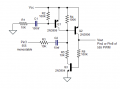
Latching circuit to activate the 555 pwm after delay pulse.
Version #1:
When the output of the mono goes Low Q2 is triggered and latched by Q3 sending Vout to activate the 555pwm.
When the mono is powered ON the output pin3 is Low. Q1 prevents Q2 from activating at this time.
1737483131621.png
 
Last edited:

crutschow

Joined Mar 14, 2008
38,392
I am trying to create a signal that consists of a single pulse followed by a PWM.
Edit: It's commonly called a "Hit & Hold" circuit for powering things such as solenoids to reduce the steady-state current.

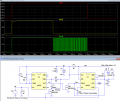
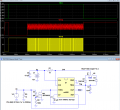
Below is the LTspice sim of a circuit that should do what you want using two 555s and two MOSFETs.
The R4C3 time-constant determines the initial output ON time.

As can be seen the output (green trace) goes high when the input control (red trace) goes high, then starts the PWM when 555 U3 output (yellow trace) goes low.
The output then stops when the input goes back low.

Edited to include needed R5 pullup.
1737489310119.png
 
Last edited:

sghioto

Joined Dec 31, 2017
8,634
Apparently I misread the pulse requirement.
Crutschow ,
Doesn’t C5 require a pull up on the drain side of M1 to discharge?
Why is C3 returned to Vcc and not ground?
 

sghioto

Joined Dec 31, 2017
8,634
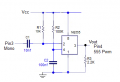
Version #3:
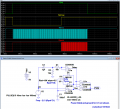
Expanded on crutschow's drawing using 2 mosfets and one 555 .
V2 ON sets the output High until M2 shuts OFF after a delay set by C3 and R3.

1737496765457.png
 

crutschow

Joined Mar 14, 2008
38,392
I see the PWM starting 65ms after triggered.
Yes, that's just an arbitrary value for the sim.
The TS needs to say what he requires.
Expanded on crutschow's drawing using 2 mosfets and one 555 .
V2 ON sets the output High until M2 shuts OFF after a delay set by C3 and R3.
Yes, I had a circuit similar to that, but went with the two 555's for better timing accuracy.
The initial delay with the one 555 circuit depends upon the Vgs(th) of M1, which has a wide variation from unit-to-unit, and is temperature sensitive.
So the tradeoff is between one less 555, and better timing accuracy of the initial delay.

The circuit I had with one 555 and a MOSFET is below:
By reversing the RC connection at the MOSFET input, only one MOSFET is needed.

1737506541729.png
 

crutschow

Joined Mar 14, 2008
38,392
And, for your amusement, here's a simple version of a Hit & Hold circuit that uses one CD4093 Schmitt-trigger NAND IC package:
It's timing accuracy is likely not quite as good as the two 555 circuit.
The two NAND outputs are paralleled to get a lower impedance drive, if going to a MOSFET gate.

1737521528440.png
 

LowQCab

Joined Nov 6, 2012
5,101
I enjoy watching these solutions getting bandied-about,
and I think I have a far simpler solution,
but since the Thread-Starter has not been back for questions and verifications,
I'm hesitant to just throw it into the mix.

Hey Thread-Starter, are You out there ???
.
.
.
 

Thread Starter

samsam0510

Joined Jan 16, 2025
9
First of all, I apologize for the late response, and I want to thank you all for the helpful advice! You are all experts.

Edit: It's commonly called a "Hit & Hold" circuit for powering things such as solenoids to reduce the steady-state current.
This is exactly the circuit I need, as I'm currently designing a low-power enabling circuit for electromagnetic brakes.
While I appreciate all the design ideas you've provided, I'm still open to other approaches, so please feel free to suggest any additional options!

Also, I'm using a power of 24Vdc but the other ICs like timers operate way less than that so I need a voltage regulator in my circuit.
However, I don't want to waste much energy by using an LDO and another buck converter circuit might be too heavy for my case.
So I'm thinking of a zener diode for a voltage regulator.
I'd like to hear your opinions about this too.

Thank you:)
 

Thread Starter

samsam0510

Joined Jan 16, 2025
9
I guess the question is how long is that initial pulse suppose to be.
To answer this question, my desired initial pulse is 0.2 seconds, and the following PWM frequency is 20kHz with a 33% duty cycle.
I'll soon attach my modified schematic based on the suggested ideas to get reviewed.

Thank you!
 

crutschow

Joined Mar 14, 2008
38,392
I don't want to waste much energy by using an LDO and another buck converter circuit might be too heavy for my case.
So I'm thinking of a zener diode for a voltage regulator.
You will waste the same amount of power whether it's an LDO, a Zener diode, or any other type of linear regulator.
The minimum power loss is always the current times the voltage drop from input to output.

The only way to be more efficient is to use a switching regulator.
 

Thread Starter

samsam0510

Joined Jan 16, 2025
9
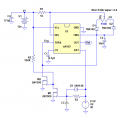
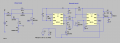
I made a circuit based on the diagram crutschow shared with us, which is the one with two timers.
I divided the circuit into two parts, the power lines, and the internal circuit, for clearance.

1737532421955.png

It works as expected!

1737533017987.png


I think now I should consider changing the zener to switching regulator, and test other suggested approaches.
Since the holding time accuracy is not crucial, maybe I can try other ideas using a single timer.

Thanks to all and I'm still open to discussions!
 

LowQCab

Joined Nov 6, 2012
5,101
"" I'm currently designing a low-power enabling circuit for electromagnetic brakes. ""

It would really help if You would explain, in detail, exactly what You expect to accomplish,
and why You feel that this function is necessary to achieving those ends.

What are these Brakes stopping ?,
a Trailer of some sort ?, or maybe some kind of an Industrial-Machine ?

Is the Circuit supposed to reduce the "apply-delay" of the Brake(s) ? or,
do You want to be able to adjust, and/or, reduce the "Park-Current" or the "Stopped-Current" ?

Do You intend to supply the Brake(s) with more
initial, or, "apply" Voltage than their Continuous-Voltage-Rating ?

How much Current do the Brake(s) require at
the Supply-Voltage that You intend to use ? ( worst-case-maximum ).

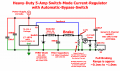
The Chip proposal that I have in mind
can safely handle ~50-Volts and ~5-Amps with a moderate Heat-Sink, ( ~50kHz Switching ),
lesser amounts may not require a Heat-Sink.
And, it can easily be set-up with a switchable "Holding-Current".
The Output is reasonably smooth DC with only a very slight Ripple.
The slight Ripple can be easily Filtered-out if deemed necessary.

If I deem it a good fit to your requirements I'll supply a Schematic.
.
.
.
 

Thread Starter

samsam0510

Joined Jan 16, 2025
9
The brake I’m using requires 24V at 0.5A to engage, but continuously operating at this level consumes excessive power and causes overheating.

Since the brake can function with approximately 7V after being engaged, I’m implementing a step-down mechanism to reduce the voltage immediately after activation.

The process works as follows: when a button is pressed or a signal becomes HIGH, 24V is applied to the brake to ensure proper engagement. After a short period, the voltage is reduced to 7V.

Instead of stepping down the HIGH-side voltage directly from 24V to 7V, I raise the LOW-side voltage from 0V to around 16–17V using PWM, by switching the MOSFET on the low side.

The initial 24V activation period doesn’t need to be precisely timed, but for reliable engagement, I suggest keeping it at least 0.2 seconds.

These brakes are used in the joints of a robotic arm and provide a fixed holding torque of about 2Nm, which is independent of the supplied voltage.
 

AnalogKid

Joined Aug 1, 2013
12,081
And, for your amusement, here's a simple version of a Hit & Hold circuit that uses one CD4093 Schmitt-trigger NAND IC package:
Close to what I would have posted, but no drafting software on the laptop. And, no, I couldn't post a hand-drawn sketch. Despite what we tell people about that being fine, mine are not fine; they scare small children.

ak
 
Top