Assistance_Zener Diode Temerature Rise Calculation

Thread Starter

mishra87

Joined Jan 17, 2016
1,063
Hello All,

I have requirement of 47V, 1W, 5% Zener diode for my application.
Current flowing through Zener is 4mA.

I have selected the part of SML4756A-E3/5A.
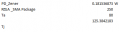
I have thermal calculation as per below. Since I have chosen SMA package the thermal resistance for junction to ambient is 250C/W.
Tj (ﹾC) = 150ﹾC
upload_2019-6-12_20-3-39.png
As I can see the junction temperature is coming 125ﹾC. So now my question is there any risk for selecting this part.
Which package is having minimum thermal resistance for junction to ambient .
What should I do, should I select for higher wattage part.

Regards,
 

crutschow

Joined Mar 14, 2008
38,322
That's a very high ambient temperature.
Where is this ambient located?

The 47V zener has a high temperature coefficient.
Will that voltage change with temperature be a problem in your circuit?
If so, depending upon the application, you could use a programmable reference (zener), such as the TL431, configured with a transistor to dissipate the heat.

Yes 125°C is marginal for good reliability.
But I think you assumption of 250°/W is based upon the unmounted part, and is too high.
The data sheet (below) states that for TL=75°C, it can dissipate 1W [where TL is assumed to be the PCB land (mounting pad) temperature].
This means the junction temperature rise to land temperature (thermal resistance) is 75°C/W (assuming a 150°C max junction temperature), so the junction temperature rise would be 13.5°C above land temperature for 0.18W dissipation.
Thus if you keep the PCB pads below 100°C you should be okay.
Using larger copper pads and traces on the PCB will help dissipate the heat and keep the pad temperature close to ambient.
Here are some articles that can help with calculating the needed pad size.

upload_2019-6-12_9-44-12.png
 

Thread Starter

mishra87

Joined Jan 17, 2016
1,063
That's a very high ambient temperature.
Where is this ambient located?

The 47V zener has a high temperature coefficient.
Will that voltage change with temperature be a problem in your circuit?
If so, depending upon the application, you could use a programmable reference (zener), such as the TL431, configured with a transistor to dissipate the heat.

Yes 125°C is marginal for good reliability.
But I think you assumption of 250°/W is based upon the unmounted part, and is too high.
The data sheet (below) states that for TL=75°C, it can dissipate 1W [where TL is assumed to be the PCB land (mounting pad) temperature].
This means the junction temperature rise to land temperature (thermal resistance) is 75°C/W (assuming a 150°C max junction temperature), so the junction temperature rise would be 13.5°C above land temperature for 0.18W dissipation.
Thus if you keep the PCB pads below 100°C you should be okay.
Using larger copper pads and traces on the PCB will help dissipate the heat and keep the pad temperature close to ambient.
Here are some articles that can help with calculating the needed pad size.

View attachment 179562
Thanks for your very good information.
I think you well interpreted the datasheet.

Actually my product operating range will be -25degC to 80degC. So I have to calculate the junction temperature for through out operating range.

I am unable to understand and sorry if silly questions i am asking.

1. How did you calculate 13.5degC value.
2 . How will you keep pcb pad below 100degC.
3. What if I select higher wattage part I.e 1.5w or 2W.

Regards ,
 

crutschow

Joined Mar 14, 2008
38,322
1. How did you calculate 13.5degC value.
0.18W * 75°C/W.
2 . How will you keep pcb pad below 100degC.
I won't. :rolleyes:
But you can read one of the articles I referenced, in the last sentence of my previous post, on PCB pad dissipation.
3. What if I select higher wattage part I.e 1.5w or 2W.
Depends upon their thermal resistance to ambient or to the mounting pad, depending upon the package type.
 
Top