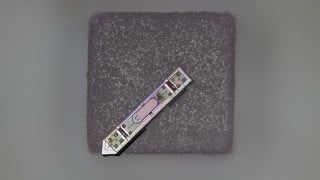
Things like that are useful for cleaning power vacuum desoldering tips. The tips tend to gunk up with burned flux residues and oxidized solder. If tips aren't cleaned frequently they can be really hard to clean with just a wire and a very carefully used drill may be necessary. Those cleaners look like they have teeth, so care would be needed to avoid damaging the centre tube or plating in a desoldering tip.
Before I looked at the link, I thought they might be lead straightening tools. These are pieces of "hypodermic tubing" (stainless steel tubing used to make hypodermic needles - quite strong and thin-walled) set into a handle. If you have to repair a board that has had the leads of the parts bent over flat on the board before soldering, such tools are very useful for lifting and straightening the lead. You don't see boards like that very often anymore, but they are a pain to deal with without such a tool.
Sometimes a stiff solder-resistant wire poked through a hole while the solder is molten can be useful. I use hard steel "music wire" for that. It is available at most hobby shops that sell supplies for model aircraft and railroads and the like. I wouldn't use the raspy cleaners for plated through holes for fear of damaging the plating.
Yes, it is often hard to remove the solder in plated through holes, so those needles which appear to be in different sizes, could help.
Just heat the hole up with your iron and then just quickly poke the needle through.Saves having to use a sewing needle, etc!
Also for cleaning desoldering tools, as mentioned.
In regards to cleaning the powered solder suckers; in my own experience, part of the problem is the back portion of the tube, that is in the vacuum chamber, can be cool enough that solder will harden there, eventually blocking the tube. You might possibly be able to clear it with one of these tools, but I've found that in this case it's sometimes not possible to ram anything through the clog and it actually works better to heat the tube with a small torch or hot air. This melts the solder plug so the solder can drain out and gets things going again.
If you haven't used a powered solder sucker, they are like magic for clearing through-holes. Flood it with flux, touch the tip to the hole, pull the trigger and presto you've got an open hole! You can often suck the pins on through hole components so clean that the part simply falls off of the board when you're done. They're also wonderful for clearing SMD pads. Add flux, touch to the pad, pull the trigger and instantly the pad is clean.
You want a stainless steel pin with low thermal capacity.
I use the end of a SS needle and embed it into the end of a wooden stick. I use this to penetrate a plated-thru hole as I apply heat to the hole.
Again - these have "teeth", they are like tiny round files. They can do damage to the plating in holes, so great care would be needed if they are used for cleaning plated through holes. I strongly recommend smooth hard steel wire, with the end carefully finished to remove sharp edges, for that purpose. It would be nice if there were smooth versions available.
"... touch the tip to the hole, pull the trigger and presto you've got an open hole!"
Never tried to desolder or clean holes on a board where the holes are connected to solid copper inner planes, have ya? I've done several. They are HORRIBLE! Parts I could remove in a few seconds on an ordinary double sided board took many minutes. Even with hot air preheating and a big tip bridging both leads (electrolytic caps), it was a struggle to get the parts removed. Then I used a soldering iron on one side of the board and my power vacuum delsoldering iron on the other to clean the holes. LONG dwell time was required prior to turning on the vacuum to get the blasted solder to melt.
But in general, power vacuum desoldering irons are a huge improvement over solder wick or the spring-powered solder suckers. I even used mine for cleaning up pads on surface mount boards prior to putting in a new part. I made special tips for the purpose.
I usually use a spring loaded solder sucker. If I have a lot of components to desolder, I use the desoldering attachment with my hot air tool. I haven't used solder wick in decades.
@ebp - I've felt your pain. Years ago I built a drone and the PCBs for the motor controllers had enough copper to flow 40+A. Assembly was bad enough, but the little bit of rework/repair I had to do on those was very painful. The copper just sucked the heat away faster than you could apply it. This was before I had hot air and powered sucker..
Note that those needles are not polished, so they may have a better ability to grab solder out of a hole in a PCB. I've used sewing needles in a pinch.
A dual heat Weller soldering gun that I bought when I was a kid had an aluminum tipped tool that came with it, I think. One was conical shaped and the other slotted to help undo and twist soldered wires without the solder sticking to it.

 Facebook
 Google
 GitHub
 Linkedin