i was born before internet and still managed to find what i wanted and in this case i did not need it either... but sites like google just make it easy nowdays. use it...
for example open google.com in your browser. click on AI (near search button), then type something like "where do i find bulbs for wien oscillator"... or click on mic and talk...
that is really all it is to it. you can also ask it to recommend how to control your oscillator without light bulb and it will get you reasonable suggestions (varistor, photoresistor, whatever).
i was born before internet and still managed to find what i wanted and in this case i did not need it either... but sites like google just make it easy nowdays. use it...
for example open google.com in your browser. click on AI (near search button), then type something like "where do i find bulbs for wien oscillator"... or click on mic and talk...
that is really all it is to it. you can also ask it to recommend how to control your oscillator without light bulb and it will get you reasonable suggestions (varistor, photoresistor, whatever).
honestly, i would love to see one or more todays youths taken for a month back to 70s for example just to see how they cope.
it would be hilarious.... ;-)
Well that's a first. I asked a perfectly reasonable question - what do you mean by pure? This is the real world, nothing is pure unless you throw a lot of time and money at it., but sufficiently pure depends on the purpose. No mockery given or intended, ever. I have helped 100s of people successfully complete projects, but if you don't want my input, that's ok too. And to your other point, regarding the other thread, what you posted was interesting but not directly relevant to the thread starter's question - that is the definition of hijacking and I politely suggested you might like to start another thread for your questions.
honestly, i would love to see one or more todays youths taken for a month back to 70s for example just to see how they cope.
it would be hilarious.... ;-)
That is an interesting hypothetical experiment. We need time travel machine first! I am pretty sure you remember how science magazines (which were mostly paper version of click baits in those days) promised how close we were to occupy Mars etc. Poor Elon Musk is still stuck in that stage. But I do not envy the tech availability of the younger generation. We had rotary phone and our phone number was 5 digits. I had everybody's phone number in my memory, even till the age of computers. The cellphones made me more passive. Now, sometimes i forget my own cell number. Technology does not give you anything without taking something away .......
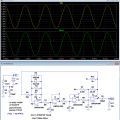
Below is the LTspice sim of a 4-stage, phase-shift Bubba oscillator which uses a quad opamp package,
The diodes soft-clip the signal to limit the amplitude of U1, and the three following RC stages, along with providing the needed phase-shifts, act as low-pass filters to give a low distortion output:
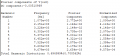
The LTspice Fourier analysis shows an output harmonic distortion of about 0.7%, which I think should be sufficient for your application.
You can use that output to drive a small IC power audio amp if you need more output current.
Well that's a first. I asked a perfectly reasonable question - what do you mean by pure? This is the real world, nothing is pure unless you throw a lot of time and money at it., but sufficiently pure depends on the purpose. No mockery given or intended, ever. I have helped 100s of people successfully complete projects, but if you don't want my input, that's ok too. And to your other point, regarding the other thread, what you posted was interesting but not directly relevant to the thread starter's question - that is the definition of hijacking and I politely suggested you might like to start another thread for your questions.
I beg to differ. I thought (and still think) it was very much in the range of "building SMPS from scratch" and I really believed keeping them under the same page would be helpful to someone if googles key words like "building my own SMPS" and Google brings them to that page. I run across many valuable lessons while reading the answers of other members, and those answers were just like that: not direct answer to the thread but very relevant, so leaned things that I did not even knew I needed to know about my intended project.
But I do appreciate your clarification. Sometimes I do get paranoid maybe?? or aging makes me more ill-tempered while some others mellow with passing of years
Sincerely
H
Sinewave oscillators are fascinating circuits. Fascinating because in theory, they are relatively simple circuits. But in practice, to get them right, with the correct specifications and proper performance, it takes a lot of effort….. but fascinating effort, nevertheless.
That is the reason for the myriad sinewave oscillator circuits. Different complexities, different performances.
One key aspect of any topology is, if your frequency is fixed, it simplifies things enormously.
Below is the LTspice sim of a 4-stage, phase-shift Bubba oscillator which uses a quad opamp package,
The diodes soft-clip the signal to limit the amplitude of U1, and the three following RC stages, along with providing the needed phase-shifts, act as low-pass filters to give a low distortion output:
The LTspice Fourier analysis shows an output harmonic distortion of about 0.7%, which I think should be sufficient for your application.
You can use that output to drive a small IC power audio amp if you need more output current.
That is perfect. Yes would be fantastic with less than 1% distortion. Just one question, is the C6 necessary if i have a center tap power supply? It is easy and I have made one for the Wien Bridge. Just takes one half of LM358 and PNP-NPN transistor. The other half of the LM358 can be used for the "super diode" as it is needed to measure inductance with basic multimeter, Overall, 3 op-Amp and couple of resistors and capacitors. Any hobbyist must have that much stuff around.
Sinewave oscillators are fascinating circuits. Fascinating because in theory, they are relatively simple circuits. But in practice, to get them right, with the correct specifications and proper performance, it takes a lot of effort….. but fascinating effort, nevertheless.
That is the reason for the myriad sinewave oscillator circuits. Different complexities, different performances.
One key aspect of any topology is, if your frequency is fixed, it simplifies things enormously.
A problem with most sine circuits that have some form of amplitude stabilization is that the transfer characteristics of the gain-varying device are what sets the output. The circuit you linked is an excellent example. The distortion is super and the frequency stability can be very good if you splurge on the capacitors, but the amplitude is set by the transfer characteristics of an LED and a photo-resistor. As those components warm up (short-term) and age (long-term), the output amplitude will vary. It will vary even more from one build to another.
Better to run the output of the rectifier stage to an opamp subtractor with a decent voltage reference (LM4040 -ish) as its reference. This would produce a control voltage that goes to the LED. The loop would need compensation for stability, but the long- and short-term output amplitude stability would be as good as the reference . . .
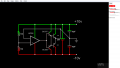
and two of the four rectifier diodes. For his application he decided he didn't need a full-blown active full-wave active rectifier, but it would improve the circuit performance.
What I would do -and that is only me- is a 50% duty cycle square wave feed it to an integrator, and a triangle wave will come out. Both waveforms will have odd harmonics but the harmonics of the trianglewave are reduced by the square of the harmonic. Then a high order monolithic lowpass filter, of which Analog Devices has dozens devices, and you’ll enjoy a beautiful sinewave.
What I would do -and that is only me- is a 50% duty cycle square wave feed it to an integrator, and a triangle wave will come out. Both waveforms will have odd harmonics but the harmonics of the trianglewave are reduced by the square of the harmonic. Then a high order monolithic lowpass filter, of which Analog Devices has dozens devices, and you’ll enjoy a beautiful sinewave.

 Facebook
 Google
 GitHub
 Linkedin