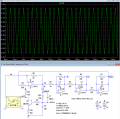
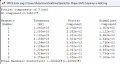
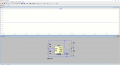
For your interest, below is the sim of a 3-stage phase-shift oscillator with a MOSFET-output, opto-isolator to perform an AGC function:
The isolated MOSFET has better bipolar signal linearity and thus lower distortion for gain control, than a JFET.
For your interest, below is the sim of a 3-stage phase-shift oscillator with a MOSFET-output, opto-isolator to perform an AGC function:
The isolated MOSFET has better bipolar signal linearity and thus lower distortion for gain control, than a JFET.
Thanks but what is this one called? For my project, an amplitude that does not fluctuate with the changes in power supply output is almost necessary, or the one who might want to build this "multimeter-based inductance meter" might end up needing a second multimeter to keep an eye on the output of the oscillator
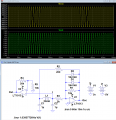
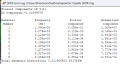
And below is a Colpitts oscillator with diode limiting, and the output taken from the tank circuit with a buffered amp to give a low-distortion sinewave.
Thanks. I will stick with the Bubba Oscillator. I will figure some way to make the op-amp based rail splitter keep voltage steady. That one design feels more resilient and sturdier and foolproof to me
I see that many beginners search for circuits with the fewest parts- this is a trap.
Those circuits can be very hard to debug, relying on subtle and complex interactions - and often they don't work at all.
A circuit with more parts can be more forgiving and much easier to troubleshoot.
I see that many beginners search for circuits with the fewest parts- this is a trap.
Those circuits can be very hard to debug, relying on subtle and complex interactions - and often they don't work at all.
A circuit with more parts can be more forgiving and much easier to troubleshoot.
I personally never try to build a super complex circuit that is posted by some random guy (like myself) on the Internet and spend hours and days even, to see if it works at all. The circuit should be simple enough to be worth the try.
Now seeing you know all about LTspice, I was wondering why imported component take ages to simulate?? I got the actual LM358 from TI and used it to see what happens. For the testing, I just put one op-amp and a follower. A .tran of 1m takes about 10sec.
I personally never try to build a super complex circuit that is posted by some random guy (like myself) on the Internet and spend hours and days even, to see if it works at all. The circuit should be simple enough to be worth the try.
Build this one, it provides a beautiful sinewave at 1 kHz and is simple using an LM386 power amp instead of the usual op amp, i have it built on breadboard and have been using it until i get my new function generator delivered today.
Hi,
In several of the circuits presented above, the signal amplitude is controlled using silicon diodes.Keep in mind that the resistance of these diodes changes considerably with temperature.Therefore, it will not be easy to obtain a signal with a stable amplitude.To obtain a stable amplitude for the AGC circuit, it would be necessary to use a precision rectifier.
I was wondering why imported component take ages to simulate?? I got the actual LM358 from TI and used it to see what happens. For the testing, I just put one op-amp and a follower. A .tran of 1m takes about 10sec.
the resistance of these diodes changes considerably with temperature.Therefore, it will not be easy to obtain a signal with a stable amplitude.To obtain a stable amplitude for the AGC circuit, it would be necessary to use a precision rectifier.
The amplitude should remain constant for the duration of the test the OP wants to do.
If amplitude stability with temperature change is needed then yes, a more temperature insensitive design would be needed.
Sure there is - a long time-constant R-C network in front of the gate, which is just a part of better control signal filtering. If you can tolerate a 1 or 2 second startup delay, that's a 2000:1 difference in frequency, and that is a lot of attenuation.
Build this one, it provides a beautiful sinewave at 1 kHz and is simple using an LM386 power amp instead of the usual op amp, i have it built on breadboard and have been using it until i get my new function generator delivered today.
The phase-shift and bubba oscillators are much more "straightforward" than a Wein.
3 R-C Stages: Phase-shift Oscillator - 60 degrees of shift per stage
4 R-C Stages: Bubba Oscillator - 45 degrees of shift per stage
Sure there is - a long time-constant R-C network in front of the gate, which is just a part of better control signal filtering. If you can tolerate a 1 or 2 second startup delay, that's a 2000:1 difference in frequency, and that is a lot of attenuation.
It is Wien pronounced "veen" Wien | Übersetzung Englisch-Deutsch
My gut feeling tells me that the 3 RC and 4 RC are more robust. IDK why, but just feel more confident about them. But for my learning I would appreciate if you could provide a full schematic for that " time-constant R-C network" implementes in the Wien Bridge
Hi,
In several of the circuits presented above, the signal amplitude is controlled using silicon diodes.Keep in mind that the resistance of these diodes changes considerably with temperature.Therefore, it will not be easy to obtain a signal with a stable amplitude.To obtain a stable amplitude for the AGC circuit, it would be necessary to use a precision rectifier.
Hi,
In several of the circuits presented above, the signal amplitude is controlled using silicon diodes.Keep in mind that the resistance of these diodes changes considerably with temperature.Therefore, it will not be easy to obtain a signal with a stable amplitude.To obtain a stable amplitude for the AGC circuit, it would be necessary to use a precision rectifier.
Thanks for bringing that up. The " precision rectifier" is actually part of the inductance meter setup. A 3rd op-Amp is going to do the rail splitting and super diode, or as you call it precision rectifier. Can a 500Ω potentiometer be placed in series with R3, and the user can fine tune the amplitude to a fixed, say, 3v by taking advantage of the precision rectifier?? Does it make sense?

 Facebook
 Google
 GitHub
 Linkedin