Any ideas why this fuse blows?

Thread Starter

nickmms

Joined Jan 2, 2014
47
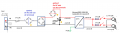
Looking for some advice/ideas why the 5-amp resettable fuse trips sometimes and the Meanwell dc to dc gets hot and the cable from one of Led leads was hot also. This is a random problem
I have bench tested the bridge rectifier and tests ok.
The 2 Leds seem to draw the right current 1.9 and 0.6amps 24VDC
3.7amps AC measured on the bridge rectifier
I have had the leds on for 4 hours and everything tests OK and nothing really gets too hot.
I thought it may be the Led lamp failing (60 watts) but I would have thought the quick blow fuse 3 amp would trip first.5 amp fuse.png
Thanks
 

bertus

Joined Apr 5, 2008
22,885
Hello,

The input of the dc dc converter is a rectified sinewave and has a huge ripple.
Place a capacitor after the rectifier, to smoothen the input voltage.

Bertus
 

Thread Starter

nickmms

Joined Jan 2, 2014
47
The input of the dc dc converter is a rectified sinewave and has a huge ripple.
Place a capacitor after the rectifier, to smoothen the input voltage.
OK thanks
we have been using the same circuit for a couple of years and we did not seem to have the heat/ tripping problem until recently so i thought it was maybe either the rectifier/ 60watt led /dc-dc convertor failing.
If it was the led failing and drawing too much current wouldn't the 3 amp glass fuse blow before the 5 amp one?
 

sagor

Joined Mar 10, 2019
1,046
Remember that a 24VAC rectified will produce 33.9VDC peak spikes. Your Meanwell device has a maximum input rating of 33.6VDC. That is real close, especially if your 24VAC is a bit high, you could be exceeding the safe input voltage to the DC-DC converter. Verify what the 24VAC voltage really is, try to have it a bit lower if possible.
Inrush current for the Meanwell is 5A at 24VDC, if you are exceeding that, your 5A fuse may not be quite high enough. It is possible with such a high starting voltage (33.9VDC) your inrush current is much higher.
 

Thread Starter

nickmms

Joined Jan 2, 2014
47
Remember that a 24VAC rectified will produce 33.9VDC peak
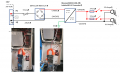
measured the output of the rectifier no load 32VDC and load 29VDC but the transformer I use for testing is different to the one we use in the field. The 24VAC we use in the field is off a 1000V so the peak output could be higher than the ones I just measured.
Also, The 24VAC in the 1000 V power pack is neutralized, does this cause any problems with the bridge rectifier?
What would be the best (easiest) way to drop the peak voltage down then?
thanks

1kv.png
 

Tonyr1084

Joined Sep 24, 2015
9,744
I would have thought the quick blow fuse 3 amp would trip first.
If one lamp is operating close to 3 amps then neither the 3 or the 5A fuses would blow. But if you're operating BOTH lamps, let's assume 2.75A each, the 5A fuse would not be able to carry the whole load.
measured the output of the rectifier no load 32VDC and load 29VDC but the transformer I use for testing is different to the one we use in the field.
AC voltage is measured at RMS. That means the usable voltage of an AC source is 0.7071 times the peak voltage. The top 0.2929 volts is unusable as an AC voltage. When rectified you may still get the same usable voltage. But when run through a filtering cap that voltage can be (1÷0.7071) 1.4142 times the starting voltage. So as sagor has stated your 24V can have a peak waveform of (24 x 1.4142) = 33.941 VDC. Even though it's unusable voltage without filtration, it's still a spike that can generate a lot of heat and excess current.
One caveat: The rectifiers will have a slight "SLIGHT" voltage drop of about 0.6V each. And with an AC source only two of those rectifiers are conducting at any given moment. So 24VAC rectified (through two diodes) might be 22.8V rectified. But even then you still can't control the AC in voltage. It may vary from place to place. I once took a 12V transformer and built a filter for it to power a car radio. When plugged in at home the radio played. But when I took it to work with me it wouldn't play. The reason was over voltage. At home I may have had 110VAC but at work 120VAC. A 12VAC transformer isn't a transformer that delivers 12 volts it's a 10:1 transformer. So if you power it with 100VAC in you will get 10VAC out. (ignoring factors such as efficiency). Put 140VAC into it and you get 14VAC out.

Not only do you need to consider the current draw of the lamps you also need to factor in the current being used by the converter. Perhaps your lamps are drawing only 2.25A each. That's 4.5A total draw FROM THE CONVERTER. I haven't looked up the specs on your Maxwell so I could be wrong, but if your lamps are drawing 4.5A and the Max is drawing 0.6A - you're over your fuse rating.

One other thing in your drawing: Your voltage is 1KV. I suppose that can be a possible voltage source, but it makes me wonder about frequency. A high frequency can further affect how your circuit works. If your Max is seeing 24VDC with significantly fast ripple, and since buck/boost converters also run on high frequency, perhaps you're getting some sort of feedback, which might be where the excess heat is coming from and possibly blowing the fuse.
 
Last edited:

MrChips

Joined Oct 2, 2009
34,628
How does your meter measure any varying voltage? There are differences in how the meter takes its measurement.
It could be measuring average DC, fake "RMS", or true RMS.
 

Thread Starter

nickmms

Joined Jan 2, 2014
47
How does your meter measure any varying voltage?
I have used 2 MMs now one Klein CL390 True RMS Fluke 179 True RMS .They give approx. same output
3.0 to 3.5 Amps ac to rectifier Output from rectifier 2-2.2 amps DC.
I think the amps differ when I measured after the LEDS were on for a awhile and not on for long
25/24 VAC 33VDC no load 30VDC load
One LED 60 watt and is meant to draw 1.9amps at 24V and the other 20W about .6amp at 24V
 

Thread Starter

nickmms

Joined Jan 2, 2014
47
If one lamp is operating close to 3 amps then neither the 3 or the 5A fuses would blow
HI Tony
I have measured: One Led draws 1.9amps and the other only 0.6amps each going through a switch and 3amp quick blow fuse
and 3-3.7amps AC at the rectifier.
 

MrAl

Joined Jun 17, 2014
13,667
For something like this you have to be able to measure the inrush current. That sounds like what is tripping the 5 amp fuse.
Inrush current is harder to measure though because it can be for only a short time. You might need an oscilloscope.
You can try adding a small series resistance like 1 Ohm just to see if that helps.

The only question then is why this start happening all of a sudden. That usually means something changed and it's hard to tell what it was without doing more measurements. If you are not using the EXACT same setup in the lab for testing as in the field though, that's a bad way to start. You have to get the right setup first so you can make meaningful measurements. If impedances differ that could make a BIG difference, and this can include something as simple as longer wires vs shorter wires with something like this.
 

Thread Starter

nickmms

Joined Jan 2, 2014
47
If you are not using the EXACT same setup in the lab for testing as in the field though, that's a bad way to start.
Yes I know however I thought i might have been able to replicate the problem using just the 24VAC transformer if the rectifier, meanwell or led had gone bad.
It is a bit hard to use the exact field setup as we dont have a 1000V.
As mentioned it all has been fine for the last 2 years and nothing has been changed from the original setup
 

Thread Starter

nickmms

Joined Jan 2, 2014
47
Try installing a poly fuse.
I think the resettable fuse is doing its job though.
In the field the meanwell seemed to get hotter than normal and the led cable also appeared hotter than normal so i would have imagined something is drawing more current than previously. the fuse might have tripped after say 5 hours powering the 2 led lights.
 

Rod777

Joined Aug 24, 2019
11
I am a little curious here. Does the wire that gets hot before or after the meanwell. If before, then there seems to be a problem with the meanwell. If after, then the load is the problem. Is it possible to see the circuit of your meanwell device.?
 

MrAl

Joined Jun 17, 2014
13,667
Yes I know however I thought i might have been able to replicate the problem using just the 24VAC transformer if the rectifier, meanwell or led had gone bad.
It is a bit hard to use the exact field setup as we dont have a 1000V.
As mentioned it all has been fine for the last 2 years and nothing has been changed from the original setup
Some tests you have to do on-site. There is no way around it, sometimes.
I had to fly to different places in the US and Canada to do testing and redesigns on-site, and that was expensive but necessary.
 

panic mode

Joined Oct 10, 2011
4,866
you are killing that DC/DC converter by bring DC that is pulsed and at upper voltage limit of what its input can handle. i would definitely consider adding a filter capacitor to the input 4700-10000uF 63V will do nicely if frequency is low (50-60Hz). also you may want to drop the voltage a bit. i don't see transformer taps but you seem to like bridge rectifiers and probably have spare one kicking around. if you add it into circuit, that will drop another 1.2-1.5V.if the input range is 18..33VDC, you want to stay closer to the middle of that range. otherwise any transient or grid or load balance may sink your canoe.
1763136941847.png

about wiring additional rectifier, you can simply bring output of previous rectifier to AC terminals and get DC out. or you may throw a monkey wrench and only use two terminals. or if you want to mess with people, or pretend you did something, short the two unused terminals. personally i do not like naked terminals... i would rather put insulated spade connectors on them but without any connections.
 

Tonyr1084

Joined Sep 24, 2015
9,744
Some tests you have to do on-site. There is no way around it, sometimes.
You reminded me of a case where in the field problems existed but on the test bench the failure could not be repeated.
I was working for a burglar alarm company. One client had a complaint that every time she set the alarm it would trip into Panic mode. We tried everything including changing the control wires from the key pad to the alarm panel. Nothing worked. EVEN when we were at the clients home, every time we set the alarm it would function normally. In the field we could not trigger the failure. So one last time before leaving I turned the key once more. BANG! There it was - panic mode. That was when we took the panel out and replaced it with an older unit. Built a pulse device - don't remember how - to bench test the panel. Tested it for a month, day after day, all day, all night, and never did it trip into panic mode. After the first week we began to think since we were switching it every second or two that maybe switching it that often was the reason why we couldn't find a failure. We reset the pulse timer to switch once every 10 seconds and still no failure. Set it to switch every 5 minutes (time is approximated) and after a month of testing there was still no failure.

Finally, we took the panel back to the home owner and set it back into service. Remember, we changed the key pad and the wiring. As soon as we installed it - it tested perfectly. An hour later we got a call and it was in panic mode. Something was causing the issue with that panel. Eventually we hit upon the idea of using a capacitor as a filter. The pulses were DC so a capacitor might buffer the set signal. That didn't work. Not until we added a series resistor and took the trigger pulse from the resistor/capacitor junction. THAT was the end of the problem. Years later there was still no problem, at least none that I was aware of when I worked for the company.

So quoting MrAl, "Some tests you have to do on-site. There's no way around it, sometimes"
 

Tonyr1084

Joined Sep 24, 2015
9,744
Essentially your drawing is correct.
View attachment 358874
But adding some diodes in series with the power will drop the voltage a bit but the addition of a filter cap will up the voltage significantly.
View attachment 358875
Assuming option 1, I will assume the dashed line from + to - would be a jumper ? ? ? If so, this would drop the voltage by 2xVf (two times the forward voltage of the diodes) since only two will be in conduction at any given time. Assuming 0.6Vf two times that would be 1.2Vf dropped from the AC signal.
Assuming option 2, if the dashed line is a jumper - it would do nothing. However, in option 2 you would have four diodes conducting. I don't know if paralleling two diodes would lower the Vf or add to the Vf. Jumpering them shouldn't change anything. Two diodes in parallel I don't think would further the voltage drop. So if that's the case then you'd still have essentially two diodes dropping their forward voltage.

The math:
Without the filter cap:
24VAC - 1.2Vf = 22.8V DC. With the addition of either option, 1 or 2, you drop an additional 1.2 volts. You're now down to 21.6 volts.
With the filter cap:
At 21.6VDC the cap would increase the voltage to 34.55 volts DC. You're still over the operating voltage of the Meanwell.
 

panic mode

Joined Oct 10, 2011
4,866
At 21.6VDC the cap would increase the voltage to 34.55 volts DC. You're still over the operating voltage of the Meanwell.
34.55? i think there has to be a typo.

24V -1.2V = 22.8V
and
22.8V*1.41 = 22.8V/0.707 = 32.1V

and if needed one can use two bridge rectifiers.
24V-2*1.2V = 21.6V
21.6V*1.41 = 21.6/0.707 = 30.55V

both values are inside the input spects for the DCDC converter. and - those are values with no load.

with load this would reduce the voltage...

so using only capacitor and no additional rectifiers (no option1 or option2), DC voltage would be about 31.8V.
using "option1" once would drop that voltage to 30 V
using two times "option1" would drop it to 27V.


also noticed mistake in my post- shorting DC terminals of the rectifier is option1 is required. it is optional for option2.
 
Top