Marquee Lights - Looking for ideas—can this be done realistically?

Thread Starter

robismod

Joined Sep 22, 2015
343
Here we go again!
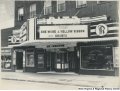
I come from a small town in WV, and have wonderful memories of the local theater in the 60s and 70s. The entrance had the huge marquee with two angled display sides, some neon, and those mesmerizing chasing white lights around the displays and above your head underneath! Several years back the marquee fell into disrepair and had to be torn off, and the theater closed. A few years later a local resident bought the property and reopened it, but the newer versions of a marquee just pale in comparison . (My opinion )
Now, I’ve thought about it for some time, and I believe it could be recreated, or at least a similar version. The technology and products today I believe could make it doable, and hopefully affordable. (Not a lot of money in the town but the theater has been doing pretty well for some time and stay afloat.)
Those “chasing lights”? We’ve had them cheap for years now with home Christmas lights and such. And LED bulbs are so much better too. (Sometime after the original marquee was torn down, I ended up with the motor unit that routed power to the bulbs—what a monster it was…big and round, heavy, motor spinning contact arms around to light particular segments.) So, I’m asking for ideas on how the elements similar to the original might be done today, and be affordable. I’ll add some pics. Thanks in advance.
first pic is the original.
 

Attachments

Externet

Joined Nov 29, 2005
2,624
Last edited:

ElectricSpidey

Joined Dec 2, 2017
3,312
If all you wanted to do was reproduce the chasing lights "Las Vegas" effect, that would be easy with just a 555 and buffers to drive the LEDs.

If you want more complex patterns, then I would suggest using some 3 watt "NeoPixels" with a micro controller, if programming is an option.

You might also be able to find some commercial units.
 

BobTPH

Joined Jun 5, 2013
11,463
If all you wanted to do was reproduce the chasing lights "Las Vegas" effect, that would be easy with just a 555 and buffers to drive the LEDs.
I think you would need shift registers as well, with one bit per light. And, to get that “olde time” look, I would use mains powered LED bulbs and opto-coupled triacs for the buffers.

If you are good with programming a micro, WS2811 chips could make up the shift registers, with one needed for each 3 bulbs.

It’s going to cost a buck or two per bulb (for parts.)
 
Last edited:

Thread Starter

robismod

Joined Sep 22, 2015
343
I think you would need shift registers as well, with one bit per light. And, to get that “olde time” look, I would use mains powered LED bulbs and opto-coupled triacs for the buffers.

If you are good with programming a micro, WS2811 chips could make up the shift registers, with one needed for each 3 bulbs.

It’s going to cost a buck or two per bulb (for parts.)
Whoa!! A bit above my head…(ok…a LOT above my head LOL) but I’ll try and do a little searching and learn about this.
 

Thread Starter

robismod

Joined Sep 22, 2015
343
If all you wanted to do was reproduce the chasing lights "Las Vegas" effect, that would be easy with just a 555 and buffers to drive the LEDs.

If you want more complex patterns, then I would suggest using some 3 watt "NeoPixels" with a micro controller, if programming is an option.

You might also be able to find some commercial units.
Yea, I think “Las Vegas effect” would describe it. 555 I remember something about it being a timer of sorts. For several years I’ve thought about those chasing Christmas lights, and many times thought how cool to have that task ability for cheap, and why couldn’t it be upscaled a bit for a bigger use? I would think it would have to be much cheaper than the old analog technology that did it. Of course I’m sure it could get very expensive still with some of the more glamorous ones today, but I’m just thinking of how to recreate it simply as it was all those years ago. That “effect”. And finding ourselves enthralled with our eyes chasing the chasing. Anything fancier and I’d have to find someone to take it to the next level. ☺
 

MisterBill2

Joined Jan 23, 2018
27,159
Certainly the marquee effects can be duplicated with modern technology, possibly cheaper, and certainly more reliably than the older mechanical schemes. And not a single 555 device involved.
BUT one gnawing question arises: What would the Return On (the) Investment?? For most of us there needs to be a financial return of some size to justify an investment. And those with enough wealth to not need any ROI to justify what they spend on fun things sre probably ( words ) and would not donate the funds.
But finding the "best" scheme to duplicate "the marquee effect" could be an interesting design exercise for a collection of those folks with the required skills sets.
 

Thread Starter

robismod

Joined Sep 22, 2015
343

Thread Starter

robismod

Joined Sep 22, 2015
343
Certainly the marquee effects can be duplicated with modern technology, possibly cheaper, and certainly more reliably than the older mechanical schemes. And not a single 555 device involved.
BUT one gnawing question arises: What would the Return On (the) Investment?? For most of us there needs to be a financial return of some size to justify an investment. And those with enough wealth to not need any ROI to justify what they spend on fun things sre probably ( words ) and would not donate the funds.
But finding the "best" scheme to duplicate "the marquee effect" could be an interesting design exercise for a collection of those folks with the required skills sets.
An interesting take for sure…and ROI? In this case I don’t think an actual figure could be applied—small community, weekend viewings, poorer state, etc. But for what it’s worth, I believe a great “attention getter” would entice more locals to notice and at least get them in the doors to give it a try. And that’s worth something.
I know the owner, who grew up here, and has done very well for himself and others. And I believe he and his local family organization would tend to dive in a little deeper for anything that betters the community in some way. Business smart, but have heart also, I have seen. IF…I could present something attractive and exciting, and affordable within reason, I believe it could happen…
 

Thread Starter

robismod

Joined Sep 22, 2015
343
Let me explain myself and intentions a little better. Remember, I’m thinking “basic” to start with, and build on that. By “basic” I mean along the lines of: frame of wood, maybe 10’ or so wide, then white plastic sheets which would be back-lit, and some form of grid lines from which the old-style of letters could be hung. Or, one of those lit signboards on wheels that can be seen alongside roads in front of stores could be inset. And then strings of chasing LED bulbs could be be applied around the signboard. See what I mean? That’s pretty basic . Now, it should be easier to make improvement suggestions. Thanks so much for participating with me.
 

xox

Joined Sep 8, 2017
936
Yea, I think “Las Vegas effect” would describe it. 555 I remember something about it being a timer of sorts. For several years I’ve thought about those chasing Christmas lights, and many times thought how cool to have that task ability for cheap, and why couldn’t it be upscaled a bit for a bigger use? I would think it would have to be much cheaper than the old analog technology that did it. Of course I’m sure it could get very expensive still with some of the more glamorous ones today, but I’m just thinking of how to recreate it simply as it was all those years ago. That “effect”. And finding ourselves enthralled with our eyes chasing the chasing. Anything fancier and I’d have to find someone to take it to the next level. ☺
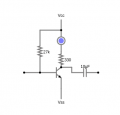
You'd probably have the best luck going with something along the lines of what has already been suggested. Having said that, there is a really easy way to create a chaser effect with just a single transistor, a capacitor, and a couple of resistors (per LED that is). The biggest drawback to that route however is that the speed would be impractical to adjust once the entire thing has been constructed. There also would likely be slight timing issues due to error-tolerances of the components, not to mention the effect of changes in temperature and whatnot.

flash.png

That's the basic gist of it. The LED's resistor can be calculated using the equation R=(Vcc-Vf)/Ic, where Vcc is the input voltage, Vf is the forward voltage of your LED, and Ic is the current required by the LED. The other resistor and capacitor determines the flash rate.

Anyway you'd just chain the capacitor of one to the base of the next transistor and so on. (For tuning purposes you'll need to chain a minimum of two of these "modules" together in order to see what the flash rate is going to look like.) Of course you'll need to make sure that the transistor can indeed drive the LED you have selected to use, that the overall circuit can handle the total amount of watts being driven through it, etc.
 

Ya’akov

Joined Jan 27, 2019
10,226
Classic electromechanical marquee chasers used three channels for the lamps:

+------------------------( Channel A lamps )----+
HOT (120 VAC) ----[ FUSE ]----[ SW ]----+ |
| |
| +----[A CONTACT]-----+
| |
| +----[B CONTACT]------------------( Channel B lamps )
| |
| +----[C CONTACT]------------------( Channel C lamps )
|
+----( Synchronous Motor )----+
|
NEUTRAL --------------------------------------------------------------+

The lamps were wired so they were fed:

A B C A B C A B C...

To achieve the same visual effect the same pattern should be maintained.

My approach would be with appropriately rated MOSFETs and a small MCU (e.g.: ATTiny85A) but the same could be accomplished with a 555 and a shift register.

Which MOSFET to use will depend on the load—that is incandescent or LED, the current requirements based on the chosen device and the number of them. Obviously, you will want a multiple of three to make it neat.

Alternative approach is to use an MCU and an addressable LED string (WS2812B or similar). You would probably want RGBW (dedicated white emitter) and not just RGB as the latter produces a very poor white which is what you most likely want to use.

This setup would allow for a lot of flexibility including use of PWM dimming and color—though that might not be needed at all.

One last thing worth mentioning is the large number of controllers readily and cheaply available (like this one). A suitable RGBW string and the controller would do what you want out of the box. The exact best choice for controller/string will depend on your particular application but I would guess you'd want a bright, low density string on wires rather than the flexible PCB type.
 

MisterBill2

Joined Jan 23, 2018
27,159
There are, or at least were, commercially available "Light Chaser" driver systems available. I came across a couple of them in a remodeling project at a commercial "GYM" that had changed hands. That setup had a five light sequence rather than the three light sequence described by "Y". The main downside of that scheme was that it required a separate supply for the lights voltage, and so it was a bit complex. BUT a similar scheme could be created using available solid state relays and mains powered lighting, and a simple logical ring counter circuit. Using a shift register scheme it could be done with a relatively small number of components,
 

BobTPH

Joined Jun 5, 2013
11,463
The lamps were wired so they were fed:

A B C A B C A B C...
Ah, yes, that is far simpler than what I was thinking of. If this is going to be visible in daylight, you need some pretty hefty LEDs.

I would go with line powered LED bulbs and 3 solid state relays( SSRs). That circuit could be built for well under under $100. A 555, 4017, a few diodes, the three relays and a few passive components.
 

BobTPH

Joined Jun 5, 2013
11,463
If you are more mechanically oriented, a small gear motor, cam and three lever switches plus the SSRs.

I love the idea of this project, and I hope we can help you complete it.
 

MisterBill2

Joined Jan 23, 2018
27,159
There may be "an issue" with some LED bulbs, in that some of them do not illuminate and extinguish as fast as the incandescent types. I have observed this difference between different brands of LED bulbs.
 

BobTPH

Joined Jun 5, 2013
11,463
There may be "an issue" with some LED bulbs, in that some of them do not illuminate and extinguish as fast as the incandescent types. I have observed this difference between different brands of LED bulbs.
True, that could be a problem. Ironically, cheap ones that simply use a capacitor dropper would probably be the best in that respect.

I favor standard shaped bulbs because of the retro look, but, if they don’t work, they don’t work.

Also the cost of a low voltage DC supply for that many LEDs would be significant.
 
Top