How efficient are LED strip lights?

Thread Starter

oz93666

Joined Sep 7, 2010
742
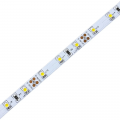
These are very popular as light sources , a self adhesive tape that can be cut to length where indicated , the led chips are small and spread out , which should result in high efficiency , but there's a resistor in series with each bunch of 3 leds (for a 12v strip) , this resistor is wasting power, but how much? A 12V strip can be operated on lower voltage , light stops being emited at about 6V, so this must mean the back EMF from the chips is 6V. Does that mean half the input power is wasted in heat in the serries resistor?
1776432658475.png
 

BobTPH

Joined Jun 5, 2013
11,480
A 12V strip can be operated on lower voltage , light stops being emited at about 6V, so this must mean the back EMF from the chips is 6V. Does that mean half the input power is wasted in heat in the serries resistor?
No, there is no back EMF involved. LEDs require a minimum voltage to operate, that is why you see no light at 6V. Reducing the voltage reduces the power used but also the light output, so it does not translate into added efficiency the way you think.

To determine the efficiency, measure the voltage across the 3 LEDs, excluding the resistor when operated at 12V, then divide by 12.
 

WBahn

Joined Mar 31, 2012
32,745
These are very popular as light sources , a self adhesive tape that can be cut to length where indicated , the led chips are small and spread out , which should result in high efficiency , but there's a resistor in series with each bunch of 3 leds (for a 12v strip) , this resistor is wasting power, but how much? A 12V strip can be operated on lower voltage , light stops being emited at about 6V, so this must mean the back EMF from the chips is 6V. Does that mean half the input power is wasted in heat in the serries resistor?

View attachment 366068
Your conclusion is correct (more or less), but your terminology is off. Instead of "back EMF", which is an electromagnetic phenomenon, what you are observing is that the minimum forward voltage drop across the three LEDs is 2 V (which seems a bit low, assuming these are white LEDS). The forward voltage drop of an LED is pretty constant, though it does go up some with current. But if your 2 V is at the level that you can barely see any light at all, it might be that low and be more like the normal 3 V or so at normal operating current. Apply 12 V and measure the voltage across the resistor, which appears to be a 180 Ω resistor. That voltage, divided by your input voltage, is the fraction of power being dumped in the resistor.

IF the 2 V per LED was truly current-independent, then you would be 50% efficient (in terms of power in the resistors vs power in the LEDs), but I think you will find that it is closer to 75% (if the LEDs drop 3 V each at full operating current). But "efficiency" is not a very well defined term here, because the LEDs also dissipate some power as heat, so not all of it gets emitted as light.

What you are discovering is a tradeoff in design approach. By putting a resistor in series with each group of three LEDs, the strips are made very simple and easy to use and only require a simple 12 V supply capable of delivering the total current needed by all of the segments (which I'm guessing is going to be in the 20 mA range, give or take, per segment). But you accept more power lost in the limiting resistors as the price. If you really want more efficiency, you go to long strings of LEDs in series and then drive them with a high-voltage constant-current power supply. Most complex, but you get much better efficiency.
 

panic mode

Joined Oct 10, 2011
4,902
... your terminology is off...

...
IF the 2 V per LED was truly current-independent, then you would be 50% efficient ...
not sure how current-independent LEDs would factor to precisely 50% of his efficiency.
sorry, just could not resist... ;)

count resistors, check their value and measure voltage drop across one of them. wasted energy is Pwaste=N*V^2/R
Since Ptotal=12V*Istrip
then efficiency is = (Ptotal-Pwaste)/Ptotal
at least that is the fraction of energy/power wasted on resistor.

the true efficiency should express that in terms of light output. you can paint the LEDs or put the strip in box and get no light out but energy could still be spent... in this case LEDs are also only wasting energy.

but.. what is "waste" and can we eliminate it? the answer is - it depends. because here the waste is INTENTIONAL so that LEDs are illuminated uniformly.
on the other hand one CAN make resistor-free strip by taking into account stip length, conductor resistance, and sort countless LEDs according to their Vf, and put carefully picked ones according to their position in the strip, and make sure that strip is only powered from chosen end. doing this manually is insane and very inefficient (wasting human time rather than couple of Watts). but this could be automated. and even then the problem would be failures, one dead LED would create imbalance in entire strip.
or... one can connect LEDs in series and use common constant current drive - no sorting needed. in this case single LED failure would turn off entire strip. also driving voltage would be higher (dangerous). so do we prefer few Watts wasted over few lives lost? what is your preference?

and what problem you are trying to solve? for decades, Vegas and some other places were famous for lights, the era was using incandescent bulbs. talks about scorcher in a desert and then someone turns on millions of incandescent lightbulbs... you would think that people would be running away or turn this madness off. but that is not what happened. so what is your real goal?
 

WBahn

Joined Mar 31, 2012
32,745
and what problem you are trying to solve? for decades, Vegas and some other places were famous for lights, the era was using incandescent bulbs. talks about scorcher in a desert and then someone turns on millions of incandescent lightbulbs... you would think that people would be running away or turn this madness off. but that is not what happened. so what is your real goal?
I have the impression that sis "problem" is just trying to see if he understands things correctly, combined with an intuitive disappointment that these strips might be dumping half their power in a resistor when we are constantly being told how "efficient" LED lighting is. But two factors come into play -- first, LED strips like this are not designed for energy efficiency, but rather flexibility of application. Second, even starting at 50% efficiency (and I don't think it's quite that bad), it will still be more efficient than the old incandescents. But the true efficiency of any of them is not stellar -- creating light is actually a pretty inefficient process. For an LED, about 15% to 25% of the power consumed by the LED ends up as emitted light, But that is roughly an order of magnitude better than incandescents, which are in the 1.5% to 2.5% range -- I've heard incandescent bulbs described as heaters that leak light. This is why LED bulbs designed for energy efficiency usually claim to use about 1/10 of the power than the incandescent bulb they are replacing). So we can make a design decision that cuts the overall efficiency in half and still come out a factor of four or five lower in the end.
 

Thread Starter

oz93666

Joined Sep 7, 2010
742
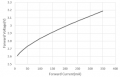
Thanks for all your replies . My error was in asuming the voltage per chip was fairly constant , it's normally listed as 2.8-3.2 , but search shows this ...
1776455928587.png
The graph doesn't go all the way to zero current but my strip (not the same as pictured above but has 3 chips in each segment) still shows light at 6V... so 2V is the minimum voltage to emit light ... but in normal 12v operation the voltage per chip is 3.2 .. total voltage across chips is 9.6 .... the % wasted in the resistor is 2.4/12 x100 = 20%, Is that correct? It seems rather a lot .
The manufacurer often shows these strips being used in commercial green houses , hard to understand that amount of waste could be tollerated , when it's easy to design a system with no resistor , the chips would be slightly underpowered for safety , but thats an advantage , when underpowered the chip itself is more efficient.
 
Last edited:

panic mode

Joined Oct 10, 2011
4,902
20% waste means 80% is used. that is a MASSIVELY better than many things that humanity engineered. i wish modern transportation, solar panels, energy grid etc could get NEAR such figures. even the best Diesels (gold standard for efficiency) id not breaking 50% mark. at least we do not use steam power anymore. before James Watt got initial improvements, they were averaging about attorcious 0.5% or so. so what are you really after? if the goal is to save the world, why not look at things that have most room for improvement?
 

Thread Starter

oz93666

Joined Sep 7, 2010
742
20% waste means 80% is used. that is a MASSIVELY better than many things that humanity engineered. i wish modern transportation, solar panels, energy grid etc could get NEAR such figures. even the best Diesels (gold standard for efficiency) id not breaking 50% mark. at least we do not use steam power anymore. before James Watt got initial improvements, they were averaging about attorcious 0.5% or so. so what are you really after? if the goal is to save the world, why not look at things that have most room for improvement?
Well... all the things you list have laws of physics which restrain efficiency .. As I pointed out it is posible to design LED circuits without current limiting resistors , for home use these strips with 20% loss are a resonable trade off for convienience , but large set ups shouldn't have to tollerate what would be a very large waste of electricity ...
Domestic led 'light bulbs' could be much more efficient and longer lasting , but they're made on the cheap with planned obsolescence...
The ruller of Dubai became aware of this and commisioned the design of better bulb ... running the chips at 25% usual current they last virtually forever and turn much more of the electricity into light ...
https://hackaday.com/2021/01/17/leds-from-dubai-the-royal-lights-you-cant-buy/
 

WBahn

Joined Mar 31, 2012
32,745
Thanks for all your replies . My error was in asuming the voltage per chip was fairly constant , it's normally listed as 2.8-3.2 , but search shows this ...
View attachment 366091
The graph doesn't go all the way to zero current but my strip (not the same as pictured above but has 3 chips in each segment) still shows light at 6V... so 2V is the minimum voltage to emit light ... but in normal 12v operation the voltage per chip is 3.2 .. total voltage across chips is 9.6 .... the % wasted in the resistor is 2.4/12 x100 = 20%, Is that correct? It seems rather a lot .
The manufacurer often shows these strips being used in commercial green houses , hard to understand that amount of waste could be tollerated , when it's easy to design a system with no resistor , the chips would be slightly underpowered for safety , but thats an advantage , when underpowered the chip itself is more efficient.
The manufacture showing them used in a commercial greenhouse doesn't mean that they are the best option for such applications. Remember, their goal is to sell a product, so if they can convince someone that they are suitable for an application that they may not be and it seems simpler or cheaper to install than better alternatives, that's fine with them.

If you want to run without a current limiting resistor, then you need to use a constant current supply. That supply is not going to be 100% efficient, either (although neither is the constant-voltage supply you are using for the 12 V strips).

There is nothing that says that you have to use these types of strips if you are concerned primarily with efficiency.
 

panic mode

Joined Oct 10, 2011
4,902
so your objective is not the efficiency... it is the longer life of the lamps. this is nothing new. even incandescent bulbs can last 100s of years if operating at reduced power. but unlike such lamps that turn yellow or even red with less heat, LEDs deliver more uniform color at different power levels.
so i did the same with my how LED lamps. instead of rated 150 mA or so, operate them at 50-60mA. they produce awesome light, run cool and have yet to fail. and since individual LEDs are dirt cheap. i can pack more of them in same volume and still forego heatsink. for Dubai or any place with hot climate running cool is one of the challenges. as said, this is not about energy efficiency, it is about longevity. so you can use the same LED strip you already have and just set your PSU to lower voltage. there is no need for marketing gimmicks like "Dubai lightbulb"

https://www.washingtonpost.com/nation/2025/03/22/longest-burning-lightbulb-guinness-world-records/
 
Last edited:
These are very popular as light sources , a self adhesive tape that can be cut to length where indicated , the led chips are small and spread out , which should result in high efficiency , but there's a resistor in series with each bunch of 3 leds (for a 12v strip) , this resistor is wasting power, but how much? A 12V strip can be operated on lower voltage , light stops being emited at about 6V, so this must mean the back EMF from the chips is 6V. Does that mean half the input power is wasted in heat in the serries resistor?
This is actually a good question. These resistors are there to save energy and the entire light strip. To understand why these resistors are there, you need to get to know how the LEDs are manufactured and the technical complications involved. Without any research, it seems plausible that all LEDs that come out of the same product line are 100% identical, but the reality is they are far from identical, no matter where you buy them from, and these small differences lead to massive problems. The problem with LEDs, in general, is that, unlike incandescent bulbs, they have a very low tolerance for voltage fluctuations. You have probably noticed that below certain threshold, they emit no light at all, then they come to life, then their resistance drops significantly for each millivolt that you add. If you connect all of them in parallel, then there is no proper voltage that can light them up evenly, because of those small differences that are inevitable during mass production. If you give, say, 1.8v to the strip, some of them emit more light than some others. If you increase it just to 1.9v, then those dim ones light up like normal, but what happens to the normal ones? If you do an experiment, you will see that the seemingly insignificant 0.1v makes them twice brighter but take about 3 to 5 times more current, overheat, and die soon. Here is where the "current limiting" resistors save the day. If the voltage in that section is a bit higher for those LEDs, the resistor acts like a simple and efficient regulator, by governing the "current" which is the key, which otherwise would dramatically increase AND waste more energy instead of saving energy, not to mention shortening the life of those LEDs that pass more current. Hope clarifies a bit.
 
Top