analyzing pulse generating circuit

Thread Starter

yef smith

Joined Aug 2, 2020
1,445
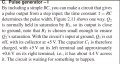
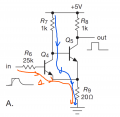
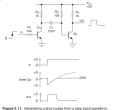
Hello,in the book the art of electrnics there is the following circuit.
the npn's are used as switches.
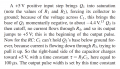
how exactly the C1 capacitor works in controlling the rise and fall moment of the pulse.
what is the math on generating this pulse?
the verbal explanation is not clear.
how the capacitor controls the state of the npn?
Thanks.
1768673900082.png
1768673872777.png
1768673808406.png
 

crutschow

Joined Mar 14, 2008
38,313
The input signal turns off Q2 through C1.
The R3C1 time-constant then determines how long it takes C1 to charge to the point where Q2 can turn back on, which is the output pulse-width.

What about the math shown, don't you understand?

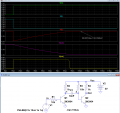
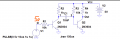
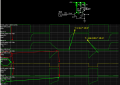
Below is the LTspice sim of the circuit
It shows both sides of the capacitor voltage (blue and red traces), and the voltage across the capacitor (purple trace):

1768678563594.png
 
Last edited:

MisterBill2

Joined Jan 23, 2018
27,153
The explanation presented is accurate! The first paragraph describes the initialcondition while the second describes the mechanism of creating the pulse.
 

Thread Starter

yef smith

Joined Aug 2, 2020
1,445
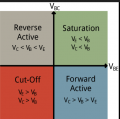
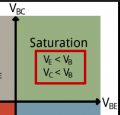
given the photo below when the input rises, how can I see that Q1 gets saturated.
Is there some mathematical explanation?
Thanks.

1769026329519.png
 

MrChips

Joined Oct 2, 2009
34,621
A capacitor in series creates a high pass filter.

It is also a differentiator (as compared to an integrator).
Hence it passes the derivative dv/dt of the input signal.
There is an RC time constant associated with this. It is R3C1 in this case.

This time constant determines the width of the exponential decay time and hence the width of the output pulse.
 

MrChips

Joined Oct 2, 2009
34,621
Choose a Vbe threshold voltage of about 0.65 V.
Any base voltage below or about this threshold gets switched to high and low signals at the collector.
 

crutschow

Joined Mar 14, 2008
38,313
Is there some mathematical explanation?
As MB2 noted calculate the base current to see if the transistor is saturated.
If the base current is greater than the full-on collector current divided by the minimum Beta spec for the transistor, then the transistor should be in basically in saturation.
 

Thread Starter

yef smith

Joined Aug 2, 2020
1,445
Hello crutshow ,purely on mathematical level and datasheet(no simulation)
I have two transistors each one could be in forward active saturation or cuttoff.
From basic analog course I need to make an assumption and to prove or desprove it.
So I have 9 options to choose.
you said to calculate the base current of Q1.
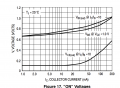
The link of the datasheet and photo shown below shows the link between Vbe and the current.
What strategy you reccomend to get a good analysis?
Thanks.
https://www.onsemi.com/download/data-sheet/pdf/2n3903-d.pdf

1769183347818.png
 

crutschow

Joined Mar 14, 2008
38,313
What strategy you reccomend to get a good analysis?
Vbe is relatively constant with current (looks like a forward-biased diode) so the base current is determined by the impedance to the base and the voltage (minus Vbe) applied to the base across that impedance.

Thus, for example, to a first approximation at low currents, Q1's base current when on, is (Vin-0.7V) / R1.
 

Thread Starter

yef smith

Joined Aug 2, 2020
1,445
Hello,given the circuit below I tried to find the collector voltage
I_b1=(5-0.7)/10k=0.43mA
based on datasheet beta is 100
Ic1=Ib1*100=43mA
Vc_Q1=5-R2*43mA=5-1k*43mA=-38V
I get a very problematic result, what should I do?
Thanks.
1769189046523.png

1769189250392.png
 

crutschow

Joined Mar 14, 2008
38,313
I get a very problematic result, what should I do?
Think about how a transistor actually operates, and not blindly use incorrect equations.
(You seem to have a shaky understanding about how transistor work, so suggest you look as some tutorials).

The transistor doesn't force current through the transistor (why would you think it does?).
The hFE current-gain is just what current the transistor will pass at a particular base current and collector-emitter voltage.
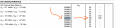
The transistor basically acts as a variable resistor and, when in saturation, that value generally becomes a few ohms, depending upon the transistor current rating (for the transistor graphs you posted, that value is about 4Ω).
(From Wikipedia: The word "transistor" comes from John R. Pierce at Bell Labs, combining "transfer" (or transconductance) and "resistor" ).

Then obviously the transistor collector current can't be higher than what the R2 collector resistor allows (in this case the maximum is 5V / 1kΩ = 5mA).
 
Last edited:

MrChips

Joined Oct 2, 2009
34,621
You are misusing beta as IC = β x IB.
Instead, you should be using IB = IC / β when the transistor is switched from cutoff to saturation.
IB does not drive Ic. Beta tells you how much base current is needed to turn on the transistor.
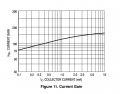
Beta is not fixed. It varies with IC as shown in the graph below.

2N3904 beta.jpg

Given Vs = 5 V and R2 =1k Ω, Icmax = Vs / R2 = 5 mA
From the graph, beta = 150
Using, IB = IC / β

Required IB = 5 mA / 150 = 33 μA
(For saturation, we use β = 10. Required IB = 5 mA / 10 = 500 μA)

With V1 = 5V, R1 = 10k Ω
Actual IB = (5 - 0.7) / 10 k = 430 μA
(and you only needed >50 μA)
Hence the transistor is in saturation mode.
 

crutschow

Joined Mar 14, 2008
38,313
Hello crutschow, When can I see in the datasheet the proper beta I should use un this case?
The value to use depends upon whether the transistor is being used as a switch in saturation, or being used as a linear amplifier in the active region.

But it's not the value of beta that's your problem.
It's your misuse of that value in your equations.
 

Thread Starter

yef smith

Joined Aug 2, 2020
1,445
Hello Mrchips, the equation below you wrote

Actual IB = (5 - 0.7) / 10 k = 430 μA misses R9 voltage drope shown below the emitter of Q4 is not connected ground.

there are the equation I wrote:
KVL1 from input to R9 ground:
5-Ib*(R6)-0.7-(Ic_q4+Ic_q5)*R9=0

KVL2 from Vdd to R9:
5-R7*Ic_q4-Vce_q4-(Ic_q4+Ic_q4)*R9=0

The problem is in these equation Vce_q4 is dependant on the operating state, iC_q5 is also dependant on the state of q5 .
there are too many variables ,what could be done to calculate exactly each voltage on the Q4 Q5 transistors ?


1769280540835.png
 
Top