Facebook
 Google
 GitHub
 Linkedin

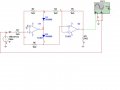
I am having some issues with a full analysis of this circuit. I have to be able to completely analyze all currents etc. I now how it works intuitively, but in detail is another question. Here is what I have so far...
Positive cycle:
- looking at U1, positive input is at ground, therefore neg input is also at ground (an assumption we are allowed to make)
- output is inverted therefore D1 is on and D2 is off
- voltage at node 3 is -Vin because I = (0-Vin)/R=(V3-0)/R
- voltage at node 5 is 0
- looking at U2 and applying similar concepts, -Vin is inverted to provide a Vin on the output.
Negative cycle:
This is where the problems begin. I was trying to apply the same logic (assuming it is not faulty), D1 is off and D2 is on. With this then 0.7V of the diode will be subtracted from the output which is already a problem as this configuration supposed to be free from diode effects. And then I found an unexplained analysis in the textbook which looks at how the current splits between upper and lower branches in ratio of 1:2. I am not so clear where that comes from as upper branch has 3 resistors although they are shared between two op amps. To make a long story short, I am not sure how to analyze it correctly using current.
Positive cycle:
- looking at U1, positive input is at ground, therefore neg input is also at ground (an assumption we are allowed to make)
- output is inverted therefore D1 is on and D2 is off
- voltage at node 3 is -Vin because I = (0-Vin)/R=(V3-0)/R
- voltage at node 5 is 0
- looking at U2 and applying similar concepts, -Vin is inverted to provide a Vin on the output.
Negative cycle:
This is where the problems begin. I was trying to apply the same logic (assuming it is not faulty), D1 is off and D2 is on. With this then 0.7V of the diode will be subtracted from the output which is already a problem as this configuration supposed to be free from diode effects. And then I found an unexplained analysis in the textbook which looks at how the current splits between upper and lower branches in ratio of 1:2. I am not so clear where that comes from as upper branch has 3 resistors although they are shared between two op amps. To make a long story short, I am not sure how to analyze it correctly using current.
Attachments
-
 49.3 KB Views: 50