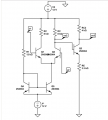
Analyzing a differential amplifier.

Thread Starter

Anwesa Roy

Joined Aug 7, 2017
3
I want to perform the small signal AC analysis of the circuit. To calculate gm. I need IC ,ie the DC quiescent collector current. But in the differential amplifier stage, the AC input voltages are not connected via capacitors....So while performing DC analysis ,we cannot open circuit the AC voltage sources. Then how we are to find the quiescent collector currents?...Also even if the AC voltage sources are connected via capacitor, then while DC analysis, the base would be floating....!Please help me solve this problem.
 

Attachments

MrAl

Joined Jun 17, 2014
13,702
Hi,

If you are looking for quiescent operation then you would probably just set both inputs to 0 volts. You could then take it from there by changing one voltage by a small amount and looking at the output.
 

crutschow

Joined Mar 14, 2008
38,503
As MrAl stated you connect both inputs to ground for both the DC bias calculation and the AC analysis.
If you AC couple the source than you need a resistor to ground from the transistor base to carry the bias current.
 

Thread Starter

Anwesa Roy

Joined Aug 7, 2017
3
Hi,

If you are looking for quiescent operation then you would probably just set both inputs to 0 volts. You could then take it from there by changing one voltage by a small amount and looking at the output.
Sir, that means while DC analysis, we need to short circuit the AC voltage source and open circuit the AC current source. Irrespective of whether they are connected to capacitors or not, just as in case of AC analysis, we short circuit the DC voltage source and open circuit the DC current source. Is this valid because of superposition theorem?
 
Last edited:

Thread Starter

Anwesa Roy

Joined Aug 7, 2017
3
As MrAl stated you connect both inputs to ground for both the DC bias calculation and the AC analysis.
If you AC couple the source than you need a resistor to ground from the transistor base to carry the bias current.

Sir, that means while DC analysis, we need to short circuit the AC voltage source and open circuit the AC current source. Irrespective of whether they are connected to capacitors or not, just as in case of AC analysis, we short circuit the DC voltage source and open circuit the DC current source. Is this valid because of superposition theorem?
 

MrAl

Joined Jun 17, 2014
13,702
Sir, that means while DC analysis, we need to short circuit the AC voltage source and open circuit the AC current source. Irrespective of whether they are connected to capacitors or not, just as in case of AC analysis, we short circuit the DC voltage source and open circuit the DC current source. Is this valid because of superposition theorem?
Hi,

Well, in general, yes. The circuit has to be linear also, or at least be in a place where you can call it linear.
 
Top