An electrical cable to be immersed in drinking water

Thread Starter

PlasmaT

Joined Feb 19, 2015
61
For a DIY project related to capacitive level sensing in drinking water I need some information regarding a suitable insulated conductor that can be used.

I am planning to use the insulated conductor as one of the terminals for the capacitive sensor probe.

I believe that normal insulated wires (flexible wires generally used in household wiring) are not properly waterproof (am I wrong?). Even if they do, I doubt whether the insulated material can be immersed in drinking water ("food safe")

So as an alternative method, I have tried with a bare conductor wire through a flexible pvc tube. But I am not satisfied with the arrangement.

Any advice on suitable material/ conductor for this project.
 

Marley

Joined Apr 4, 2016
514
I don't see any reason why normal PVC insulated cable could not be safe in drinking water. PVC has a limited temperature range, normally 0 to 70 deg C but that should be OK in this application.
Obviously make sure it is clean before use!
I assume you are using a low voltage internally and it is very carefully isolated from any high voltage supply.
 

Hypatia's Protege

Joined Mar 1, 2015
3,228
So as an alternative method, I have tried with a bare conductor wire through a flexible pvc tube. But I am not satisfied with the arrangement.
Please expand upon that (i.e. in what way is it unsatisfactory?) Would a hollow plastic 'swizzle stick' suffice? Such improvisation via approved 'food handling' items will save you a lot of 'agro':)

Best regards
HP:)
 

AnalogKid

Joined Aug 1, 2013
12,060
I'd go with Teflon insulated hookup wire. These often have MIL designations because that's their primary market. Normal 300 V stuff has one layer of insulation. 600 V rated stuff has two layers of different colors co-molded so you can tell if the outside layer is nicked. That's the good stuff, and Teflon sitting in battery acid will outlive cockroaches.

ak
 

shortbus

Joined Sep 30, 2009
10,050
As I worked at a company that makes wire, this is only from their standpoint. The plastic used by them was a combination of virgin and recycled plastics. Maybe other companies do the same. Like HP said putting the wire in a drinking straw will keep the surface of the wire at a known food safe level.
 

MaxHeadRoom

Joined Jul 18, 2013
30,566
If unsure of the cable being used I have used both food grade plastic tubing and also small dia schedule 40, it is rated for potable water, and goes down to 1/8" int dia.
One advantage with SCH 40 is if you need a rigid installation and I have also used a cap fitting on the end to drill and tap for a sensor etc, this keeps the wiring out of the liquid completely.
Max.
 

Thread Starter

PlasmaT

Joined Feb 19, 2015
61
Thanks everyone for your advice.
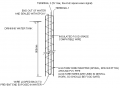
Herewith I have attached as sketch of the arrangement for further clarification.

Basically, the probe consist of two terminals.
One in direct contact with water. ( Ligature wire for this case. Or stainless steel can be used). The other terminal to be insulated from water in order to form a capacitive action.

I see some hope with Teflon coated wire as suggested by AnalogKID. But is it water proof. I mean free of fine cracks or will water penetrate in long run. Or do I have any other alternative?

My thoughts are also to use a aluminum tube inside a thin flexible pvc tube. This gives grater capacitve area. But matching both diameters are not possible practically. If there is a air gap in between the pvc tube and the conductor, then it is unsuitable for the probe to function properly.

Thanks
 

Attachments

ErnieM

Joined Apr 24, 2011
8,415
Just how do you intend to form a capacitor out of a single length of wire? Capacitance exists between two conductors separated by a dielectric. Typical systems I have worked on use two conductors, a small center within a larger cylinder this can be filled with the liquid in the tank.

Change from air to liquid you change the dielectric and hence the capacitance in a controlled linear fashion.

Why are you driving this with a square wave? Since th apacitance is changing placing the sensor in any oscillator or mulitvibrator will give you a frequency proportional to level. I've even seen this work with a 555. (NOT my design).
 

AnalogKid

Joined Aug 1, 2013
12,060
Ernie - one conductor is the water outside the insulation, and one conductor is the wire inside the insulation. The wire's insulation is the dielectric barrier.

PT - Teflon has a very high breakdown voltage characteristic, so for the same insulation voltage rating it is thinner than PVC. Also, the number of strands and their physical arrangement make for an almost circular cross section that has very tight dimensional tolerance over length. Finally, there are no air gaps; the Teflon flows into the valleys between the sides of the outside strand layer. Low cost PVC hookup wire has 7 strands, an ideal arrangement that is relatively stiff. The MIL stuff usually has at least 19 strands of finer wire. This doesn't map to a perfectly symmetrical outer layer, but is much more flexible, which translates directly to improved long-term reliability in a high vibration environment such as an F-15.

ak
 
Last edited:

Thread Starter

PlasmaT

Joined Feb 19, 2015
61
Why are you driving this with a square wave? Since th apacitance is changing placing the sensor in any oscillator or mulitvibrator will give you a frequency proportional to level.
I am hoping to drive the probe with a known frequency to maintain stability. When the water tank is empty the capacitance will be very low. So the frequency will increase significantly and may be reach the limits of the components well. Instead if I drive it with a pre-defined frequency (squarewave because easy to generate), I can filter and amplifier the signal with minimum noise.
 

Nick Bacon

Joined Nov 7, 2016
130
As far as I was aware you need 2 conductors and a dielectric. The Dielectric is water water/ air. Have you considered 2 x insulated aluminium rods.
 
As far as I was aware you need 2 conductors and a dielectric.
--Emphasis added--

For the OP's purposes the H2O functions as the second 'conductor' (i.e. plate)

Hence:
Metal 'wire' → Plate 1
Insulation on 'wire' → Dielectric
(Mildly) ionic solution (water) → Plate 2

Thus the establishment of variable capacitance via variation of 'plate 2' interface area (i.e. water level)...

Best regards
HP:)
 
Last edited:

Aleph(0)

Joined Mar 14, 2015
597
It is easier and cheaper to use ultrasonics. The Tx / Rx is only $2.00
Colin55 are you sure ultrasound ranging could be accurate enough over so short a range:confused:? I say variation of barometric pressure, temp and humidity would mess with it too much for accurate short distance measurement?
 

Colin55

Joined Aug 27, 2015
519
Colin55 are you sure ultrasound ranging could be accurate enough over so short a range
Are you fooling yourself?
The capacitance increase will only be one puff per cm.

If you want accurate measurement, get a washing machine float from the tip.
 
Top