Amplifier hums when in sleep mode

Thread Starter

MikeA

Joined Jan 20, 2013
447
After second look, it may not be the v3, but instead an earlier version. The V1 has the stereo-mono switch as per the TS pictures, but does not have input activated auto on. V3 has the auto-on, but the stereo-mono switch is in the wrong place compared to the TS picture.

Instead of guessing, perhaps the TS can tell us what model it actually is.
That's correct, it is an older model v1.


Schematic shows pin8 of that IC (U303) ties to a +12 volt bus.
View attachment 164073

I don't think it is humming because it is not muting, but rather it is not muting because it is humming. Take a look at the +12 volt bus (pin 8 of that 2072 is on +12 volts) with your scope and see how much ripple there is. Then check HV+ (CN306_1 Pin3) and HV- (CN306_1 pin1) for ripple. Use caution on the last two as I don't see a value listed for HV+ or HV-. Probably 35 - 50 volts.
Before trying with the scope I checked if there is any voltage between amplifier chassis and oscope chassis (both use grounded power cords, but the amps power plug ground pin is unconnected) and there is 65-67v AC even when the amp is off with the physical power switch on the front panel! (this switch doesn't cut power but goes to the main circuit board with very thin wires)

All speaker banana posts read the same 65-67v AC between them and ground.

What might this mean? Besides that I should not connect the oscope ground to amp chassis. :D
 
Last edited:

Ylli

Joined Nov 13, 2015
1,092
I can not find a schematic for the V1, but the owners manual (https://www.manualslib.com/manual/649379/Parasound-Zamp.html) makes no mention of a 'sleep' mode. Only a remote on/off input. So I guess I am still a bit confused.

If the amps ground pin is not connected (why is it not?) then leakage currents can easily raise the apparent chassis voltage to that 65 volt area. Try connecting a small load (such as a 15 - 25 watt incandescent bulb) between the two chassis'. I'll bet that 65 v drops to zero. If that is the case, go ahead and connect the scope ground to the amp chassis.
 

MisterBill2

Joined Jan 23, 2018
27,563
Yup, dead silent until sleep.


Where would I measure this?
I am using the circuit drawing posted in #17, and the terminals of the 4700mFD capacitors. Or the collector terminals of the output transistors, all referenced to the common bus, ground.
An interesting possibility is that the relay that appears to switch off the power to the amplifier, is not switching off. But that may be a speaker protection relay, not a power switching relay, the diagram is difficult to follow on my computer screen.

So now another question for you: why not simply switch the amplifier off when you are not listening to it? That is far more efficient in power usage and also it will extend the life of all the components except the power switch.
 

Thread Starter

MikeA

Joined Jan 20, 2013
447
If the amps ground pin is not connected (why is it not?)
I guess by design. Is it common to ground chassis of audio equipment? I've owned lots of amplifiers and none except this one had grounded plugs.

Try connecting a small load (such as a 15 - 25 watt incandescent bulb) between the two chassis'. I'll bet that 65 v drops to zero. If that is the case, go ahead and connect the scope ground to the amp chassis.
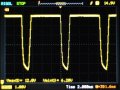
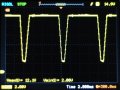
I tried grounding through a resistor and indeed there is practically no current. So I looked at the power pin on the 2072 chip and here how it looks.

This is when the amplifier hums.

DSC_6828.JPG

And this is when it's playing something and is not humming.

DSC_6831.JPG

Seems like the same 120hz.
 
Last edited:

Thread Starter

MikeA

Joined Jan 20, 2013
447
An interesting possibility is that the relay that appears to switch off the power to the amplifier, is not switching off.
I think it is a power relay. It clicks when the power switch on the front panel is toggled.

I'll try touching the collectors on the transistors next.

So now another question for you: why not simply switch the amplifier off when you are not listening to it? That is far more efficient in power usage and also it will extend the life of all the components except the power switch.
It does hum VERY loud. If there is no incoming signal is starts humming when auto-off/sleep kicks in.
 

MisterBill2

Joined Jan 23, 2018
27,563
I think it is a power relay. It clicks when the power switch on the front panel is toggled.

I'll try touching the collectors on the transistors next.


It does hum VERY loud. If there is no incoming signal is starts humming when auto-off/sleep kicks in.
Not touching the collectors, but measuring the DC voltage relative to the amplifier common bus.
 

Ylli

Joined Nov 13, 2015
1,092
I guess by design. Is it common to ground chassis of audio equipment? I've owned lots of amplifiers and none except this one had grounded plugs.

I tried grounding through a resistor and indeed there is practically no current. So I looked at the power pin on the 2072 chip and here how it looks..
I would think safety requirements be require the chassis be grounded to the safety ground. I'm not aware of any exceptions for audio equipment.

Again, I can't find a schematic for v1, but the voltage on the 2072 power pin does not look good to me. Try to follow it back, looking for something like a 7812 voltage regulator IC. If you find one, look at the input voltage to that chip - should be fairly clean. Check any tantalum/electrolytic caps on that power bus, and working your way back check the diodes used in the rectifier supplying power to the 7812.

The v3 schematic is in post #17, your v1 may be similar.
 

MisterBill2

Joined Jan 23, 2018
27,563
I would think safety requirements be require the chassis be grounded to the safety ground. I'm not aware of any exceptions for audio equipment.

Again, I can't find a schematic for v1, but the voltage on the 2072 power pin does not look good to me. Try to follow it back, looking for something like a 7812 voltage regulator IC. If you find one, look at the input voltage to that chip - should be fairly clean. Check any tantalum/electrolytic caps on that power bus, and working your way back check the diodes used in the rectifier supplying power to the 7812.

The v3 schematic is in post #17, your v1 may be similar.
While the chassis may be connected to the safety ground there is no reason for the transformer-isolated electronic circuit system common to be connected to it. The green-wire safety ground is often a source of noise for systems with higher gain and frequency response that includes the mains frequency. And yes, the voltage at the input to the regulator does seem to have a component that would cause problems. That would make suspect the power supply, either a capacitor no longer adequate capacitance, an open rectifier in a bridge circuit, or possibly an open connection at a failed solder joint. I have seen all three in past service and repair instances.
 
Top