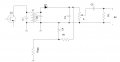
Q1 would be the last IF amplifier stage. The signal is coupled through the last IF transformer and rectified by D1. The output of DC is filtered to remove the remaining RF and allow the audio to be impressed across the volume pot. C5 couples the audio into the audio amplifier. R1 and C4 couple and filter the DC output of D1 to develop a voltage which controls the gain of the earlier stages.
There is lots of info online, google "How does an AM detector work?"
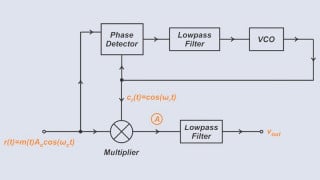
Remember that AM is Amplitude Modulation where the low-frequency audio information is riding on the amplitude of the high-frequency RF carrier.
So the circuit rectifies and filters the RF, leaving just the audio signal amplitude variation.
Yes, I can explain how it works, but before I offer an explanation I nee to know if you understand how a resistor, capacitor, and diode work. Without that understanding my explanation will not mean anything to you. In addition I need to know if you understand the explanation of AM as presented in post #3. Without a basic understanding of these things the explanation of the circuit function carries little value.
C3 must have a low reactance at the IF frequency, thus charging and discharging at the audio frequency rate. C1,C2, and C3 will work fine as shown, however the curved side of the schematic symbol is usually connected to ground.

 Facebook
 Google
 GitHub
 Linkedin