How to improve this emf detector

Thread Starter

Jason Grace

Joined Mar 1, 2026
3
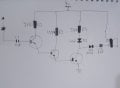
Hello, i wanted to make a emf meter for fun and to gain some learning experience , after digging around the internet I found interesting circuits but the most common circuit i found was a 3 stage darlington amplifier based design so i made it with some tweaks of my own

But the circuit had some problem of its own for example the (i) detection range decreases every time it detected emf (ii) the sensitivity of the circuit was quite low

For the (ii) problem I think connecting it's output to a inverting amplifier should fix the problem but right now I do not have a opamp to use so I am not sure
 

Attachments

Last edited:

MisterBill2

Joined Jan 23, 2018
27,315
I realize that your goal is an electro-magnetic-field detector, NOT an Electro-Motive-Force dtector, more commonly known as a voltmeter.

BUT that is not at all what the circuit shown in post #1 shows us!! That circuit contains no portion that will sense any magnetic field. So it will never sense the "deadly EMF fields" that some sources franticly warn us about.

What the circuit will respond to is an electrical potential field, also called "static electricity."

Certainly, if it functions correctly, the circuit shown will respond to any small voltage fields that reach the input, because it is a high gain DC amplifier. Unfortunately, with that simple circuit, it will be a serious challenge to have all three transistors operating in their linear ranges. At least I suspect that will be a problem.
You can achieve a similar gain level with an FET input opamp IC, the TL084.
 

Thread Starter

Jason Grace

Joined Mar 1, 2026
3
I realize that your goal is an electro-magnetic-field detector, NOT an Electro-Motive-Force dtector, more commonly known as a voltmeter.

BUT that is not at all what the circuit shown in post #1 shows us!! That circuit contains no portion that will sense any magnetic field. So it will never sense the "deadly EMF fields" that some sources franticly warn us about.

What the circuit will respond to is an electrical potential field, also called "static electricity."

Certainly, if it functions correctly, the circuit shown will respond to any small voltage fields that reach the input, because it is a high gain DC amplifier. Unfortunately, with that simple circuit, it will be a serious challenge to have all three transistors operating in their linear ranges. At least I suspect that will be a problem.
You can achieve a similar gain level with an FET input opamp IC, the TL084.
Hello thanks for replying, can you please recommend me on how can I make my transistor based circuit more stable and better.

I personally do not believe in "harmful emf" or anything like that I just wanted to make one because I am a huge supernatural fanboy

Also regarding your TL084 based circuit you told me about will configuring them as non inverting amplifier with gain of let's say 330 will work?, i think it should work as the high gain of 35 million along with the opamp high input impendence should be able to detect even small static or em fields

Sorry if the questions seem a bit dumb I am not the wisest with opamps.
 

MisterBill2

Joined Jan 23, 2018
27,315
There is a very real potential problem with really high gain amplifiers! And, with high gain DC coupled amplifiers a second roblem as well..
NOISE is always present in some amount! So any amplifier will also amplify the "Effective input noise" along with the actual input signal.
My first experience with this reality was long ago, when I built a nice amplifir that had two gain stages of 6AU6 tubes, each stage with a gain of about 200, for a total gain of 40,000. They fed a 6V6 output stage with a gain of about 5. What I got was an amplifier with quite a bit of noise. In fact, a whole lot of noise. BUT it did also have a lot of gain. One interesting thing was that I learned about connector noise. A somple phono plug soldered onto a short shielded cable was a bit microphonic, it could actually pick up loud speech at an inch or two from the plug.

My point being that a really high gain amplifier will indeed pick up any electrical field.
BUT without any means to convert magnetic field changes into an electrical signal it will not respond to any magnetic fields or field changes. Without a pickup coil input there is no way to sense a magnetic fiels, except with a hall effect device or a magnetic field sensing resistor, both of those require an external power sourceto provide any output. AND, whatever magnetic field is present will somehow need to be varied to produce an AC voltage.

In an average residential house in the US a pickup coil will produce a mains frequency because of the current in the wiring. While a few individuals claim this is damaging, that asertion has not been verified by others. Nor has any damage been demonstrated byvalid testing procedures, that I have read about.
 

Pyrex

Joined Feb 16, 2022
502
Just by looking at the diagram you provided, several flaws are visible.

The base of the first transistor should be connected to '9V' through about a 10 M resistor.
The connection point of D2 and C2 must be connected to the '9V' through approximately a 470 Ohm resistor.

PS. Connection point: the emitter of the first transistor and the base of the second transistor. Add about 100kOhm resistor between this point to GND
 
Last edited:

MisterBill2

Joined Jan 23, 2018
27,315
Certainly, making the present circuit work is another good choice. "P" has made some good suggestions.
Making a high-gain multi-stage DC amplifier function properly is not a trivial task.
Now consider that since the input is capacitor coupled, as is the output, it makes no sense to have the three stages directly coupled, UNLESS you already have them all sitting in the center of their linear range, which is not what post #1 tells us. You will need to add a few resistors and two capacitors, though.
Probably another can provide the completed AC coupled circuit schematic.
 

Thread Starter

Jason Grace

Joined Mar 1, 2026
3
Just by looking at the diagram you provided, several flaws are visible.

The base of the first transistor should be connected to '9V' through about a 10 M resistor.
The connection point of D2 and C2 must be connected to the '9V' through approximately a 470 Ohm resistor.

PS. Connection point: the emitter of the first transistor and the base of the second transistor. Add about 100kOhm resistor between this point to GND
Hello i tried to making the changes you described but the problem is the led stays on all the time.

I am using 1M resistor for first transistor based to vcc since I did not have any larger value resistor

Thanks
 

AnalogKid

Joined Aug 1, 2013
12,087
Hello i tried to making the changes you described but the problem is the led stays on all the time.
That is because this:
The base of the first transistor should be connected to '9V' through about a 10 M resistor.
really does need a 10 M resistor. The idea was to "dangle-bias" Q1 to the edge of conduction so it takes less potential difference to turn it on. The problem is that R1 is so small (yes, 1 M is small in this application) and the overall circuit gain is so high that the output stage is on continuously. For this type of circuit you have only two output options: 1) the LED is on most of the time, and a detected field makes it flicker off; 2) the LED is off most of the time, and a detected field makes it flicker on. #2 has the battery last much longer, but it takes a larger field to wake up the first stage. This is why R1 must be as large as possible.

Also, this:
The connection point of D2 and C2 must be connected to the '9V' through approximately a 470 Ohm resistor.
is incorrect. A resistor to Vcc will pull the D2 cathode up to Vcc, so the diode never will conduct when the Q3 collector goes low.

My version of how to correct this schematic:

1. Connect the collector of Q1 directly to Vcc. Connect R1 to the Q1 base and GND.

2. Connect the collector of Q2 directly to Vcc. Increase R2 to 1 M. Connect R2 to the Q2 base and GND.

3. Add a 100K resistor from the base of Q3 to GND.

4. Delete D2. Connect the left side of C2 directly to the Q3 collector.

The speaker should be something with as high an impedance as you can find. For example, many earbuds are 60 ohms, which would be much better than an 8 ohm speaker. There are other options for the speaker connection, such as putting it in series with R3, but this should get you started.

ak
 
Last edited:

Pyrex

Joined Feb 16, 2022
502
Hello i tried to making the changes you described but the problem is the led stays on all the time.

I am using 1M resistor for first transistor based to vcc since I did not have any larger value resistor

Thanks
Since the LED is lit, it shows that the first transistor is constantly open, that is, its base current, determined by the 1 M resistor, is too high.
You would need a resistor with higher resistance, but just for testing, you can stick with 1 M. Reduce the resistor between the first transistor's emitter to GND to 30 kOhm.
The 1 M resistor sets the detector's sensitivity, so it is better when it is larger
 

MrAl

Joined Jun 17, 2014
13,680
Hello, i wanted to make a emf meter for fun and to gain some learning experience , after digging around the internet I found interesting circuits but the most common circuit i found was a 3 stage darlington amplifier based design so i made it with some tweaks of my own

But the circuit had some problem of its own for example the (i) detection range decreases every time it detected emf (ii) the sensitivity of the circuit was quite low

For the (ii) problem I think connecting it's output to a inverting amplifier should fix the problem but right now I do not have a opamp to use so I am not sure
Hi there,

I presume your diagram shows a coil of wire as the first component on the left side so it can sense a magnetic field.

That does immediately present us with a problem: that coil can sense a changing magnetic field, but it cannot sense a static magnetic field. Ideally you want both.
To get both the easiest way is to use a Hall Effect sensor. Not the kind that detects current, the kind that detects magnetic fields. If the fields are very weak then you have to get a sensitive HE sensor.
These things provide a DC output so you can detect static fields (such as with a permanent magnet) and also changing fields (like with a coil of wire driven by an AC source). You can even detect the Earth's magnetic field and sense compass directions. You may not even have to amplify it.

If you are interested in rolling your own then you might want to stick to the coil, but if you want it to be able to measure static fields you'll need a type of sensor that can respond to static fields as well as changing fields. There are a host of other types, but probably the HE device is the simplest for your use.
 

MisterBill2

Joined Jan 23, 2018
27,315
Now I have a question that should have been asked much sooner: Just exactly WHAT magnitude of electrical field intensity and megnetic field strength is the TS intending to detect??
I have read some of the articles presented by the sellers of the expensive "EMF FIELD" sensing instruments and not much of them make much sense. So asking about the anticipated field strength is a reasonable question.

Consider that OSHA seems to be able to explain the details of most of the hazards that they work to prevent, it seems that the verified hazards from the every-day magnetic and electrostatic field strengths presented as hazards should be able to be stated. Understanding the amplitude of the field to be measured is usually the first step in designing a system to measure that amplitude.
Usually, in engineering measurements, a voltage measurement is referenced toward some point, often described as "ground."
 

drjohsmith

Joined Dec 13, 2021
1,579
Hello, i wanted to make a emf meter for fun and to gain some learning experience , after digging around the internet I found interesting circuits but the most common circuit i found was a 3 stage darlington amplifier based design so i made it with some tweaks of my own

But the circuit had some problem of its own for example the (i) detection range decreases every time it detected emf (ii) the sensitivity of the circuit was quite low

For the (ii) problem I think connecting it's output to a inverting amplifier should fix the problem but right now I do not have a opamp to use so I am not sure
without looking at the circuit , just your text.

you say you made some tweaks of your own, then the circuit does not work as expected ,
what actual tweaks did you make , why and did thevorriginal work as expected ?
 

drjohsmith

Joined Dec 13, 2021
1,579
Hello, i wanted to make a emf meter for fun and to gain some learning experience , after digging around the internet I found interesting circuits but the most common circuit i found was a 3 stage darlington amplifier based design so i made it with some tweaks of my own

But the circuit had some problem of its own for example the (i) detection range decreases every time it detected emf (ii) the sensitivity of the circuit was quite low

For the (ii) problem I think connecting it's output to a inverting amplifier should fix the problem but right now I do not have a opamp to use so I am not sure
you say EMF detector,
what sort of EMF , are you talking near field detector or wires in walls or vehical presence detector or what?
an EMF detector, is a "radio receiver" , and is highly dependent upon the aerial / pickup coil.
any more details on what your trying to detect and what output of the circuit you wznt, i.e. an analog waveform or a go / no go signal?
 

BobTPH

Joined Jun 5, 2013
11,484
you say EMF detector,
what sort of EMF , are you talking near field detector or wires in walls or vehical presence detector or what?
an EMF detector, is a "radio receiver" , and is highly dependent upon the aerial / pickup coil.
any more details on what your trying to detect and what output of the circuit you wznt, i.e. an analog waveform or a go / no go signal?
He answered that in post #4:
I personally do not believe in "harmful emf" or anything like that I just wanted to make one because I am a huge supernatural fanboy
In other words, he wants to detect ghosts.
 

MisterBill2

Joined Jan 23, 2018
27,315
A GoodQuestion: How to sense a constant magnetic field with an AC coupled amplifier. And how to do it simply!
Since the voltage generated by a coil is due to the CHANGING magnetic flux, the simple way is to quickly invert the coil while it is still in the magnetic field. That will produce a thump in the sound from the speaker, rapid flipping the coil back and forth will producea series of thumps. The stronger the field the louder the thumps.
 
Last edited:
Top