Ways to improve my Bubba phase shift oscillator?

Thread Starter

360NoClones

Joined Oct 2, 2025
4
Hi everyone, I am a EE student, currently trying to design a pure 10kHz oscillator for a university assignment. It is supposed to have controllable amplitude at the output, between 0 and 5Vpp.

After some research, I settled on the Bubba phase shift topology, with diode amplitude stabilization and an inverting op-amp configuration at the output, for the voltage control. I did some component matching and now get a constant 60-65dB SINAD, but would like to do more. My ideal would be around 80-90dB.

What can I do to improve it further, that will not change the topology significantly? I know I can't really mess with the filters, or I will mess up the45deg phase shift each one provides, therefore not satisfying the Barkhausen criteria. Does this mean that the phase shift oscillator is limited by its topology? If so, what is a more "up-gradeable" one? Thank you in advance!

This is the circuit diagram, I also included the pdf file the screenshot is low quality:
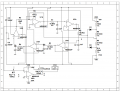
Screenshot 2025-10-02 205652.png
 

Attachments

drjohsmith

Joined Dec 13, 2021
1,584
Hi everyone, I am a EE student, currently trying to design a pure 10kHz oscillator for a university assignment. It is supposed to have controllable amplitude at the output, between 0 and 5Vpp.

After some research, I settled on the Bubba phase shift topology, with diode amplitude stabilization and an inverting op-amp configuration at the output, for the voltage control. I did some component matching and now get a constant 60-65dB SINAD, but would like to do more. My ideal would be around 80-90dB.

What can I do to improve it further, that will not change the topology significantly? I know I can't really mess with the filters, or I will mess up the45deg phase shift each one provides, therefore not satisfying the Barkhausen criteria. Does this mean that the phase shift oscillator is limited by its topology? If so, what is a more "up-gradeable" one? Thank you in advance!

This is the circuit diagram, I also included the pdf file the screenshot is low quality:
View attachment 356677
why did you settle on the bubba?
where's this circuit from ?

classical, at that sort of frequency a wein bridge would be used for the lowest distortion / noise

https://www.ti.com/lit/an/snoa665c/snoa665c.pdf

you also need to check what type of distortion you have, phase, noise or what ?
 

Thread Starter

360NoClones

Joined Oct 2, 2025
4
why did you settle on the bubble?
In the documents I read, it is apparently pretty low-distorsion, because of the cascaded low-pass filters. It also produced the largest SINAD in my simulations, in which I also tested a Wien Bridge and a quadrature oscillator


where's this circuit from ?
This was designed by me, in multisim, then saved as pdf and screenshoted. The original Bubba comes from a TI document, which I now attach (bubba is on last page)


classical, at that sort of frequency a wein bridge would be used for the lowest distortion / noise
https://www.ti.com/lit/an/snoa665c/snoa665c.pdf
I see that makes a lot of sense, I had not seen this document before, thank you


you also need to check what type of distortion you have, phase, noise or what ?
Also, keeping in mind I am a noob, how would I check that? To check the SINAD, I look at the FFT of the signal on an oscilloscope, but how can I distinguish between the several distorsion types?
 

Attachments

Last edited:

crutschow

Joined Mar 14, 2008
38,423
What can I do to improve it further
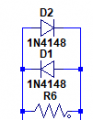
You might try a softer clip by connecting the diodes directly across R6, which will reduce the clipping distortion that is filtered by the following stages.
You may have to increase the gain of one of the following stages to compensate for the reduced gain this will cause.

Another way would be to add a 3-pole 10kHz LP active filter at the output, which will help reduce the distortion.
Edit: Here's a website for calculation of the components for a single opamp 3-pole filter.
 
Last edited:

Thread Starter

360NoClones

Joined Oct 2, 2025
4
You might try a softer clip by connecting the diodes directly across R6
Thank you for the advice, but I don't understand what this means. Does that mean connnecting one diode to each terminal of R6? If so, doesn't that change the structure of the clipping?
 

MisterBill2

Joined Jan 23, 2018
27,362
I have never come across " the Bubba phase shift topology, " as an oscillator or anything else. And I followed the links that it was claimed to be on, and did not see it. Was the TI article on You Tube (the cartoon channel) by any chance?????
 

LvW

Joined Jun 13, 2013
2,018
Also, keeping in mind I am a noob, how would I check that? To check the SINAD, I look at the FFT of the signal on an oscilloscope, but how can I distinguish between the several distorsion types?
Please note that - as far as "distortion " is concerned - the method used for determining/stabilizing the oscillation amplitude is the only subject that matters.
Each working oscillator needs a certain kind of non-linearity (as small as possible) which can limit the rising amplitudes before clipping occurs.
 
Top