AM-AM and AM-PM graph generation in LTSpice

Thread Starter

Mike2526

Joined Nov 10, 2020
86
Greetings to all,

I am writing with a question regarding graph generation in LTSpice. I am using LTSpice XVII and am trying to plot AM-AM and AM-PM characterization for a power amplifier, but I haven't been successful yet, likely due to my lack of practice with this specific analysis. I have been using a square wave input at 8.2 MHz as the voltage waveform for my power amplifier. I would greatly appreciate your assistance in this matter. For your reference, I have attached the schematic file as a text file. Thank you in advance for your kind help.
 

Attachments

Thread Starter

Mike2526

Joined Nov 10, 2020
86
What is AM-AM and AM-PM characterization?
Dear Sir, It's amplitude to amplitude and amplitude to phase. It is said that for a switching amplifier like Class-D, the AM-AM / AM-PM plot is often more straightforward to simulate and relates directly to amplitude accuracy. This checks how the output power and signal phase change as you increase the input power.
 
Last edited:

sparky 1

Joined Nov 3, 2018
1,218
Some qualities to look for in phase modulation are numerous: constant envelope, accurate phase deviation, controlled modulation index, spectral purity, intermodulation distortion, stable carrier,
phase noise. The limiting and filter stages.

On Ltspice
Code:
B1 out 0 V=sin(2*pi*1k*time + 2*V(mod))
Vmod mod 0 SIN(0 1 100)
On the bench
8MHz with 400Hz a tank circuit about 4uH and 100pF by including a varactor in parallel to the
tank circuit's capacitor, a small DC bias plus 400Hz results in PM.
The most common amplifier that uses this resonant circuit is Colpitts.
 

Thread Starter

Mike2526

Joined Nov 10, 2020
86
Some qualities to look for in phase modulation are numerous: constant envelope, accurate phase deviation, controlled modulation index, spectral purity, intermodulation distortion, stable carrier,
phase noise. The limiting and filter stages.

On Ltspice
Code:
B1 out 0 V=sin(2*pi*1k*time + 2*V(mod))
Vmod mod 0 SIN(0 1 100)
On the bench
8MHz with 400Hz a tank circuit about 4uH and 100pF by including a varactor in parallel to the
tank circuit's capacitor, a small DC bias plus 400Hz results in PM.
The most common amplifier that uses this resonant circuit is Colpitts.
Thank you so much, sir, but I want to ask how to use these commands) code in LTSpice. Should we need to add an additional tank circuit? If yes, then at which place do we add? Thanks in advance.
 

sparky 1

Joined Nov 3, 2018
1,218
Your thinking is likely correct. In any case start fresh, reset.

If you had a very elaborate signal generator what would you do with it?
And so, what is all this B1 stuff anyway!


Concept, first clear your mind.
Form your own PM model concept.

Imagine 3 circuit building blocks.

1. An 8 MHz Oscillator.
2. A 400 Hertz Oscillator.
3. A varactor and bias network circuit.
 
Last edited:

sparky 1

Joined Nov 3, 2018
1,218
A radio builder might use BB833 because it is a low voltage varactor that works nicely.
Remember that the 400Hz rides on top of the DC bias.

Code:
* Varactor bias network for BB833
Vbias  vbias 0  DC 5V          ; DC bias supply (set to 5 V)
Rbias  vbias vctrl 100k        ; High-value resistor to isolate RF
Cmod   vmod  vctrl 10u         ; Coupling capacitor for 400 Hz modulation
Vmod   vmod  0  SIN(0 0.5 400) ; 400 Hz modulation source, ±0.5 V
Cshunt vctrl 0  1n             ; RF bypass to ground at varactor node
Dvar   vctrl tank BB833        ; Varactor diode connected into LC tank

.model BB833 D(Is=1n Rs=2 Cjo=30p M=0.5 Vj=1.0 Fc=0.5)

Vbias: Provides the DC reverse bias (adjust 2–10 V depending on desired capacitance range).
Rbias: Feeds the DC bias while isolating the RF tank.
Cmod: Couples the 400 Hz modulation into the varactor node.
Vmod: Your 400 Hz sine source. Adjust amplitude to set modulation depth.
Cshunt: Provides a low‑impedance path to ground at RF, ensuring the bias node is “quiet” at 8 MHz.
Dvar: The BB833 varactor diode model. The .model line above is a generic SPICE diode model with capacitance parameters approximating the BB833. You can refine it with exact datasheet C–V values.

Use Ltspice FFT to fine tune the bias network looking at the side lobes.

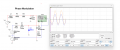
It can be difficult to see on a spice Oscilloscope but here is a slower version.
The output in red moves up and down.

1761961090359.png
 
Last edited:

Thread Starter

Mike2526

Joined Nov 10, 2020
86
A radio builder might use BB833 because it is a low voltage varactor that works nicely.
Remember that the 400Hz rides on top of the DC bias.

Code:
* Varactor bias network for BB833
Vbias  vbias 0  DC 5V          ; DC bias supply (set to 5 V)
Rbias  vbias vctrl 100k        ; High-value resistor to isolate RF
Cmod   vmod  vctrl 10u         ; Coupling capacitor for 400 Hz modulation
Vmod   vmod  0  SIN(0 0.5 400) ; 400 Hz modulation source, ±0.5 V
Cshunt vctrl 0  1n             ; RF bypass to ground at varactor node
Dvar   vctrl tank BB833        ; Varactor diode connected into LC tank

.model BB833 D(Is=1n Rs=2 Cjo=30p M=0.5 Vj=1.0 Fc=0.5)

Vbias: Provides the DC reverse bias (adjust 2–10 V depending on desired capacitance range).
Rbias: Feeds the DC bias while isolating the RF tank.
Cmod: Couples the 400 Hz modulation into the varactor node.
Vmod: Your 400 Hz sine source. Adjust amplitude to set modulation depth.
Cshunt: Provides a low‑impedance path to ground at RF, ensuring the bias node is “quiet” at 8 MHz.
Dvar: The BB833 varactor diode model. The .model line above is a generic SPICE diode model with capacitance parameters approximating the BB833. You can refine it with exact datasheet C–V values.

Use Ltspice FFT to fine tune the bias network looking at the side lobes.

It can be difficult to see on a spice Oscilloscope but here is a slower version.
The output in red moves up and down.

View attachment 358045
Thank you so much for sharing a detailed response. Sir, I would like to ask one question: as I have used two inverted voltage sources (VP1 & VP2 in my schematic), what about the inverted voltage source? Should it be the same circuit or a different strategy? I shall be grateful to you if you can do this experiment on my .asc file. Thanks in advance for your kind understanding and cooperation.
 

sparky 1

Joined Nov 3, 2018
1,218
Doing more testing I found an error in the above simulation.
I am tempoarily unable to access my older files. The problem is with the varactor.
The Ltspice is also affected by hardware issues and file system recovery.
 
Last edited:

sparky 1

Joined Nov 3, 2018
1,218
1762084635886.png

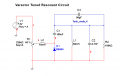
Converted this schematic to an Ltspice .cir in converting, Open a new simulation add the parts. Keep the same labels and nodes then debugging will be easy.
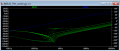
This program characterizes a varactor it shows what the varactor needs to fine tune a PM circuit. Performing a voltage sweep the varactor's capacitance is changing the resonance of the tank. 200kHz was chosen to give simulation best visual feedback. From this model other frequencies can be calculated and tested on Ltspice.
It is a tool to facilitate the use of any varactor and size it for radio and other applications. From low band up it is possible to use low voltage varactors.
This demo is meant to show that precision voltage tuning is absolutely within reach for an intermediate to advanced level or very careful step by step approach.
I am sorry it does not completely resolve the T bias PM modulator above at this time.

1762085186278.png
 

Attachments

Last edited:

Thread Starter

Mike2526

Joined Nov 10, 2020
86
Dear Sir, Thank you so much for sharing and helping me a lot. The above-mentioned graph is simulated but using a "varactor-tuned tank circuit." But I would like to ask, did you attach this tank ckt to my PA circuit? This graph shows the AM-AM and AM-PM of my PA circuit at the frequency of 8.2 MHz. Thanks in advance for your kindness.
 

sparky 1

Joined Nov 3, 2018
1,218
I managed to piece together a working LTspice .asc and adjust the varactor tuned tank circuit for 200kHz..
Enclosed is the simulation with a .measure statement to generate a plot for whoever stumbles across Varactor tuning for radio.
right click on the graph and "add a trace" called V(Tank)
 

Attachments

Last edited:

Thread Starter

Mike2526

Joined Nov 10, 2020
86
I managed to piece together a working LTspice .asc and adjust the varactor tuned tank circuit for 200kHz..
Enclosed is the simulation with a .measure statement to generate a plot for whoever stumbles across Varactor tuning for radio.
right click on the graph and "add a trace" called V(Tank)
Thank you so much, dear Sir. Let me work on it and update you soon.
 
Top