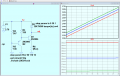
i fixed one huge error which was OA4 was accidently connected to have positive feedback instead of negative. so we now have that side of things working. but still no response at the output from OA3, and no response when adjusting the gain pot.
temperature readings taken from OA4 output are 6°c 1.285v and 18°c 1.209v.
could it just simply be down to adjustment now? whatever i try doesnt seem to help though.
here you go, the same circuit as before but with OA4 flipped upside down.
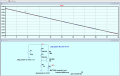
now, what i am rather startled about is, quite a log time after the temperature probe was put in the fridge, and a long time after the output from OA4 rose to 1.285v, the output from OA3 did in fact slowly begin to come down and has settled at 970mv, which is only slightly below the simulation target of 1.081v. Now im struggling to get my head around this- why the lag? it isnt actually a problem, in fact its probably quite beneficial in this application, but im wondering now how i can possibly set the pots correctly if its taking so long to respond??
Looks like we are getting close to sorting it though!
now i see why, its not lagging, it needs to get down below a certain point before it starts controlling the output to the load transistor. it appears this works linearly up until it reaches 1.347v and then sits there at the voltage.
regards
Why is this so hard. Is this still a level translation problem or did it progress beyond that at some point?
I'm just asking because level translators are not that complicated even when the range has to change also.
we have the level translation working, but its not letting me adjust it to the parameters i need. Its like it has some sort of upper limit at the output which is far below what it should be.
Hi Steve,
You must consider that you are using a low Vsupply of ~3.7V which does give you much headroom to remove that ~2.5V DC level on top of which the actual sensor signal is measured.
I would suggest you consider inverting that constant current source, so that one end of the sensor diode is connected to 0V, then amplify/shift the signal to suit.
E
If you want a draft circuit idea for the CC, just ask.
Are we certain the circuit is absolutely correct? Because from what I can tell, the simulation software I use cant tell the difference between certain op amp configurations.
On the real version the following is happening-
Output responds to input but cannot be amplified, in fact, turning the gain pot has the opposite effect to what you would expect. The offset can be adjusted to give what ever output I like, but this is not responding to the sensor signal at anything above 1.4 vout. If you cool the sensor, it will respond a little, but I cant adjust the gain enough to get the right readings even at the lower ends of the scale.
Is it possible that the circuit which should cancel out the first 1.2v is working in a back to front manner and actually limiting the output? from what I can tell it certainly appears so.
If it requires more circuitry then so be it, and I would be interested to see a draft circuit as this is a side to electronics I have not really had much to do with with before, and I am very keen to learn. But I would like to be double sure that we don't have some other drawing or wiring error first.
Hi S,
I guess you realise that the LM324 Vout is limited to Vsup -1.5V into 2K load.? ie: 3.7-1.5V = 2.2V.
As explained, this will cause limiting and non-linearity problems that you are experiencing trying for 2.4V through 0.9V. ouput.
The reason I chose 3.7v is because ideally id like this to run from a USB supply, but these can be anywhere between 4.8v and 5.1v which plays havoc if it were to fluctuate. Ive used a buck converter to give me a much more stable supply but obviously v in needs to be at least a volt higher than v out. I had wondered if there was a circuit that could clamp the input at USB minimum voltage of say, 4.8v but i couldnt find anything i thought was stable enough. A buck/boost converter is another consideration but i have space constraints. Is there anything i've missed? Do perfectly stable USB chargers exist? Voltage regulator IC that can work with vout close to v in?
Hi S,
This is a sim of the inverted CC source, note I have also stepped the Vsupply 4.8V thru 5.1V.
The OPA's will be OK and if we use zeners for the offset voltage sections there should be minimal problems.
Give it a run in your simulator.
E
the problem im going to have is the temperature readout. it is a repurposed ammeter with a full scale deflection of only 120mv.
Its driven from vcc with a NPN transistor. The slightest fluctuation of input voltage is a rather large deflection on the gauge.
Im going to see if i can drive the transistor base at a narrower voltage range. see if i can get 2v on the op amp output to drive it full scale, but also hope it can drive the transistor low enough for the gauge to read zero.
Ill get back to you with the results.
steve
So, ive carried out the changes above. The output voltage now needs to be 0.7- to 2v.
The circuit will not operate within this range but it will let me adjust it outside of these ranges.
Does the first trim pot need to be set to a specific voltage and then left alone? Whatever i do, i can either get low to mid range working correctly or mid to high range working correctly, but the circuit refuses to do both despite the simulations saying they should. Im pretty sure im not driving any opamp stage into saturation so why wont it simply adjust to the right parameters? Is there anything else ive potentially done wrong/not thought of???
here you go. fixed resistors all correct, pot R4 adjusted to give 1.282v at OA1 + input. Pot R7 set to the resistance in the drawing, pot R12 set to give1.142v ate OA3 + input. it works brilliantly up until OA3 output gets to 93mv. it then simply stays there and refuses to go higher. Its annoying because i only need to get it to 116mv.
I wonder if upping the voltage on the buck converter ever so slightly might just squeeze the extra mv's i need? itll be good if it limited itself around 115mv as that would save the need to worry about over-driving the gauge.
The reason I chose 3.7v is because ideally id like this to run from a USB supply, but these can be anywhere between 4.8v and 5.1v which plays havoc if it were to fluctuate. Ive used a buck converter to give me a much more stable supply but obviously v in needs to be at least a volt higher than v out. I had wondered if there was a circuit that could clamp the input at USB minimum voltage of say, 4.8v but i couldnt find anything i thought was stable enough. A buck/boost converter is another consideration but i have space constraints. Is there anything i've missed? Do perfectly stable USB chargers exist? Voltage regulator IC that can work with vout close to v in?
Look for a "low dropout voltage regulator".
If your current is low you can find a lot of these things. With 4.7v minimum input you can get 4.5v output easy, and regulated. Some work with even higher currents than 100ma.
Look for a "low dropout voltage regulator".
If your current is low you can find a lot of these things. With 4.7v minimum input you can get 4.5v output easy, and regulated. Some work with even higher currents than 100ma.
Ye, I think thats the way im going to go. The simulation sees an op amp stage go as low as 600mv at the output. I had thought they go lower than this but you live and learn...
Ye, I think thats the way im going to go. The simulation sees an op amp stage go as low as 600mv at the output. I had thought they go lower than this but you live and learn...
That gets a little tricky. Sometimes for not too high current you can also use a series diode and pull down resistor to get to actual zero volts output. The diode anode connects to the output and the load connects to the diode cathode.
It all depends how much current you need on the output. This also limits the top end voltage too though, but sometimes that is not a problem. I had to do this on a solar project one time where I needed to measure current down to nearly zero.

 Facebook
 Google
 GitHub
 Linkedin