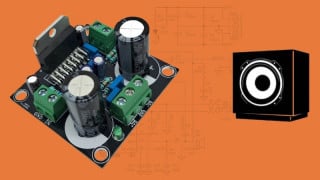
Adding startup and Shotdown sound to circuit

Thread Starter

juliaaaan

Joined Jan 22, 2025
45
Hello everyone,

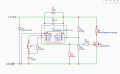
I have designed the following circuit (see attachment): A 555 timer is used as a flip/flop to control a MOSFET.

I want to add a startup and shutdown sound (two different sounds) to this circuit. My question is, what's the easiest way to do this (I have limited space)?
 

Attachments

MrChips

Joined Oct 2, 2009
34,628
Hello everyone,

I have designed the following circuit (see attachment): A 555 timer is used as a flip/flop to control a MOSFET.

I want to add a startup and shutdown sound (two different sounds) to this circuit. My question is, what's the easiest way to do this (I have limited space)?
Why would you want to do this except for the nerd effect?
 

Thread Starter

juliaaaan

Joined Jan 22, 2025
45
Why would you want to do this except for the nerd effect?
This circuit activates a steering wheel heater. The button that triggers the 555 timer cannot be placed in sight. So, to still be sure whether the steering wheel heater turns on or off, I want to play a sound for confirmation.
 

TechPete

Joined Apr 7, 2023
1
You could use a ultrasonic transducer to listen to the sounds and do the switching.
I used some of them for different applications but the principle I believe is the same.
The key is to know what frequency you need to listen. The transducer will generate an electric signal when it senses the specific frequency. F
rom then you will need to attach it to your electronics to to the switching from the electric impulse it senses.
If you need come examples, here they are:
SMATR25H15XTKA --> 25 Khz
SMATR10H40X80 --> 40 KHz
SMATR125H23KS --> 125 KHz
SMATR200D14K --> 200 Khz
I don't know what frequency range you need to work. Above are some examples with a good spread of frequencies and you can find several other frequencies searching online.
 

Thread Starter

juliaaaan

Joined Jan 22, 2025
45
You could use a ultrasonic transducer to listen to the sounds and do the switching.
I used some of them for different applications but the principle I believe is the same.
The key is to know what frequency you need to listen. The transducer will generate an electric signal when it senses the specific frequency. F
rom then you will need to attach it to your electronics to to the switching from the electric impulse it senses.
If you need come examples, here they are:
SMATR25H15XTKA --> 25 Khz
SMATR10H40X80 --> 40 KHz
SMATR125H23KS --> 125 KHz
SMATR200D14K --> 200 Khz
I don't know what frequency range you need to work. Above are some examples with a good spread of frequencies and you can find several other frequencies searching online.
Thanks for your response. However, I don't want to control the circuit with a sound, I want to play a sound through a speaker when the system is turned on or off.
 

Thread Starter

juliaaaan

Joined Jan 22, 2025
45
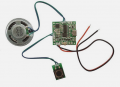
Thank you for your response, that's along the lines of what I had in mind. However, this PCB doesn't fit in the space where it needs to go, so I'm actually looking for a circuit diagram of a similar system that I can implement on my own PCB.
 

dendad

Joined Feb 20, 2016
4,635
I could not remember the boards I used so had to go and dig in my shed......
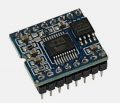
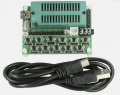
Look for the WT588D boards on Ebay.
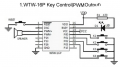
They are about 2cm square and will drive a speaker with 4 switch contact select-able sounds, many more if you drive them from a processor, like an Arduino.

1744632977303.png
1744632636109.png
They are under $5 each.
You will need a programmer...
1744632712484.png
and they are less than $15.

This may help...
https://www.instructables.com/Getting-the-Most-Out-of-a-WT588D-Sound-Module/
 

Thread Starter

juliaaaan

Joined Jan 22, 2025
45
I could not remember the boards I used so had to go and dig in my shed......
Look for the WT588D boards on Ebay.
They are about 2cm square and will drive a speaker with 4 switch contact select-able sounds, many more if you drive them from a processor, like an Arduino.

View attachment 346917
View attachment 346915
They are under $5 each.
You will need a programmer...
View attachment 346916
and they are less than $15.

This may help...
https://www.instructables.com/Getting-the-Most-Out-of-a-WT588D-Sound-Module/
I've chosen a similar circuit to create my startup and shutdown sounds. In this circuit, pin 1 needs to be grounded for the startup sound, and pin 2 for the shutdown sound. I'm now looking for an IC or circuit that can alternately ground these pins using a single push button (from the steering wheel heater). I've looked into some logic-level ICs, but the problem with those is that one output is always the inverse of the other. Since the circuit shouldn't produce any sound when the car is started (and thus the circuit gets power), neither pin 1 nor pin 2 should be grounded at that time. Does anyone have a possible solution for this?
 

Thread Starter

juliaaaan

Joined Jan 22, 2025
45
I have installed steering wheel heating in my car. With a single push button, I can turn the heating on and off using a single switch.


To this circuit, I want to add startup and shutdown sounds using a DY-SV17F (voice module). Connecting pin 1 to ground plays the startup sound, and pin 2 plays the shutdown sound.


To achieve this, I've devised the following logic system:


General description: an RS latch, a NOT gate, and an AND gate.


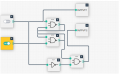
  1. The car is started and the circuit receives power (see figure 1): The reset of the RS latch is temporarily held high (using an RC circuit) to ensure both outputs remain low.
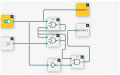
  2. The steering wheel heating is turned on (see figure 2): Output 1 goes high, grounding pin 1 of the MP3 module to play the startup sound. Additionally, the output of the RS latch is set high and latched.
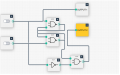
  3. The steering wheel heating is turned off (see figure 3): Through the NOT gate and the latched RS circuit, both inputs of the AND gate are high, causing output 2 to go high and play the shutdown sound.

Since the RS latch is not reset after the car is started, it will remain high, allowing toggling between on and off.

My question to you is whether this circuit will actually work, or if there is an easier way to generate the same output sequence using a single 12V on/off signal.?
 

Attachments

Top