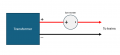
Assuming the ammeter will be external to the transformer, you need to disconnect the wire to the + output of your transformer and connect it to the - terminal of your ammeter (assuming you have one already) then connect the + terminal of your ammeter to the + output of the transformer. That's it.
Voltmeters are wired in parallel with the source, that is across the + and - while ammeters are wired in series, meaning inline with the source.
So whether you want to build it into the transformer case or make it external, the basic idea is the - of the transformer goes to the + of the ammeter and then you can think of the - side of the ammeter as the new output of the transformer.
[EDITED FOR REVERSED POLARITY (NOW CORRECT), SEE POST BELOW]
Err... are you sure that's the right way round Ya'akov? When I use my multimeter, red (+) goes to the higher voltage side, eg the source... (convention is current flows from + to - )
Err... are you sure that's the right way round Ya'akov? When I use my multimeter, red (+) goes to the higher voltage side, eg the source... (convention is current flows from + to - )
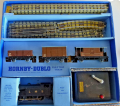
My first & only train set was ( iirc - 60+ y ago) a 3 rail AC system (of now unknown make, solid tin-plate base to the tracks?) with a speed control, but reversing was a lever on the loco. When my 1st son was born, 45y ago, I bought him/me a Hornby set which was, and still is, 12v DC. Was once a big static setup in the attic but now confined to a box which occasionally my 8y old grandson gets out. Lovely memories...
To further digress, my trains set when I was a kid was made by Marx.
It had a 4-wheel steam locomotive model running on AC with a three-rail track (027 gauge I think).
It was reversed by starting and stopping the train.
I ran it on a rectangular track, set on a piece of 4' x 8' plywood with one set of track switches going to a track through the middle of the rectangle, with a model train station that generated a steam train whistle sound.
The sound was produced by a small motor driving a centrifugal fan the blew through a two-tone plastic whistle.
I showed my electrical understanding early to solve a problem with the train, where it significantly slowed down on the far side of the track from the transformer connection, due to track resistance.
To minimize that I ran one transformer connection to the near side of the track and the other connection to the far side.
That way the effective total track resistance from the transformer to the train was more constant no matter where the train was, and it then ran at a fairly constant speed all the way around.
I played with the train so much that the gear driving the wheels on the locomotive wore out.
We actually were able to send it in for repair and they replaced the gear.
Digressing further, a little research suggests my earlier set was actually Hornby Dublo 3-rail which makes sense for the age! Also the original controllers were 14v DC for the track and 16v AC for accessories (old school rectifiers?!)
One complication is that train transformers/power packs have a reversing capability. This can be a simple reversing switch (DPDT) and your ammeter will need to be installed before the reversing switch. Some more complicated ones have a dial that rotates in both directions and uses a relay as the voltage reversing switch. Would need more information on your power pack.
One complication is that train transformers/power packs have a reversing capability. This can be a simple reversing switch (DPDT) and your ammeter will need to be installed before the reversing switch. Some more complicated ones have a dial that rotates in both directions and uses a relay as the voltage reversing switch. Would need more information on your power pack.
Good point. If ammeter is digital, it'll most likely just display a negative # when in reverse. If not, it'll need to go before the reversing switch/relay.
ah ha, that's what I thought I heard and was afraid of. I did hook up the amp meter and volt meter to the wires running to the track outside of the transformer an it does work but only in one direction. was wondering if I got analog meters with the needle pointing on zero in the middle of the meter with a plus and negative side if that would show both directions. I can use as is in only one direction but thought if I can get that kind of meter with negative and positive if it would work.
Mrc made a transformer called tech 3 with amp and volt meters but they don't make them anymore . you can find them on eBay once in awhile but not cheap. not a big deal it works with meters attached outside but only in one direction which I can live with. might open up transformer and see if I can add it to inside before the direction switch someday if I feel up to it.
Similar to bertus's suggestion, you could use a Schottky 5A bridge rectifier to connect the ammeter (ammeter connected across center of bridge).
That would give about a 1V total voltage drop in the output supply voltage @ 3A, if that's acceptable.

 Facebook
 Google
 GitHub
 Linkedin