Adding directionality to ferrite rod receiving antenna...

Thread Starter

Externet

Joined Nov 29, 2005
2,635
Would this contraption work ?

A wound horizontal ferrite rod antenna receiving a 100KHz signal as for RF direction finding.

If a second ferrite rod, bare with no windings is placed/attached/joined parallel next to the receiving wound one; would the signal coming from the direction of the bare rod be sensed as weaker ?

W= wound receiving rod
B= bare rod

RF signal source ---> )))))))) W B bare rod 'behind' wound one = higher signal strength ?

Rotating 180° :

RF signal source ----> )))))))) B W wound rod 'behind' bare one = weaker signal strength ?


(It is about building-in non-ambiguity for direction finding)
 

AlbertHall

Joined Jun 4, 2014
12,625
You are looking to detect the signal maximum for the transmitter direction but the maximum is very broad and will not give you good accuracy. Consider looking for the signal null. This will be much sharper and will give greater accuracy.
 

Thread Starter

Externet

Joined Nov 29, 2005
2,635
Thank you.
Yes, but still the ambiguity persists for a null also. The intention is seeing if a 'blocker/attenuator' to one of the nulls or peaks is achievable with a physical passive element. Sort of director of reflector (as in Yagi) for a ferrite rod to produce a front/back gain difference.

I remember one of these RDF on a fishing boat had a button that when pressed indicated 'front or back' which could had well been an active circuitry coming into play.
 

DickCappels

Joined Aug 21, 2008
10,661
the signal coming from the direction of the bare rod be sensed as weaker ?

W= wound receiving rod
B= bare rod

RF signal source ---> )))))))) W B bare rod 'behind' wound one = higher signal strength ?

Rotating 180° :

RF signal source ----> )))))))) B W wound rod 'behind' bare one = weaker signal strength ?


(It is about building-in non-ambiguity for direction finding)
I could have made an argument for the ferrite to increase the signal no matter which side or end the additional ferrite was placed.

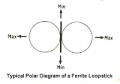
It was easy enough to perform a quick experiment, so I got out a battery powered AM receiver equipped with a loopstick antenna and a bundle of similar ferrite rods. I rotated the antenna horizontally to obtain the loudest signal. The antenna is most sensitive to signals perpendicular to the axis of the loopstick.
upload_2017-7-31_17-41-1.png

I found that placing the bundle of rods at about 1 cm either end produced the same result -no noticeable effect therefore no difference. Then I placed the bundle of rods one one side of the loopstick and then the other (left and right in the diagram above). The result was about 6db drop is amplitude from the headphones and there was no noticeable difference in the amplitude drop between when the rods were placed on one side of the loopstick or the other.

There may have been some de-tuning effect when placing the rods next to the loopstick but the fact that the audio drop off was the same no matter which side of the loopstick I placed the rods makes any de-tuning effect drop out of the question about directionality.

The electric sense antenna addition that AlbertHall suggested is the only disambiguation method I've seen.
 
Top