Facebook
 Google
 GitHub
 Linkedin
Hi,
We are developing an analogue front-end for a gas sensor project. We are planning to use the Analog Devices AD5940/AD5941. The reason for choosing this device is to provide us with flexibility.
We aim to use electrochemical gas sensors such as the NO₂ sensor from Alphasense, as shown in the link below:
Nitrogen Dioxide sensor NO2-B43F - Alphasense - B2B
In principle, we are replicating the following circuit from the application note:
aan_105-03_app-note_v0.pdf
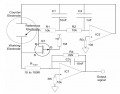
While replicating this circuit using the AD5940, it appears that our prototype PCB has a small error: we did not place the shorting capacitor between the Counter and Reference electrodes, as shown in the reference design (C1).
I understand that this RC circuit (R1 and C1) filters out any possible high-frequency noise. For a prototype, would I be correct in understanding that if the PCB is kept inside a Faraday cage-type enclosure (to shield it from high-frequency noise), we might be able to get away without using C1?
Our aim is to avoid the delay associated with producing a corrected PCB. Ideally, this capacitor will be included in the next PCB revision.
We are developing an analogue front-end for a gas sensor project. We are planning to use the Analog Devices AD5940/AD5941. The reason for choosing this device is to provide us with flexibility.
We aim to use electrochemical gas sensors such as the NO₂ sensor from Alphasense, as shown in the link below:
Nitrogen Dioxide sensor NO2-B43F - Alphasense - B2B
In principle, we are replicating the following circuit from the application note:
aan_105-03_app-note_v0.pdf
While replicating this circuit using the AD5940, it appears that our prototype PCB has a small error: we did not place the shorting capacitor between the Counter and Reference electrodes, as shown in the reference design (C1).
I understand that this RC circuit (R1 and C1) filters out any possible high-frequency noise. For a prototype, would I be correct in understanding that if the PCB is kept inside a Faraday cage-type enclosure (to shield it from high-frequency noise), we might be able to get away without using C1?
Our aim is to avoid the delay associated with producing a corrected PCB. Ideally, this capacitor will be included in the next PCB revision.