Interfacing with Electrochemical Gas Sensors

Thread Starter

hoyyoth

Joined Mar 21, 2020
528
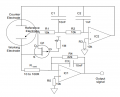
I am interfacing alphasense_cl2-d4 with TI CC1352P.This sensor will produce a current at its WE terminal when the gas is detected.Below is the circuit diagram from their reference design.Since the sensor output is a current I need to convert it to a voltage before connecting it to ADC.
1744909060207.png


I have 2 questions

1)May I know why they used a Rload (10 to 100R) here.I never see TIA like this

2)In my case I need to provide a voltage of 1.65V at IC1 non inverting input,because TI CC1352P is working at 3.3V.Please confirm
 

MisterBill2

Joined Jan 23, 2018
27,180
As it is shown, what is marked as Rload is not, by the standard understanding, a load resistor. The voltage at the non-inverting input depends on if IC1 has a bipolar power supply or only a positive supply.
I have not seen such a circuit either. I am guessing it is an effort to make the output closer to linear.
 
Last edited:

bertus

Joined Apr 5, 2008
22,885
Hello,

Did you read the text about the control circuit

Control Circuit
The control op amp (IC2 in figure 1) provides the current to the counter electrode to balance the current required by the working electrode.
The inverting input into IC2 is connected to the reference electrode and must not draw any significant current from the reference electrode. An op amp with an input bias current of less than 5nA is recommended.
When switching on the circuit, the depletion mode JFET (Q1 in Fig 1) goes to a high impedance state and IC2 provides the current to maintain the working electrode at the same potential as the reference electrode. Any offset due to the input offset voltage in IC2 will therefore cause a sudden shift in potential at switch-on. Toxic gas sensors have a large capacitance, so significant currents can flow for small potential shifts, so ensure that your op amp has a low offset voltage, certainly less than 1 mV and preferably less than 100µV; also check the op amp offset voltage at the
maximum usage temperature.
Typically, for an oxidisable gas (such as CO) with a platinum reference electrode, the counter electrode will be -300 to -400mV from the ground potential. However, if hydrogen ions rather than oxygen molecules are reduced, then the potential could be as large as -1.05V. Also, reducing gases (such as NO2 or Chlorine) force the counter electrode to oxidise water, evolving oxygen; in this case the potential relative to the reference electrode is between +600 and +800 mV, depending on the type of reference electrode. Therefore, you must allow IC2 enough voltage swing to drive the counter electrode to the required potential and with sufficient current demanded by the sensor. If the circuit is unable to do this, then e⁸xtreme non-linearities will occur at higher concentrations. It is best to allow ±1.1V swing on IC2 (plus any imposed bias voltage). This means that for a CO or H2S sensor the counter electrode wants to be typically -350 mV below the ground point, so IC2 needs a negative supply. If you are using a single ended low voltage power supply, pay particular attention to the available output swing on the op amp at the required current.
Table 1 below shows the maximum generated steady state current for each type of sensor. At full scale no sensor generates more than 210µA, but
allow at least 500µA for a general purpose circuit, although this can be decreased for specific, well tested sensor/ circuit combinations

Bertus
 

MisterBill2

Joined Jan 23, 2018
27,180
Given that the current is the variable, the circuit shown in the link is incorrect!! The load resistor would not connect to an opamp input like that. The connection in the link is wrong. At least it looks wrong to me! The opamp should be connected to read the voltage across the load resistor.
 
Top