Actuator- what kind do i need?

Thread Starter

wirenutz

Joined May 18, 2024
21
torque is calculated as product of force and length of the lever.
T=Fd*sin(a)
assuming angle is a=90deg, that simplifies to
F=Fd
so your measurements seem to be something like
T=10lbf*1in = 10lbf*in or 11.5kgf*cm
or
T=5lbf*3in=15lbf*in or 17.28kgf*cm

but you want to add some safety factor in there too so 25gf*cm servo should be fine.
the 150kgf*cm model will do too but it will cost more, be larger, require higher voltage and have way more torque.

https://hitecrcd.com/support/analog-vs-digital-servos#:~:text=Depending upon the speed and,thing as too much torque!
i would like to stay 12vdc on everything. less components, easier to troubleshoot, etc. i am ok with the cost of 150kfg if the cost of support components is affordable. i am however having a problem matching the individual components. would you mind recommending matching components to me & the best way to add wireless remotes ( key fob if possible). i think what internet is calling a tester is actually a controller & maybe programmer? i prefer to use amazon but not a requirement. i understand that i will need to download the arduino app & i will study some more on this. thanks for your patience.
 

MisterBill2

Joined Jan 23, 2018
27,551
OK,using 12 volts for power and keeping te power use to a minimum defines a system that drives to a position and stops powering the move. That instantly disqualifies any RC toy servo because it needs a constant pulse signal. A motorized leadscrew could be used to drive to a position and switch off until it was commanded to move to a different position. That could be quite simple.And depending on the required lifetime it could also be fairly cheap, if the leadscrew were a piece of threaded steel rod stock. Then just a fairly small 12 volt gear motor could do all of the moving.
 

Thread Starter

wirenutz

Joined May 18, 2024
21
OK,using 12 volts for power and keeping te power use to a minimum defines a system that drives to a position and stops powering the move. That instantly disqualifies any RC toy servo because it needs a constant pulse signal. A motorized leadscrew could be used to drive to a position and switch off until it was commanded to move to a different position. That could be quite simple.And depending on the required lifetime it could also be fairly cheap, if the leadscrew were a piece of threaded steel rod stock. Then just a fairly small 12 volt gear motor could do all of the moving.
i looked at screw drive when i originally started this & have kept it in mind as a reference. now that i have learned(use that term loosely) i tend to agree. the problem is that they are long(6"+) & it requires mounting to push/pull. this is where i have the least amount of room to mount. i just had an idea- hold that thought.
 

Thread Starter

wirenutz

Joined May 18, 2024
21
i looked at screw drive when i originally started this & have kept it in mind as a reference. now that i have learned(use that term loosely) i tend to agree. the problem is that they are long(6"+) & it requires mounting to push/pull. this is where i have the least amount of room to mount. i just had an idea- hold that thought. remote actuator actuator2 this is what i got in mind? maybe, y/n, learn more, pick another career ...
OK,using 12 volts for power and keeping te power use to a minimum defines a system that drives to a position and stops powering the move. That instantly disqualifies any RC toy servo because it needs a constant pulse signal. A motorized leadscrew could be used to drive to a position and switch off until it was commanded to move to a different position. That could be quite simple. And depending on the required lifetime it could also be fairly cheap, if the leadscrew were a piece of threaded steel rod stock. Then just a fairly small 12 volt gear motor could do all of the moving.
 
Last edited:

MisterBill2

Joined Jan 23, 2018
27,551
I have seen a picture of a "maker built" lead-screw made with the threaded 3/8-16 rod stock. One end was bored out to fit over the 1/8 inch diameter shaft of a gear-motor. Clearly the difficult part was boring the hole in the end of the shaft. THAT will require a lathe.
But another option would be a disc, or a portion of a disc, bolted ti the end of the shaft that the lever rotates. That could even be a fine-pitch sprocket, with a much smaller sprocket on the shaft of a gear motor. OR it could be half of a worm gear pair. That would tenr to not back-drive and so it would stay where it was stopped.
 

Thread Starter

wirenutz

Joined May 18, 2024
21
I have seen a picture of a "maker built" lead-screw made with the threaded 3/8-16 rod stock. One end was bored out to fit over the 1/8 inch diameter shaft of a gear-motor. Clearly the difficult part was boring the hole in the end of the shaft. THAT will require a lathe.
But another option would be a disc, or a portion of a disc, bolted ti the end of the shaft that the lever rotates. That could even be a fine-pitch sprocket, with a much smaller sprocket on the shaft of a gear motor. OR it could be half of a worm gear pair. That would tenr to not back-drive and so it would stay where it was stopped.
actuator2 i posted this in the last thread just after you responded. i can weld a washer to the sleeve to fit the lever.
 

MisterBill2

Joined Jan 23, 2018
27,551
OK, yes, one of those will easily provide enough force, and they will stay in position when the power is off.
But welding to that "nut" may not work, because there is probably plastic as pat=rt of the nut. Make a clamp pf some sort for it.Or a sleeve to slip over it, and weld to the sleeve before putting the sleeve on it.
 

Thread Starter

wirenutz

Joined May 18, 2024
21
OK, yes, one of those will easily provide enough force, and they will stay in position when the power is off.
But welding to that "nut" may not work, because there is probably plastic as pat=rt of the nut. Make a clamp pf some sort for it.Or a sleeve to slip over it, and weld to the sleeve before putting the sleeve on it.
yes, after i posted that i decided to make a clamp with a pin release
 
Hey wirenutz,

Welcome to the world of actuators! They can be overwhelming, but for your setup, a linear actuator (not rotary) sounds like a good fit. It pushes/pulls in a straight line, perfect for your lever.

Search for "12v DC linear actuator" with stroke length over 1.25 inches. You can often adjust end-points for the 1" and 1.25" throws.
 

Thread Starter

wirenutz

Joined May 18, 2024
21
Hey wirenutz,

Welcome to the world of actuators! They can be overwhelming, but for your setup, a linear actuator (not rotary) sounds like a good fit. It pushes/pulls in a straight line, perfect for your lever.

Search for "12v DC linear actuator" with stroke length over 1.25 inches. You can often adjust end-points for the 1" and 1.25" throws.
yes, thank you. i have been researching actuators for days. my problem is space. i don't have much room. i am still open to suggestions but i think i will have to use a right angle actuator. from center of the lever i need to move 1" forward & 1" reverse +/-. so the moving collar on a screw drive with limit switches at each end will work, 'i think'. i also researched step motors & again i could not find one that would fit in the tight space. i am still 'lookin' & 'learnin'.
 
Glad to hear you're narrowing down your options! Space constraints can definitely be tricky. Have you looked into the actuators for jedo door handles? They come in a variety of sizes and might be a good fit for your tight space. They also tend to be readily available online.
 

Thread Starter

wirenutz

Joined May 18, 2024
21
Glad to hear you're narrowing down your options! Space constraints can definitely be tricky. Have you looked into the actuators for jedo door handles? They come in a variety of sizes and might be a good fit for your tight space. They also tend to be readily available online.
i had never heard of them, so thanks for the input. i have looked at them & still the same problem. space. i don't have enough room to mount a push/pull actuator & motion of extension. i have about +/- 3 to 4" to push/pull. that small of an actuator does not allow for enough linear motion of 1". all of these small actuators only have 1/2 to 3/4" motion. i have ordered the r. angle screw actuator just to see if it will fit. if it doesn't i can return it keep researching. thank you
 

MisterBill2

Joined Jan 23, 2018
27,551
If you can post a photo of the area where an actuator might be located, it may be that some visitor to this thread might be able to suggest some device that the rest of us never heard of. All it takes is one good suggestion to solve the problem.
 

Thread Starter

wirenutz

Joined May 18, 2024
21
If you can post a photo of the area where an actuator might be located, it may be that some visitor to this thread might be able to suggest some device that the rest of us never heard of. All it takes is one good suggestion to solve the problem.
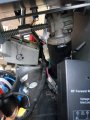
the photos i posted originally show the area. There are pencil marks showing how much movement i need. its less than 4" total length for a push/pull lever. in the pic the lever would move rt to lft. on the rt it is a 3/8" metal plate w/ no room on the backside so cutting a hole out won't work. on the lft is the cover(not shown). when the rt angle actuator gets here i will post for observation. thanks to all yall
 

Thread Starter

wirenutz

Joined May 18, 2024
21
the lever that i need to move is right behind the collar on that actuator screw shaft. notice the pencil marks at the base of the lever.. the lever pivots, forward/backward about 1". this actuator motor is 2" in diameter, for reference. to the right of the actuator is a 3/8" plate. from the lever to the plate is less than 4". no room for linear actuator with shaft extended. so i used rt angle actuator with screw shaft & this gives plenty of torque. wired it to forward/reverse wireless remote. i will mount micro limit switches to each end of the shaft to stop the motor & this will hold the lever in place while the machine is moving. i installed a kill switch next to the lever & the remote has stop button. it works without limit switches as of yesterday. to all yall, Thank You. please continue to do what you do. some of us really want to learn.
 

Attachments

Top