Actuator- what kind do i need?

Thread Starter

wirenutz

Joined May 18, 2024
21
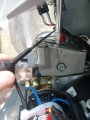
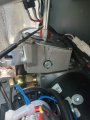
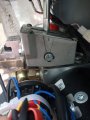
teach me; ( see pics ) i need to install a 12vdc actuator on a lever to move the lever approximately 1" +/- to the left & 1 1/4"+/- to the right. lever operates a hydraulic pump. first & second pics- i am pointing to the lever with a 12v test light. there are 3 pencil marks on the face of the lever mount. the middle pencil mark is neutral position(center). the mark to the right is forward (1 1/4" movement) & the mark on the left is backward ( 1" movement ). movement is from center. Notes; mounting room on this machine is limited. 12vdc system. i do not know anything about actuators, so i am studying online. i know wiring & electricity. i will also be adding a 12vdc wireless remote controller to the actuator. i am thinking a rotational actuator ( ? ) & it needs to be forward/reverse & be able to set the amount of movement to stop at 1" & 1 1/4". it does NOT need to return to neutral position (but if it does that is ok ). it CAN stay in the reverse position if necessary (power is OFF in neutral & reverse ). NOT a lot of torque involved to move the lever, but their is some torque because the lever uses springs to hold it in neutral. if you know actuators you have my absolute respect. who knew there were that many different kinds, makes, models, etc. any assistance with be treated with respect & my thanks.
 

Attachments

panic mode

Joined Oct 10, 2011
4,864
what is "not a lot torque"? need value.
also what about safety? what if the actuator fails and you need to disengage it?
a hobby servo could do it and you can have a mechanical coupling that allows decoupling (a pin or whatever).
the advantage of servo is that it does have built in feedback so it can stop at different position.
to drive servo you would need something to generate pulses.
 

LowQCab

Joined Nov 6, 2012
5,101
Generally speaking, and without knowing anything about the machine in question,
my first response is that this could be a very dangerous proposition.

There may well be very good SAFETY reasons why You need to physically have
your hands on a 100%-manual, mechanical, spring-return-lever, to make anything happen.
.
.
.
 

Thread Starter

wirenutz

Joined May 18, 2024
21
what is "not a lot torque"? need value.
also what about safety? what if the actuator fails and you need to disengage it?
a hobby servo could do it and you can have a mechanical coupling that allows decoupling (a pin or whatever).
the advantage of servo is that it does have built in feedback so it can stop at different position.
to drive servo you would need something to generate pulses.
thank you for your info but i don't know anything about actuators. now i will study 'hobby servo ' controller & now 'Arduino board first vs Raspberry Pi ' . the remote that i mentioned has a emergency stop/disconnect. also i will be using a pull pin to mechanically connect to lever.. i do not know what generates pulses. this 'lever controller' will only be used a few times a day, does it have to have pulses consistently?
 

panic mode

Joined Oct 10, 2011
4,864
yes... servo needs pulses constantly. duty cycle of the pulses tells position where the servo is to go. there are ready RC controllers and receivers so this can be plug an play. you just need one channel. this is all totally doable but as stated in previous posts safety is a concern. but if you are the only one using it you are entitled to do whatever you want. if someone gets harmed it will be just you.
 

Thread Starter

wirenutz

Joined May 18, 2024
21
yes... servo needs pulses constantly. duty cycle of the pulses tells position where the servo is to go. there are ready RC controllers and receivers so this can be plug an play. you just need one channel. this is all totally doable but as stated in previous posts safety is a concern. but if you are the only one using it you are entitled to do whatever you want. if someone gets harmed it will be just you.
assuming that a fishing spring scale & a regular spring scale are the same? i measured 8.5to 9.5 lbs of pull one inch from the base of the lever but at three inches from base of lever i got less than 5 lbs of pull. but i don't know the mass/speed of a lever that operates a 1.5hp motor? i also used a push spring scale but i get a lower read on it. so when its not in use(lever) it gets a 0 pulse? does it return to neutral? or does the pulse keep it at last position? the hp has nothing to do with the torque, its the springs that hold the lever in neutral that cause the torque on the lever. i'm thinking outload & typing, sorry.
 
Last edited:

panic mode

Joined Oct 10, 2011
4,864
no... pulses are always there... it is called a pulse train.
interval between pulses does not change, pulse length does,
it is a narrow pulse with length related to actuator position, something like this:
1717358141716.png
check the online tutorials/demos for more info.
 

Thread Starter

wirenutz

Joined May 18, 2024
21
no... pulses are always there... it is called a pulse train.
interval between pulses does not change, pulse length does,
it is a narrow pulse with length related to actuator position, something like this:
View attachment 323738
check the online tutorials/demos for more info.
no... pulses are always there... it is called a pulse train.
interval between pulses does not change, pulse length does,
it is a narrow pulse with length related to actuator position, something like this:
View attachment 323738
check the online tutorials/demos for more info.
thank you. i have watched a few videos & that was the best at a simple explanation for a dumb ol country boy. so my spring test for lbs of torque/force not good? please suggest a way to get lbs of force on lever? this is a hi torque adjustable servo on amazon [150kg Digital RC Servo] - DS51150 12V waterproof IP66 high torque. ASIN; B0CXLM953C i am having a hard time finding a reversible controller that i can connect to a wireless remote controller.
 

Thread Starter

wirenutz

Joined May 18, 2024
21
i think i just realized that if i put a wireless remote on this servo controller that; it will only turn ON the 12v when i am using the machine. when not using the remote, the receiver will power OFF. so some servo have a wireless remote. can these remotes set the pulses also? ok, so i need to use a Arduino to program a key fob & set the servo motion?
 

panic mode

Joined Oct 10, 2011
4,864
torque is calculated as product of force and length of the lever.
T=Fd*sin(a)
assuming angle is a=90deg, that simplifies to
F=Fd
so your measurements seem to be something like
T=10lbf*1in = 10lbf*in or 11.5kgf*cm
or
T=5lbf*3in=15lbf*in or 17.28kgf*cm

but you want to add some safety factor in there too so 25gf*cm servo should be fine.
the 150kgf*cm model will do too but it will cost more, be larger, require higher voltage and have way more torque.

https://hitecrcd.com/support/analog...g upon the speed and,thing as too much torque!
 

MisterBill2

Joined Jan 23, 2018
27,169
OK, now it is time for a lot of questions. First, before even asking about the amount of force, a question about the actual motion: Is this a linear control, where a little bit of lever motion leads to slow movement and then a bit more leads to faster motion? Many hydraulic servo systems work like that. OR is it really just three positions: Forward, Stopped< and Reversed? As a matter of fact, I have designed a few of them for controlling hydraulic pumps. If only three positions are needed then possibly the whole of control can be provided by one small hydraulic cylinder and two small hydraulic valves and a wireless control with only three conditions.
But now if the control scheme is to be variable, with zero to 100% available in each of two directions, that is quite totally a different picture entirely.
So far all I have seen is a discussion of toy servo mechanisms. If I were to suggest something like that to a client that would be the end of the conversation.
Controlling a system that is capable of a lot of force is not the area where hobby class plastic actuators should even be part of the discussion.
AND, the TS has not even mentioned as to if the control is to be three positions only, or variable in each of two directions. Next question is about feedback: Is there to be any feedback, even from the lever motion back to the control system, to let it know that thw motion of the lever is completed.
 
Last edited:

Thread Starter

wirenutz

Joined May 18, 2024
21
torque is calculated as product of force and length of the lever.
T=Fd*sin(a)
assuming angle is a=90deg, that simplifies to
F=Fd
so your measurements seem to be something like
T=10lbf*1in = 10lbf*in or 11.5kgf*cm
or
T=5lbf*3in=15lbf*in or 17.28kgf*cm

but you want to add some safety factor in there too so 25gf*cm servo should be fine.
the 150kgf*cm model will do too but it will cost more, be larger, require higher voltage and have way more torque.

https://hitecrcd.com/support/analog-vs-digital-servos#:~:text=Depending upon the speed and,thing as too much torque!
i think i am starting to get the picture. its not simple but its not that complicated either. get a 12v IP65 hi torque servo. get a Arduino board. get a potentiometer . USB to USB cord. download control program to laptop. plug & play until i get it set. get a learning key fob & match it to servo(i think? still reading)
 

Thread Starter

wirenutz

Joined May 18, 2024
21
OK, now it is time for a lot of questions. First, before even asking about the amount of force, a question about the actual motion: Is this a linear control, where a little bit of lever motion leads to slow movement and then a bit more leads to faster motion? Many hydraulic servo systems work like that. OR is it really just three positions: Forward, Stopped< and Reversed.? As a matter of fact, I have designed a few of them for controlling hydraulic pumps. If only three positions are needed then possibly the whole of control can be provided by one small hydraulic cylinder and two small hydraulic valves and a wireless control with only three conditions.
But now if the control scheme is to be variable, with zero to 100% available in each of two directions, that is quite totally a different picture entirely.
first; no. the lever motion is one speed forward-one speed reverse. just 3 positions Forward, Stopped< and Reversed. this does control hydraulic drive pump motor. but i am trying to save battery power. an actuator uses minimal amps & simple to mount. please correct me if i am wrong, but a hydraulic control will need the pump motor & thats a lot of amps. i'm still learning, thank you
 

LowQCab

Joined Nov 6, 2012
5,101
There needs to be a lot more discussion on the SAFETY of such a Rube-Goldberg contraption.

What happens when the Control-Lever gets stuck in any particular position ?

It's going to happen at some point, then what's going to happen ?

It seems that nobody here can answer this question, or has bothered to even ask it.

Machines can destroy things or even kill someone.
.
.
.
 

MisterBill2

Joined Jan 23, 2018
27,169
OK, so it is strictly a 3 position system. THAT makes it easier. Now another question: Does it need to be able to be bypassed for "local control by a human"?? A simple leadscrew actuator with limit switches to stop it in each of the three positions can do the job. It would only draw power while changing positions, and if communication were lost it would return to neutral. That would be a bit like the hen-house door controller but with the at rest condition midway instead of at an end. It might also work to implement a rotary control to the end of that shaft that looks like the lever rotates it. That might require less space.
 

MisterBill2

Joined Jan 23, 2018
27,169
There needs to be a lot more discussion on the SAFETY of such a Rube-Goldberg contraption.

What happens when the Control-Lever gets stuck in any particular position ?

It's going to happen at some point, then what's going to happen ?

It seems that nobody here can answer this question, or has bothered to even ask it.

Machines can destroy things or even kill someone.
.
.
.
@L.Q.C, I have already been considering how to implement the return to neutral if there is a loss of communication. Unfortunately I have not yet asked about just what this system actually is. I do have quite a few misgivings, but it might be as benign as the control of a rope tow at a ski hill. OR NOT!!!
 

Thread Starter

wirenutz

Joined May 18, 2024
21
@L.Q.C, I have already been considering how to implement the return to neutral if there is a loss of communication. Unfortunately I have not yet asked about just what this system actually is. I do have quite a few misgivings, but it might be as benign as the control of a rope tow at a ski hill. OR NOT!!!
to mediate safety; this machine has 3/4" ground clearance. it will roll over a penny on concrete but a small rock in front of any wheel will stop it. i cannot walk as slow as this thing moves, its inches per minute. if this machine pinned you against the wall a small child could push it back to get out. it has to have a key to operate & it is in my pocket 24-7.no kids involved at all. key to my shop is in my pocket 24-7. shop is safer than a private swimming pool with locked gate, fence, & enclosure.
 

Thread Starter

wirenutz

Joined May 18, 2024
21
to mediate safety; this machine has 3/4" ground clearance. it will roll over a penny on concrete but a small rock in front of any wheel will stop it. i cannot walk as slow as this thing moves, its inches per minute. if this machine pinned you against the wall a small child could push it back to get out. it has to have a key to operate & it is in my pocket 24-7.no kids involved at all. key to my shop is in my pocket 24-7. shop is safer than a private swimming pool with locked gate, fence, & enclosure.
it does not need stops for human control. its on a track & has stops at both ends. how much power would it draw while changing positions ? how much space does this hydraulic control need ? very limited space is my problem. that is why i originally thought of 12vdc actuator.
 

MisterBill2

Joined Jan 23, 2018
27,169
If there is either compressed air or a bit of hydraulic power capacity available then a small double acting cylinder can move the lever in either direction with single-acting 3-way valves and any loss of control signal will revert the lever to the neutral position. So the safety function would be inherent in the design, not an add-on. The down side is that either valve would need to stay actuated for the duration of the movement. That could be a battery power issue.
 
Top