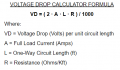
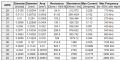
Let me try to pull it together... Not knowing the basis for the calculator, let's stick to the Single Phase Voltage Drop Equation. And it is the same equation for single phase AC or DC.
And the AWG Wire Table
Here is where it gets weird for me. According to the AWG, #12 wire is rated for 9.3A. The NEC rates #12 wire for 20A under most conditions including residential wiring. Other tables, depending on the usage of the wire and type of insulation (if any), give different amp ratings. Solid wire ratings are different than stranded just to confuse things even more.
But the bottom line is that my understanding that there is a substantial difference in voltage drop between AC and DC was incorrect and I stand corrected. While wire size and required fuse/breaker ampacity are defined, it is the actual amps on the circuit that determines voltage drop (all other things being equal). And there are max percent drop targets, depending on the circuit use, that should be designed for.
What is wrong?
Wire resistance is 168.026Ω.
Current 1A (Calculator can not change your choice).
With current 1A: Voltage drop 168.026*1=168.026V.
168.026V in comparison with 120V is 140.022%.
Pay attention to calculator's note: " *** For wire length of 2x10ft, wire length should be 10ft."
It calculates resistance of 2-wire cable.
So, instead 84Ω it shows 168Ω.
I suspect one of the problems with the calculator is the 'resistivity' line. This figure is the resistivity in Ωm not the resistance of the wire in Ω/m.
to be exact the war isn't over yet, at the time it was an economical race to distribute the electricity to every home,
today almost all the distribution is AC but beyond a certain distance the DC is more economical than AC (used in the north sea)
the inconvenient of AC is that it consume a reactive power not the DC
in the installations like a boat its more about safety to use a 12V or 24V...
i think the AC resistance must be the same as DC one (in the particular case where the frequency of AC is too high there is more resistance) in the same conditions
The difference is in the effect of the voltage drops, and the amount of current for a given power requirement. a 120 watt load on 120 volts only draws one amp, while on 12 volts a 120 watt load draws ten amps, and as a result it has TEN times the voltage drop in the wiring. And worse yet, that greater voltage drop is a much larger portion of the voltage for the load.
And as for the AC/DC argument, the fact is that even today it is more complicated to change voltages for DC than for AC. Mister Edison had the Dynamo technology and patents but nothing about alternators and transformers. Even today there are poorly informed folks touting the claimed benefits of DC in the homes. They still do not understand that while the LED lights may ultimately use DC, just like the TV and the computer, the different voltages needed by each would be a problem for distribution within a room or a house.. And then, also, consider the challenges of having a dozen switcher power supplies in a room.
Here is where it gets weird for me. According to the AWG, #12 wire is rated for 9.3A. The NEC rates #12 wire for 20A under most conditions including residential wiring. Other tables, depending on the usage of the wire and type of insulation (if any), give different amp ratings. Solid wire ratings are different than stranded just to confuse things even more.
AWG is a standardized definition of wire diameter, and as a result of the cross-sectional area and conductivity of the medium, a resistance per unit length can be calculated. Wikipedia has a good overview of the calculation. This is irrespective of AC and DC. On the other hand, NEC is an electrical standard to provide safety to the community over a wide range of scenarios... You're comparing apples and oranges... sure there's some loose similarities, but don't read too much into it.
Actually, the NEC, National Electrical Code, is authored by the NFPA, National Fire Protection Association, which is a Safety Organization. The NFPA is a very broad coverage document encompassing many Fire and Safety Standards and Codes. The NEC is also embodied in the SBC, Southern Building Code, which has been adopted by most State and Local agencies in the Southeastern States as setting the legal requirements for Residential and Commercial construction and occupancy. https://www.nfpa.org/
I have never come across that 9.3 amp rating for #12 wire, and so I am wondering what application that is related to. Could if be for use in encapsulated transformers? The 20 amp protection specified for #12 is based on temperature rise with a constant current. Where was that 9.3 amp rating shown? And for what sort of application??
seen: https://www.powerstream.com/Wire_Size.htm where it says: The Maximum Amps for Power Transmission uses the 700 circular mils per amp rule, which is very very conservative
It came from the AWG Table. And I have never seen that before as most of my work had to be done to NEC code specs. I have seen higher amp ratings than the NEC usually dealing with chassis wiring inside an enclosure and for very limited distances (as in inches).
So how much effect does "skin depth" have at 50 hZ? From the lecture on skin depth that I attended the bottom line was that it did not matter at our power line frequencies. And just try to imagine #2/0 Litz wire. Mind Boggling indeed.
Talking purely theory here, there is is essentially no difference in heating effects between AC and DC for a given RMS current at line frequency. That's why we measure AC values in RMS; RMS values are mathematical DC equivalents.
That is, until you get into large conductors and currents (or higher frequencies). Once you start dealing with conductors over say 1/2" in diameter or so, AC skin effect starts to become a real issue. Due to the constantly reversing flow of current, the conductor will build up a magnetic field that concentrates all of the current near the outer surface or 'skin' of the wire. This is why modern switchgear, unit substations and most plug-on bus ducts use *flat* busbar and braided jumpers instead of round wire; A flat conductor is fairly good at negating this effect. It's also part of the reason why power lines are usually comprised of a core of steel strands jacketed by aluminum ones.
As some people have already mentioned, conductors often need to be oversized above their allowable ampacities in automotive and marine applications because of the extremely low voltages employed. A drop of 3 volts on a 480 volt circuit is insubstantial. However that same drop on a 12 volt system constitutes a brown-out and could cause the load to malfunction or cease to operate completely. The only solutions are to either increase the system's nominal voltage, supply more copper for the electrons to travel through or upgrade to an electro-plasma system.
Another reason to use DC in high voltage lines is that, for a given current and peak voltage as limited by the insulators, a DC line can carry more power then a 3-phase AC system for the same peak voltage and amount of copper wire.
Another reason to use DC in high voltage lines is that, for a given current and peak voltage as limited by the insulators, a DC line can carry more power then a 3-phase AC system for the same peak voltage and amount of copper wire.
Correct me if I'm wrong, but doesn't HVDC also have less of an issue when it comes to corona discharge?
Though on the downside (if you can really call it that) I'm told HVDC lines do need to have their polarities reversed regularly to equalize dirt and dust accumulation.
The problems with DC distribution are at the ends of the line, because converting the DC power back to a conveniently usable voltage is a lot more complicated than with AC power. The 380 KV AC power just takes a big transformer to step it down, while with the DC system it takes some sort of inverter. And what sort of electronic devices are suitable for such high voltages? Probably much less efficient than a good transformer, no doubt.
Even coming into the house, as each appliance required a different voltage, it would get complicated. The lack of an efficient conversion method is what lost the battle for Edison and DC. It is very unfortunate that he did not figure that out a lot sooner.

 Facebook
 Google
 GitHub
 Linkedin