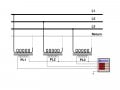
Is there is efficient way to monitor 3 phass 480vac , without losing too much power, is there chip I can use? I need to measure 480vac and send this signal to micro controller , also there is isolation between input(480vac) and micro side.
Is there is efficient way to monitor 3 phass 480vac , without losing too much power, is there chip I can use? I need to measure 480vac and send this signal to micro controller , also there is isolation between input(480vac) and micro side.
Yes, and for an industrial setting I recommend an off the shelf solution similar to this link. The link shows three wire (Delta) and four wire (WYE) solutions. They are simply voltage transducers and are available to measure either True RMS or Average Voltage and in most cases Average is all you need. Most devices like this output 4 to 20 mA which when run through a 500 Ohm or 250 Ohm will provide 2 to 10 Volts or 1 to 5 volts respectively for input to a micro-controller or data logger of your choice. You can also buy off the shelf phase monitors for phase rotation as well as under / over voltage sensors. The link is merely an example, there are dozens out there to choose from. As to voltage it's a matter of Delta or Wye in choosing a transducer.
Yes, and for an industrial setting I recommend an off the shelf solution similar to this link. The link shows three wire (Delta) and four wire (WYE) solutions. They are simply voltage transducers and are available to measure either True RMS or Average Voltage and in most cases Average is all you need. Most devices like this output 4 to 20 mA which when run through a 500 Ohm or 250 Ohm will provide 2 to 10 Volts or 1 to 5 volts respectively for input to a micro-controller or data logger of your choice. You can also buy off the shelf phase monitors for phase rotation as well as under / over voltage sensors. The link is merely an example, there are dozens out there to choose from. As to voltage it's a matter of Delta or Wye in choosing a transducer.
You might want to give us a range of whats considered "not so expensive" to you?
You are wanting to measure dangerous (deadly) voltage levels and asking for a "cheap" solution is not the smartest idea in the world..
What specifically are you intending to do with these voltage measurements once you have them?
Yes, you can do as mentioned using three small control type transformers stepping down 480 VAC to 24 VAC, then rectify it and if the micro controller has a high enough input impedance take your rectified voltage and use a voltage divider. This would be true of either a Delta or WYE 480 VAC source. I know the commercial solutions I suggested are expensive but they have their merits. Using a micro-controller I can input a voltage like 1 to 5 volts derived from the AC Transducers 4 - 20 mA output. For example 0 to 500 VAC = 4 - 20 mA = 1 to 5 Volts. Using some basic code I can display my AC mains voltage for each phase and use code to detect a low phase.
Here is an example of using a transformer to drop 230 VAC mains. Problem is you need to drop 480 VAC mains down to something useable. The example uses a 230 VAC step down to 6.0 VAC but finding a 480 VAC down to a good low level won't be easy. Even a 480 VAC to 24 VAC isn't real common. You could go 480 VAC down to 120 VAC and then 120 VAC down to 6.0 VAC but now you are butt deep in a total of 6 transformers before you even build the rectifier circuits. Then the entire combination needs some form of calibrated.
Part of the problem you face is when we get into 480 VAC three phase we get into industrial.
Problem is you need to drop 480 VAC mains down to something useable. The example uses a 230 VAC step down to 6.0 VAC but finding a 480 VAC down to a good low level won't be easy. Even a 480 VAC to 24 VAC isn't real common. You could go 480 VAC down to 120 VAC and then 120 VAC down to 6.0 VAC but now you are butt deep in a total of 6 transformers before you even build the rectifier circuits. Then the entire combination needs some form of calibrated.
Part of the problem you face is when we get into 480 VAC three phase we get into industrial.
I'd go for comparator precision rectifier applications and sample the 3 phases with suitable dropper resistors. 3 individual step down transformers would be more expensive, but safer and more reliable. Resist any temptation to sample the voltage with a rectifier/reservoir combination - the delay in sensing a failed phase could be long enough to burn a motor out.
Theoretically if I place two 240 V to 6 V transformer's primary's in series I can feed 480 V to them assuming they are identical. You still have two transformers per phase for a total of six. You just would not use three of the secondaries. I believe that is what kubeek was getting at anyway.
Here's something WAY out of left field: I used to have a pickup coil that would act like a microphone. Simply stick it to the (old style) telephone and you could listen in on the conversation, record it - whatever. What if you were to take some sort of pickup coil and stick it to a 480 V choke? In your case, three chokes.
Here's where I'm going with this. And keep in mind I have virtually NO experience with 3 phase.
Here's something WAY out of left field: I used to have a pickup coil that would act like a microphone. Simply stick it to the (old style) telephone and you could listen in on the conversation, record it - whatever. What if you were to take some sort of pickup coil and stick it to a 480 V choke? In your case, three chokes.
I had one of those several decades ago, Radio Shack sold one with a suction cup used for voice pickup on a telephone headset. Apparently they are alive and well on Ebay.
The problem becomes using one to detect a voltage. They are an inductive device and rely on changing current. Not quite like but remotely similar to using a current transformer to measure current. The pickup coil is not really looking at voltage but changes in current. Without any voice signal or changes in current the output is zero. This is why I doubt it would work well as a voltage sensor. Accurately sensing 3 phase 480 VAC and doing it accurately takes a relatively good voltage transducer and even just the average responding commercial units carry a hefty price tag. The price also increases with voltage to be measured and if the user wants true RMS responding.
I would have thought by now we would be seeing cheap Chinese AC Voltage Transducers pouring off the boats from China but not seeing that happen. While I am seeing some cheap (inexpensive if you prefer) AC Voltmeters and AC Current meters I am not seeing any with an analog output option offering an analog out signal proportional to the input.

 Facebook
 Google
 GitHub
 Linkedin