Facebook
 Google
 GitHub
 Linkedin
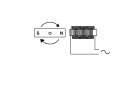
A magnet passing a coil will induce a voltage in the coil. The drawing shows an AC signal being generated. Two coils directly opposed (mounted on opposite ends) will produce more electricity. If they are located 120˚ apart they can produce three phase AC.
One coil, one magnet. OR you can have multiple coils and magnets and wire the coils either in series or in parallel you can increase the voltages or depending on how you wire them you can have multiple phases of AC.
Using a diode or bridge rectifier will change the output into DC voltages. The voltage will pulse badly with just a diode or pulse half as much with a bridge rectifier. But the rectifier is going to drop your voltage by about 0.7 volts for a single diode and about 1.2 to 1.4 volts for a bridge rectifier.
If you add a capacitor to the output (parallel to the output you can increase the DC voltage by almost 1.414 times. That means if you're reading 10 VAC, the addition of the capacitor will increase the voltage to 14.14 volts. Keep in mind there is going to be losses because of the diodes, and the capacitor is never a "Perfect" capacitor. That's why I said you'll increase voltage by almost 1.414 times. However, when working with electronics we use figures that are representative of "Perfect" components - no losses. But life comes with little trade-offs. You never get a perfect output.
One coil, one magnet. OR you can have multiple coils and magnets and wire the coils either in series or in parallel you can increase the voltages or depending on how you wire them you can have multiple phases of AC.
Using a diode or bridge rectifier will change the output into DC voltages. The voltage will pulse badly with just a diode or pulse half as much with a bridge rectifier. But the rectifier is going to drop your voltage by about 0.7 volts for a single diode and about 1.2 to 1.4 volts for a bridge rectifier.
If you add a capacitor to the output (parallel to the output you can increase the DC voltage by almost 1.414 times. That means if you're reading 10 VAC, the addition of the capacitor will increase the voltage to 14.14 volts. Keep in mind there is going to be losses because of the diodes, and the capacitor is never a "Perfect" capacitor. That's why I said you'll increase voltage by almost 1.414 times. However, when working with electronics we use figures that are representative of "Perfect" components - no losses. But life comes with little trade-offs. You never get a perfect output.
Attachments
-
 33.8 KB Views: 1