Ac generator and their loads

Thread Starter

mike _Jacobs

Joined Jun 9, 2021
223
I have a simple question with a not so simple answer I’m sure.

I wish to understand the connection between the physical rotation and force required to rotate a rotational type generator and the electric load that is placed on the outputs.

so In other words I’m talking about a generator speed control.

I have been told and seen by example that when the electrical load of a generator Increases the mechanical load of the engine increases and subsequently reversed when the electrical load decreases the mechanical load decreases and the engine must throttle down to keep from over revving

I don’t understand why that is.

let’s say for example you have a generator and it’s gas engine is outputting a constant rotational force in the shaft. It’s under some amount of load and producing electric AC voltage.

all of a sudden the load for the generator in shut off. The engineer then subsequently revs faster when the load is removed.

why is that? Why does opening the circuit cause a change in mechanical load on the shaft of the engine?

if the speed control was for voltage regulation I could understand that however that’s not the case I’m told.

why does the mechanical rotational force thag the gas engine needs to keep a constant force on the shaft change based on the electrical load??
That is the million dollar question

the only thing I can think of is magnetic forces caused by some kind of back emf perhaps?

thanks
 

ronsimpson

Joined Oct 7, 2019
4,647
Sit on your bicycle. I hold the back tire off the ground. Your job is to peddle at 60rpms. You are the motor and by watching the speed you are the governor.
When I set the bicycle on the ground your job gets really hard and you must work very hard to make 60rpm.
When I pick up the back tire you job is easy and you must watch to keep the speed down.

The generator's job is to make electricity flow. With no load there is no work being done. Easy job. If you short out the wires the generator is almost impossible to turn. With a good load the motor can turn the generator and force work into the load.
 

Thread Starter

mike _Jacobs

Joined Jun 9, 2021
223
Sit on your bicycle. I hold the back tire off the ground. Your job is to peddle at 60rpms. You are the motor and by watching the speed you are the governor.
When I set the bicycle on the ground your job gets really hard and you must work very hard to make 60rpm.
When I pick up the back tire you job is easy and you must watch to keep the speed down.

The generator's job is to make electricity flow. With no load there is no work being done. Easy job. If you short out the wires the generator is almost impossible to turn. With a good load the motor can turn the generator and force work into the load.
Sure I understand the analogy but it doesn’t make sense still

For your example, the friction of the bike tire against the road causes an increase in mechanical friction so there is more load on my legs peddling the bike

However that is not true with electricity.
The friction from the generator bearings is the same regardless of the electrical load. The rotor is turning in air and therefore there is no more load on the rotor mechanically

So what mechanical force changes that causes the motor to increase its work input based on the electrical load


Thag is the part I don’t get
 

WBahn

Joined Mar 31, 2012
32,704
The load, and hence the forces, are electromagnetic in nature.

Here's a real simple (and hence simplistic) explanation.

When you turn the generator, you have a magnet that is pushing electrons in a wire. By Newton's Third Law, those electrons are pushing back on the magnet. The amount of the force is related to how far and fast you push the electrons (i.e., the 'work' that is done on them). That's the load that is being seen as a mechanical load on the generator shaft. When you have no electrical load on the generator output, the electrons don't go anywhere, and so there's no work done on them (work is force through a distance), hence no force back on the magnets.

Of course, it's not as simple as this, but that hopefully gets a bit of the gist across.
 

crutschow

Joined Mar 14, 2008
38,322
In summary, look at it from an energy point-of-view, and that you can't get power out without power in.
Basically the engine is suppling rotational energy (speed times torque) to the generator that is proportional to the electrical load.
So generator mechanical power in equals electrical power out, reduced some by the generator efficiency.
Thus when the electrical load is removed, the mechanical load drops to near zero, and the driving engine will speed up (unless it has a governor to keeps it speed constant, as is true with (non-inverter-type) home main's electrical generators).
 
Last edited:

Ian0

Joined Aug 7, 2020
13,097
In order to power the load, the engine has to burn a certain amount of gas.
The throttle valve allows that amount of gas into the engine.
If you remove the load, it needs less gas, but you are allowing the same amount in.
Therefore it speeds up.
Try driving down a hill and see what happens if you keep the throttle open.
 

ronsimpson

Joined Oct 7, 2019
4,647
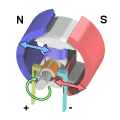
This is a picture of a DC motor but it will generate just fine.
Motor: this one has magnets. Passing current through the center coils turns the center metal into magnets and causes the center to rotate. N attracts to S.
Generator: With no load there can be no current flow in the center coils. The center metal is not magnetized. There is not attrition. The center can spin freely. There is voltage but no current because the wires are not connected. Now short out the wires and current flows. With current there will be (N&S) on the inside and N&S on the outside. With rotation the N on the inside is forced toward the N on the outside. They repel. It takes work to force the two magnets together. Because of the brushes we are constantly forcing N&N and S&S together. How strong the center magnets are is directly related to the current in the load.
1710765963325.png
 

Tonyr1084

Joined Sep 24, 2015
9,744
I'm going to give you a new job: Take a 25 pound weight and tie a 1 foot long string to it. Not a rope, a string. Your job is to hold your arm exactly 2 feet off the ground. While holding that weight in position your arm does the necessary work to keep the weight elevated. But if the string breaks - what happens to your arm? It flies upwards suddenly. You then relax your arm back to the 2 foot level. Your blood flows easier through the muscle because it's not under strain.

The generator is the weight. Your arm is the gas engine. To maintain a constant level of output the motor has to run hard. But when that load is removed the engine can relax. The carburetor throttles back and the engine runs freely.

There's no such thing as a perfect governor or regulator. As with ANYthing, the more you load it down the harder it will have to work to keep close to the target. If you were holding that 25 pound weight at a certain level and then I added another 10 pounds to it - suddenly you have to work harder. Your arm may even slightly droop. If I keep adding weight eventually your arm is going to drop so low that you can no longer maintain the elevation and your hand will just simply drop because the load is too great. Same with the generator. Overload it and either the breaker will trip or the engine will stall out. OR something in the generator will burn out.
 

nsaspook

Joined Aug 27, 2009
16,251
I have a simple question with a not so simple answer I’m sure.

I wish to understand the connection between the physical rotation and force required to rotate a rotational type generator and the electric load that is placed on the outputs.
...
thanks
There are a thousand detail about why kinetic energy (a part of mechanical energy) is converted to potential or kinetic electrical energy but the most basic rule is:

No free lunch with energy.
 

Reloadron

Joined Jan 15, 2015
7,857
let’s say for example you have a generator and it’s gas engine is outputting a constant rotational force in the shaft. It’s under some amount of load and producing electric AC voltage.

all of a sudden the load for the generator in shut off. The engineer then subsequently revs faster when the load is removed.

why is that? Why does opening the circuit cause a change in mechanical load on the shaft of the engine?
Changing the mechanical or electrical load on an AC generator will not change the rotational speed of the generator. This excludes the newer "inverter" type generators. Typical AC generators output a voltage and a frequency. The common frequencies are 50 or 60 Hz. The frequency is a function of the rotational speed of the generator. Here is how it looks:

So, one of the most common ways of changing the output frequency of a generator is to change the rotation speed of the engine. This can be helpful if you need to change from 60 cycles per second to 50, or vice versa.

The two factors relate as per the following formula:

  • Generator Frequency (f) = Number of revolutions per minute of the engine (N) * Number of magnetic poles (P) / 120
  • In other words, f = N*P/120
  • Or, P = 120*f/N
Therefore, a 2-pole generator producing an output frequency of 60 Hz has an engine speed of 3,600 rpm. Likewise, a 4-pole generator at an engine speed of 1,800 rpm produces output of 60 cycles per second.

so while the required torque may change the rotational speed does not change. Yes, as load changes the genset may momentarily speed up or slow down but regardless of load the engine speed is constant.

In theory 1.0 HP (Horsepower) is 746 watts of power and while this looks good on paper it is not really true. I have a small 4.000 watt (5,000 watt surge) generator in my garage. It is powered by an 8.0 HP gasoline engine. Well in theory 8.0 HP would be 8.0 * 746 = 5,968 Watts but my best is only 4,000 watts continuous. Well it's not a perfect world. Under full load (4.0 KW) I should only need 5.36 HP but the reality is I need almost 8.0 HP. When motors or generators run there is the efficiency factor. As someone mentioned energy in verse energy out. Feel a generator or motor running under load, do you feel heat? That's loss. The horsepower metric is defined as the work done by a force of 550 pounds acting through one foot in one second, or foot-pounds of work, the unit of power needed to raise 550 pounds one foot in one second.

Anyway matters not if the load is increased or decreased the rotational speed of an AC generator will remain constant. The rotational torque will change based on demand but not the speed. Again, this does not apply to the newer "inverter type generators".

so In other words I’m talking about a generator speed control.
The rotational speed is a fixed value and is controlled by a governor or CSD (Constant Speed Drive) on larger units.


Ron
 

nsaspook

Joined Aug 27, 2009
16,251
Changing the mechanical or electrical load on an AC generator will not change the rotational speed of the generator.
...
The rotational speed is a fixed value and is controlled by a governor or CSD (Constant Speed Drive) on larger units.
...
Ron
Should not

That's the key, closed loop-feedback to keep on frequency and voltage. I've been a ship with bad VF control on the SSTG (we had two but the other one was totally fried so we had nothing to synchronise to), so they switched to manual generation throttle (guys turning knobs while looking the the VF meter readbacks in the control room) . They would warn us when a heavy load was about to happen or was being stopped so we shutdown our electronic loads so they didn't get destroyed from the frequency and voltage swings. One of the old radars had huge autotransformers with gear motor voltage regulation. The motors chewed the gears teeth off trying to compensate.

This was on the USS Okinawa but the system was pretty much the same as below.
1710806151678.png
https://picryl.com/media/one-of-eig...tors-sstg-used-to-generate-electricity-6164f3
 
Last edited:

Reloadron

Joined Jan 15, 2015
7,857
My memories of shipboard power were interesting to say the least. :) Considering my first experiences were on CVN 69 USS Eisenhower when the ship was brand new our power was reliable. Nice pics and thanks for sharing. :)

Ron
 

nsaspook

Joined Aug 27, 2009
16,251
My memories of shipboard power were interesting to say the least. :) Considering my first experiences were on CVN 69 USS Eisenhower when the ship was brand new our power was reliable. Nice pics and thanks for sharing. :)

Ron
We had a reputation, that wasn't good.
1710864469995.png1710864550550.png
This was our combat tugboat. We were the Clown and they were on the Bozo Watch.

The Gator Navy was the lowest of the low on the budget tally in the 70's.
1710866292750.png
 

Reloadron

Joined Jan 15, 2015
7,857
Towing Brokinawa, Have to love it. I remember when a crew in the PAC wanted the boat to break because it meant a trip to Naval Ship Yard Subic Bay. Seems all the good places are long gone. Cubi Point across the bay was a favorite stopping point for me. :)

Ron
 

nsaspook

Joined Aug 27, 2009
16,251
Towing Brokinawa, Have to love it. I remember when a crew in the PAC wanted the boat to break because it meant a trip to Naval Ship Yard Subic Bay. Seems all the good places are long gone. Cubi Point across the bay was a favorite stopping point for me. :)

Ron
We are moving back.
 

MisterBill2

Joined Jan 23, 2018
27,186
Getting back to the generator:: The output current is produced by the change in magnetic flux that passes thru the coil wires. As that current flows it produces an opposing magnetic field. So WORK is required to keep the turns on the armature moving. The more current that flows, the more the opposing magnetic field grows, and so more work is required. There are equations and a bunch of vector math to prove this and attach real numbers to it, but that part is tedious and even painful. And only needed by those involved with producing efficient generators and alternators.
The folks designing efficient motors have it a bit easier.
But it all gets down to the reality of pushing current thru wires and the counter pushing of the current generated in those wires.
No analogies or funny comparisons, and no pictures of ships unprepared to defend themselves against nastys.
What gets to be a challenge is that while electricity is very difficult to see, at least it can be felt.
A magnetic field strong enough to be felt has already done damage, so run away as fast as you can.
 

nsaspook

Joined Aug 27, 2009
16,251
Getting back to the generator:: The output current is produced by the change in magnetic flux that passes thru the coil wires. As that current flows it produces an opposing magnetic field. So WORK is required to keep the turns on the armature moving. The more current that flows, the more the opposing magnetic field grows, and so more work is required. There are equations and a bunch of vector math to prove this and attach real numbers to it, but that part is tedious and even painful. And only needed by those involved with producing efficient generators and alternators.
The folks designing efficient motors have it a bit easier.
But it all gets down to the reality of pushing current thru wires and the counter pushing of the current generated in those wires.
No analogies or funny comparisons, and no pictures of ships unprepared to defend themselves against nastys.
What gets to be a challenge is that while electricity is very difficult to see, at least it can be felt.
A magnetic field strong enough to be felt has already done damage, so run away as fast as you can.
It's not the work of pushing electrons (charge carriers) thru wires that transfers electrical energy as the KE of current movements (with good conductors like copper) is very low and the net charge carrier movement is zero with AC current.

As you say (you get halfway there and then segway into the myth of electrons being electrical energy carriers), it's the fields that have the electrical energy and it's the fields that transfer energy from the mechanical forces.

That ship and others, unprepared to defend itself, is where many learned the hard reality of what we were taught in school about electrical energy. It's where generators broke and displayed what happens when you lose close-loop control and showed us in a very real way, the direct relationship of prime-mover drive to electrical energy output in voltage and frequency.
 
Last edited:

WBahn

Joined Mar 31, 2012
32,704
It's not the work of pushing electrons (charge carriers) thru wires that transfers electrical energy as the KE of current movements (with good conductors like copper) is very low and the net charge carrier movement is zero with AC current.

As you say (you get halfway there and then segway into the myth of electrons being electrical energy carriers), it's the fields that have the electrical energy and it's the fields that transfer energy from the mechanical forces.
So here's a challenge for you (and I would legitimately like to see the result).

Imagine two generators (we can make it as simple as a single loop of wire turning in a static magnetic field). In one generator, the wire is made of copper, but in the other generator it is made of glass. Since it is all about the fields and not about the movement of charge carriers and the net charge carrier movement is zero here (since this is going to be an AC generator), explain, in terms of the fields only, why we get power from one and not the other. Remember, no mention of any motion of charge carriers is allowed, everything must be described in terms of the fields.
 
Top