About opamp.

dl324

Joined Mar 30, 2015
18,326
Is there any other IC that is a comparator, but NOT an opamp?
That is not having an opamp arhitecture or design?
Opamps and comparators share a common front end (a differential amplifier). Opamps usually have compensation included in the second stage. Comparators don't need it because they're usually used to interface to digital logic or drive binary indicators. Originally comparators were all open collector, but now there are devices with push pull outputs.

With limitations, opamps can be used as comparators and comparators can be used as opamps. You just need to know when doing that is acceptable.
 

dl324

Joined Mar 30, 2015
18,326
@q12x I breadboarded the PWM circuit I posted using LM358 and LM393. I noticed some crossover distortion in the LM358 and ended up getting bogged down with studying it's limitations, using an opamp with rail to rail outputs (class AB output was "better" than class B), and checking calibration on a bunch of my vertical amplifier plug-ins.

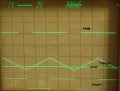
While the LM358 circuit performed reasonably well, the newer opamp was better behaved. Here are the waveforms:
pwm.jpg
The ground reference for the square wave is the bottom of the screen. For the triangle and level waveforms, one grid above the bottom. For the PWM signal, it's one grid above the middle of the screen. The square wave is shown at 5V/division, the rest are 2V/division.

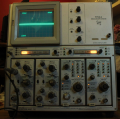
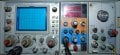
This is something you won't be able to do with the DSO138. It can be hacked to add a second trace, but 4 is out of the question. For the picture, I used a Tektronix 7704A with 2 7A26 vertical amplifiers. The on-screen display is something Tek came up with in the late 60's
 

Thread Starter

q12x

Joined Sep 25, 2015
2,227
mister @dl324 Thank you for your explanations and tests. Your last 2 answers are a bit over my head, you know me to be over sincere. I understand something but not at all entirely. And its fine. What I get from it is that comparators are dedicated components while opamps are general so they must have that "compensation included in the second stage " which only you know what it means. :]
Ive also look after your osciloscope Tektronix 7704A and i find its picture on internet, it looks very cool.
1601937805553.png
I wish i have this type of apparatus some day... eh well. It is very impressive what you have there.
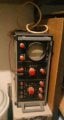
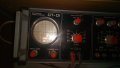
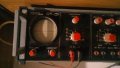
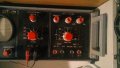
- I do have a very old model (1 channel) osciloscope, that someone give it to me from a school physics laboratory, its back from communist era, so its from the '80's made or even 70's. I know is very limited and very basic. I only use it once to see 220V in the mains, and it is showing the AC wave so in a sense i test it and is working fine. But after that i never touch it again. I kind of forget it. Because I think is very simple and cant do much, and also i blame myself in the same time not knowing when to use it and how. I am easily impressed by the new models of osciloscopes and their numerous functions. Mine dont even have the peak detector. I surely dont know how to use it, that well. For some very rudimentary readings, I think it is good, so these days I took it out from the dust , but i still didnt measure anything interesting with it. Maybe you can point me.
The text on it should be easy to figure out even in english.
Osciloscop tranzistorizat = this osciloscope is made with transistors !!!
Focalizare = focalization (blur or sharp point)
Luminozitate = luminosity
ampl or Amplificator = amplifier
pozitie = position
Timp = time
Baza de timp = time base
int=internal
ext = external
sincr = sincronicity
CC/CA = current continue or alternative
Stab- decl-rel = I dont know.
IMG_20201006_013930.jpgIMG_20201006_015549.jpgIMG_20201006_015611.jpgIMG_20201006_015637.jpgIMG_20201006_015646.jpg
I have also buy (18$) the oscilloscope you recommended DSO138 and it is in transit and will arrive in around 2 months if im lucky.
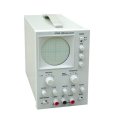
I had the bright idea , some years ago, to search for a similar (bench laboratory type) but newer version. And surprise, I did find something from our dear friends from china; I didnt note the price for it. But it it pretty close to what i have. I only search for it, I didnt buy it yet since i have no money.
Oscilloscope-China-Low-Price-Single-Channel-Oscilloscope-for-Students.jpg
I know, it doesnt even compare with what you have. I have always wished that my next osciloscope to have minimum 2 chanels on it. 4 will be optimal i think. From all the movies ive seen presenting the tool, this was an important thing to look for (in my opinion of course).
 
Last edited:

Thread Starter

q12x

Joined Sep 25, 2015
2,227
Before seing and answering to your latest posts, I had in mind a circuit with opamps that is actually hunting me from the days i put my hands on my first electronics magazine, back in the 90's i think. I was still a child back then. But extremly curious. I remember something, but not that well, about a lathe motor or a power drill that they had FEEDBACK. Meaning, the harder you pushed on the work to be made while in rotation/spinning, more current to the motor was giving. And inverse, the more you were lowering the force on the spinning work, the less current on the motor. The Idea was to maintain the same rotation speed (RPM) indifferent how hard or slow the spinning load was stressed with.
I think it was an opamp introduced in the skematic back then. But i can not be sure now, i am mostly imagining. But if it was, I think is a very nice project to have done. At least for me. I am troubled with the high voltages that the opamp must sense and deal with. I have also read recently there are opams that work with 10Amp and +-30V like this OPA549 . I think something like that will answer this problem by itself. But im also thinking from my little 741 opamp perspective. I think it can be done with him as well. Or with a transistor equivalent and more basic circuit, like the transistor long tail circuits.
 
Last edited:

Audioguru again

Joined Oct 21, 2019
6,826
An opamp or comparator IC has a voltage gain of 100000 times or more.
An opamp circuit always uses negative feedback to reduce its voltage gain down to a useable amount which also reduces its distortion to be extremely low.
The many parts in an opamp causes its output to have some delay that causes the negative feedback to be positive feedback at a certain high frequency that causes severe oscillation.
Therefore a "frequency compensation capacitor" is added to the opamp circuit or inside the opamp IC to reduce the voltage gain at high frequencies so that at the certain frequency where the negative feedback is delayed to become positive feedback the voltage gain is less than 1 so that there is no oscillation.
The "open loop frequency response" graph of an opamp on its datasheet shows the gradual reduction of high frequency gain.

A comparator circuit almost never has negative feedback so it does not need a "frequency compensation capacitor".
 

dl324

Joined Mar 30, 2015
18,326
I wish i have this type of apparatus some day... [snip] I do have a very old model (1 channel) osciloscope, that someone give it to me from a school physics laboratory, its back from communist era, so its from the '80's made or even 70's. I know is very limited and very basic.
I bought mine on eBay around 15 years ago; prices were more reasonable then. Most of my equipment is 70's/80's vintage. It was what I became familiar with when I first started studying electronics. For 40-50 year old designs, I still find them quite useful.

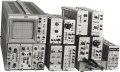
Apparently the Soviets knocked off some Tektronix designs:
Soviet_Tek_clone_family.jpg

They aren't compatible with Tek products, but they stole the modular design concept. I have the Tek version. I like the large screen and I use it for my logic analyzers (7D01) and digital scope (7D20) plug-ins.

In some ways, you're old scope will be better than the DSO138; particularly bandwidth.
 

Thread Starter

q12x

Joined Sep 25, 2015
2,227
wow, fascinating osciloscope and i like it more because is modular.
- a review on it. Just wow.
I also believe ( i didnt check) that the russian versions are probably more expensive than the american ones.
It may be an interesting thing to check some chinese (newer) versions for this type of asciloscope ... in the future.
 
Last edited:

dl324

Joined Mar 30, 2015
18,326
fascinating osciloscope and i like it more because is modular.
Tek really hit it out of the ball park with that design. They stopped making it in the 90's, so the newest units are still almost 30 years old.

There are dozens of plug-ins for those scopes. I have several 7D20 (70 MHz dual channel digital scopes) and 7D01 (16 channel logic analyzers). I also have 7D13 (DVM), 7D15 (225 MHz frequency counter).

I wish I had the curve tracer (7CT1N), but they're going for $200+ now; which is more than I paid for any of my Tek scopes. I bought a B&K 501 for around $40 (broken, but it was inexpensive to repair - one bad logic gate); even devices like this are going for $200+ now. I'd also like to have a spectrum analyzer and TDR (Time Domain Reflectometer), but they cost too much for me. I've been planning to make a DIY TDR for years now. I have the parts, but haven't gotten around to it.

I bought a rigid extender (067-0589-00) to work on the single bay plug-ins for about $15 10-15 years ago on Craigslist. I saw one on eBay recently for $600. There isn't much to it, but it makes it easier to work on plug-ins. Without it, you need to take the covers off of the scope to access the plug-ins. The 7D20 requires 3 flexible extenders to work on it. Fortunately, I've been able to repair a couple of mine without needing extenders (a resistor broken when a unit was dropped, by the previous owner or during shipping, and bad latching relays in the attenuators). Fortunately, the 7D20 has some pretty comprehensive self tests when it's powered up. It can detect problems with all but one of the latching relays used in the attenuators and gives a code to identify the bad ones.
 

Thread Starter

q12x

Joined Sep 25, 2015
2,227
...There are dozens of plug-ins for those scopes...
You are making an intro for me to all of them. VERY good and I learn them this way. I searched on google images for each model of the module/addon that you just mentioned and they are looking very professional and i bet you can make a ton with them, or at least some very specialized and in depth analyzes. I thank you for the description you take your time to make for each, that helped make an idea. That is how someone can REALLY prototype an outstanding and excelent performance, optimized and durable circuit board. I've always knew it in my hearth without seeing all you are showing, and now when i finally see them, it is clear as day light, and i know im 100% right. That is laboratory equipment and is super awesome to have. Someday... I will make those happen in my arsenal...some day. Its a big dream, but what is more sweet than having dreams and fight for them? Aaah. Yah. you really showed me some amazing stuff, and im glad i have a big mouth, asking about everything. You are super. Truly formidable.
But... my next (logical) question is: -this is it? Are there more sophisticated (commercial) prototyping/measuring/diagnose tools than your model Tektronix 7704A? I bet there are bilions and bilions dolars but im targeting the commercial ones. Or yours is the peak of versatility and customization and precision? (again, from commercial models). For sure it looks like it and I bet they are (but im guessing and wish to believe it is).
 
Last edited:

dl324

Joined Mar 30, 2015
18,326
Someday... I will make those happen in my arsenal...some day. Its a big dream, but what is more sweet than having dreams and fight for them?
Electronics isn't your chosen profession, so I wouldn't encourage you to spend a lot of money on something that's not going to be anything more than a hobby.
this is it? Are there more sophisticated (commercial) prototyping/measuring/diagnose tools than your model Tektronix 7704A? I bet there are bilions and bilions dolars but im targeting the commercial ones. Or yours is the peak of versatility and customization and precision?
There are many examples of newer, more capable scopes. But commercial grade used equipment is good enough for the needs of many hobbyists. At least it is for me.

When I was working in R&D, we had all of the newest equipment that our company made. What we couldn't do was buy from other companies. When I was working on prototypes for high speed circuits, we'd have to use sampling scopes instead of using Tek's 1GHz real time scope that was available in the late 70's.

My idea of a good job when I graduated in the mid-70's was to work for Tektronix. There was a recession at the time and they weren't hiring, so I ended up working for companies in the SF Bay Area for a dozen years before I decided there were too many people and too much crime and started moving north.
 

Thread Starter

q12x

Joined Sep 25, 2015
2,227
Electronics isn't your chosen profession, so I wouldn't encourage you to spend a lot of money on something that's not going to be anything more than a hobby.
You understood it well, and it is very true as you put it. Also I will probably never be able to afford any of the good equipment that you show me, simply of lack of money. But as you had your dreams, I have mine, and for some weird reason, im not sure why, but i have this dream, to have (someday) a minimal laboratory, where i can do the hell i want in it. Not ONLY electronics but also mechanics, and a bit more complex, but electronics will be definitely included. Its a child dream that is still alive at my age. Probably I liked too much to poke things, and that curiosity never died, even surrounded by the ultimate incompetent people, capitalist slaves who believe everything is money, and the likes. My direction was always art and probably it will be in the future (i hope, because its the best thing I can do very well). Its what i do Best. And electronics is a hobby, a distraction from my hard path, but unfortunately, I cant make any money from my art as much as i tried, so in a sense electronics is more like a gate where i hope i can get some money. It is a hope, but i know it is not a good money profession either. At least for me. Electronics is like art, in the capitalistic mentality and morality. Me and my paths, pff. The thing is I like it and I want more. Who knows. I really pushed it very high in my art domain, so I won a big fight there and im forever proud of my glorious level i got. It can be pushed higher, is always room to improvement. The success was in technique of execution, the quality, but again, zero on the capital side. My dream is to find a path in electronics, there are so many paths if you really want a straight direction, im sure of it, even with my limited experience and naivety. I didnt find mine, im still in search of it, but something is there that is from my younger age, like a little light that will definetly put me on the right path eventually. I trust it will be as that.
- For me is very important to be around interesting people, even if they are on the other side of the earth. I can learn a thing or two and also get some right directions and suggestions. And if i can inspire with my little light a little bit, im happy to give it. What is our role after all on this earth? ;)
Thank you so much for your kind answers and directions so far.
And in retrospect to MY opamp research here, im quite familiar with it now, but not complete yet. And is thanks to all who contributed to this discussion.
 

dl324

Joined Mar 30, 2015
18,326
You understood it well, and it is very true as you put it. Also I will probably never be able to afford any of the good equipment that you show me, simply of lack of money.
When I decided to start acquiring test equipment, I bided my time and looked for what I considered to be bargains. Then I set a budget and spent years acquiring the equipment I wanted. The Tek scopes I bought were all for pennies/dimes on the dollar for what they cost originally. My first 7704A came with 4 plug-ins and cost about $150 with shipping. I picked up others locally for $30. I got a 2 GS/s (giga samples per second) HP scope which works out to a bandwidth of 400-500MHz (not definitive because my 70MHz 7D20's are only 40 MS/s - Tek was clever and got better performance than one would expect) for less than $30.

Prices of used test equipment wax and wane. Prices are unbelievably high now, but they'll probably come down again.

One thing you need to consider with vintage test equipment is repairing them. I bought several non-working pieces of equipment to use for repairs. A nice thing about the Tek equipment I have is that the manuals include troubleshooting and calibration information. The bad thing is that Tek used some custom IC's and they tweaked the hardware for the 7704 mainframes enough that the parts aren't always interchangeable. Another thing about scopes is that you need one to repair or calibrate one.

Tek used the uA741 a lot (because it was considered a good opamp when the equipment was designed). For that reason, I have dozens of them in my parts bins (most are 1970's vintage that I acquired back then).

Another line of equipment Tek had was the TM5xx series of mainframes and plug-ins. My daily use scope was an SC502 (15 MHz scope) with a PI-720 dual supply and an FG501 function generator. The function generator is missing a knob, but it doesn't hinder me. Sadly, there's a problem with the scope (it blew a fuse for the CRT drive circuitry and I haven't fixed it yet). I used an SC503 that had a broken switch for CH1 sensitivity (I had to take it apart to change the sensitivity) until my DSO138 arrived.
TM504.jpg
The screen on the scope is about 3" on the diagonal, so it's small. I use the PI-720 more for it's dual voltmeters than as a power source because it can only sink or source 150mA at -25 to 25V. I'd like a couple more of the power supplies, but they're going for $100 each now. I wouldn't have paid more than $20-30.
 

Thread Starter

q12x

Joined Sep 25, 2015
2,227
There are many examples of newer, more capable scopes. But commercial grade used equipment is good enough for the needs of many hobbyists. At least it is for me.
- Give me some NEW equipment that you put your eyes on. If ! Compatible with the older used ones you already have... or equivalent or 'close by' old ones. Im very-very curious if the new ones even rise to the old ones standards. As you observed me probably , I do think the old equipment was done with heart and soul, in comparison with the modern ones that are made to last 2years, in purpose, by design.
The things you are showing me and the stories accompanying them are fantastic. I could read for hours what you have to say. :]
You should make some videos and post them on youtube, as many have. i will be your first watcher !!! :] Just a thought. I really like your stuff. Really ! Im sincere, and I can't say i understand their usage for each of them, in too much detail, they are new to me, but once (anyone) would put their hands on them, will understand their purpose and functionality. For now, im just learning their existence through you.
Very interesting point I was not that aware, about "One thing you need to consider with vintage test equipment is repairing them. ". That is trouble for me if it happens. At my level, i mean. My super limited scope I have and show you, if that will get broke, I will not be capable of going more than checking its fuse and looking for evident blown off components that is for me the immediate solution in any repair I've done so far. As a side story and an exception, I was crazy one time and took off a lot of components from a board and lucky me, I found the blown one and it was NOT evident at all, and with that, I repaired the thing. But it took me days, probably even weeks for that DARE. I think this is the way of repairing, and most probably the hard way, Im not sure how others are doing it, sincerely. Again, im not professional, not even from afar. I did learn myself some tricks, and I did it alone without a mentor or school. But i have that artist heart that guided my nose. Im bragging right now a bit, haha. :] That was the most serious repair i ever did. And it was long ago also. That successful repair encouraged me to keep going with electronics because sometime (and most of the time it is) many faults are some very stupid things, like dust collected, heat, oxidized terminals, and rarely the components themselves inside the board... at least what I could put my hands on. Again, i dont do this every day, but occasionally.
I was a bit off track with my repair story. But is a BiG problem if some expensive equipment goes down. Actually I have a big expensive thing I put my hands in it and blow it off. I still have it there under the table, under some things, forgotten. Eh well, RIP.
I did installed on a shelf my old osciloscope and made a quick test and is working. I have to measure something with it and make a picture to show it here... Im giving myself a slap not doing it sooner. But you encouraged me with your stories. That's why i took action.
Now that you mention it, where can i get damaged Tektronics equipment for very cheap prices as you did? Im not in America so it will be more costly for me. Just for curiosity, if it exist such places. I think you are more refering in your stories that those arrived in different times and different situations in your life, more as luck than a market with them on a shelf as I imagine. Right?
 

Thread Starter

q12x

Joined Sep 25, 2015
2,227
I made a test with my newly installed (very old) oscilloscope.
I really dont trust it enough, or im not that good reading it. Trust me, i switched every button in there and that is the best settings I come with. Like i said, its pornographic in its simplicity. Thats why i forget about its existence.
- Im not sorry that I purchase the 18$ - DSO138 hand osciloscope. I think is best to have more and compare the results between them. Ive seen it in many videos on youtube doing it like that, and apparently is a normal thing, and I very much agree. If you have more of them ofcourse. It is still on the way, it didnt arrive yet.
Here is a video with my test. If you have any ideas, do tell me and i will test them out.
Again, thanks for your support.
and i should have get something like this: Screenshot_4.jpg
 
Last edited:

Audioguru again

Joined Oct 21, 2019
6,826
Isn't it amazing that the output of the very old opamp circuit in the video has exactly the same level and frequency as when the oscilloscope probes are connected to nothing? It is the 50Hz from the electricity wires all around the place.

The opamp is not oscillating because its 5V supply voltage is too low. The messy wires all over the place and rows of contacts on the breadboard are antennas that are picking up the 50Hz from the high voltage electricity wires in the walls.
Even the voltage inverter circuit produces the 50Hz. The oscilloscope should have a shielded audio cable connected to its inputs.

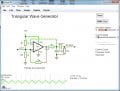
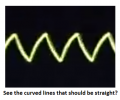
The circuit IS NOT a triangle Wave Generator. Instead it is a squarewave generator with a simple 1k resistor charging and discharging an output capacitor. A REAL triangle wave generator uses an integrator to provide a constant current charge and discharge to a capacitor so that the sides are straight lines. The Falstad simulation shows the curved lines.
 

Attachments

dl324

Joined Mar 30, 2015
18,326
I made a test with my newly installed (very old) oscilloscope.
I really dont trust it enough, or im not that good reading it.
  1. What is the frequency of the waveforms? The horizontal resolution will be given in units of time (e.g. 10ms).
  2. What is the vertical sensitivity? That will be given as volts).
  3. You don't appear to be using a scope probe. What is the input impedance of the scope?
  4. What is the power source? Is it your transformer/rectifier?
  5. I think you measured one or both of the power supplies; they shouldn't have a lot of ripple.
  6. When you touched the probes with your fingers, you were picking up line frequency from the air (your body is acting as an antenna, wires can also do this).
 

dl324

Joined Mar 30, 2015
18,326
Now that you mention it, where can i get damaged Tektronics equipment for very cheap prices as you did? Im not in America so it will be more costly for me. Just for curiosity, if it exist such places.
I purchased a lot of my equipment on eBay, but it was from a local company that bought equipment from companies liquidating inventory (they bought it by the pound). They recycled some things and listed others on eBay. I bought a lot from them when they allowed local pick up because shipping on most items was a deal breaker. The $30 HP 2 GS/s scope I bought was in that category. Shipping was $60-70, but the business was about a half hour drive from me, so I'd win a number of items and then make a trip to pick things up.

The area where I live is close to Tektronix, so there are a number of former Tek employees who have equipment to sell. One guy offered me a free scope cart, but we could never find a time to meet up (I got one from my Father In Law who got it from where he worked). I got a couple of HP signal generators for free from two members of a Tek Scopes group; one was 15 miles away and the other was 30. It turns out that the person who was 15 miles away had gotten the generator free from the person who gave me the other one. The person giving them away had a basement full of Tek equipment. He also gave me a 79xx scope mainframe that had been dropped.

I traded a 76xx series scope with a couple plug-ins for a 32" LCD TV. In terms of real value, he got the better deal, but the scope and probes only cost me around $40. It was win-win.

Much of the equipment I bought was untested (sellers didn't know how to test, or weren't able to), but not known to be nonfunctional. I just took a chance if the price was right.

I was buying 7D01's with formatters for $30-50, but few came with probes. They're useless without the probes and my first set of probes cost me $200.
 

Thread Starter

q12x

Joined Sep 25, 2015
2,227
And finally today I received my 2 types: 2N7000 and 2N7002 Field effect transistors.
I will continue the discussion on both threads as much as I can, and do the tests as required.
Fantastic stories with the tek equipment ! It pays when you know people and when in the right region of the world. Heh.
 

dl324

Joined Mar 30, 2015
18,326
And finally today I received my 2 types: 2N7000 and 2N7002 Field effect transistors.
To avoid confusion, you should call them MOSFETs. There are dozens of types of FETs, but not all have an insulated gate.

MOSFETs are static sensitive devices and most discrete devices don't have any ESD protection. In the past year or so, I've damaged 3 2N7000. None died outright, but all exhibited high leakage after being damaged. That's indicative of junction damage.
 
Top